To evaluate an ethanol supplier effectively, global B2B procurement teams must execute a comprehensive three-track verification framework spanning technical specifications, regional regulatory compliance, and verified export logistics capabilities. Buyers must first verify that an ethanol manufacturer delivers a consistent certificate of analysis matching international pharmacopeia monographs (such as USP, EP, or BP) or industrial/fuel benchmarks (like ASTM D4806) with a purity profile reaching up to 99.5% v/v.
Furthermore, reliable suppliers must present legitimate facility certifications – including Good Manufacturing Practices (GMP), ISO 9001:2015, and specialized healthcare quality standards like ISO 13485:2016, while proving cross-border supply chain resilience with documented shipping records and active trade histories across target markets like the US, EU, Australia, South Korea, and Thailand.
What are the essential criteria to evaluate an ethanol supplier
Selecting an enterprise-grade ethanol manufacturer requires a highly structured vetting process that extends far beyond a basic per-liter pricing comparison. Procurement teams must establish a multi-dimensional matrix to evaluate candidate facilities across several core operational pillars to eliminate downstream manufacturing risks. Failing to balance these essential evaluation dimensions often leads to severe regulatory non-compliance, contaminated production batches, or costly operational disruptions at your manufacturing plants.
The baseline hierarchy for an international bulk ethanol evaluation program should balance technical alignment, legal compliance, supply continuity, and total commercial value. The evaluation matrix below outlines the core framework used by leading multinational procurement teams to cross-functionally screen global chemical vendors.

| Evaluation Pillar | Critical Operational Focus Areas | Core Corporate Ownership |
| Technical Fit | Pharmacopeia alignment, maximum impurity thresholds, denaturant consistency | Quality Assurance / R&D |
| Regulatory Compliance | GMP certifications, local import registrations, REACH validation, facility audits | Regulatory Affairs |
| Supply Capability | Annual production capacity, historical export volumes, safe packaging standards | Sourcing & Logistics |
| Risk Mitigation | Feedstock diversification, dual-site redundancy, financial stability metrics | Corporate Procurement |
| Commercial Terms | Total Cost of Ownership (TCO), Incoterms alignment, flexible payment structures | Finance / Supply Chain |
Which quality and purity standards should you verify first
Product quality represents the absolute foundation of chemical procurement, requiring direct verification before initiating commercial conversations. Sourcing teams must mandate that all prospective ethanol suppliers provide verifiable evidence of compliance with globally recognized pharmacopeia or engineering benchmarks. For pharmaceutical and medical applications, suppliers must explicitly meet or exceed the active monographs of the United States Pharmacopeia (USP), European Pharmacopoeia (EP), or British Pharmacopoeia (BP).
Fuel-grade ethanol requires strict adherence to alternative technical benchmarks like the ASTM D4806 standard, which dictates stringent limitations regarding maximum water content, acidity levels, and allowed inorganic chloride concentrations. To ensure long-term batch consistency, verify that the supplier operates under a robust ISO 9001 quality management system, and review the supplier’s third-party testing laboratory validation protocols to ensure all analytical data is generated by accredited, independent facilities using gas chromatography-mass spectrometry (GC-MS) methodologies.
What certifications indicate a reliable ethanol supplier
Certifications serve as independent proof of a manufacturer’s operational maturity, regulatory compliance framework, and commitment to environmental safety. When evaluating a global ethanol supplier, your quality assurance team must verify current Good Manufacturing Practice (GMP) certificates, which ensure the facility maintains controlled environmental conditions and systematic cross-contamination prevention programs. For medical device or specialized healthcare applications, look for manufacturers holding ISO 13485:2016 certification to guarantee consistent product safety.
While broader sustainability and environmental tracking frameworks like ISCC PLUS or RSB certifications indicate general progress in renewable feedstock sourcing, procurement teams should prioritize vendors who demonstrate complete material traceability from crop input to finished product. Finally, look for active participation in responsible care programs and verified occupational health certifications to ensure the vendor operates an ethical, low-risk production ecosystem.
How do you assess regulatory compliance across different markets
Cross-border ethanol shipping is highly restricted due to customs complexities, denaturing regulations, and excise tax implications across jurisdictions. A supplier might excel technically but fail completely if they lack the specialized expertise to navigate the regulatory frameworks of your importing destination. Sourcing teams must require complete visibility into a vendor’s documentation preparation capabilities, export licensing history, and international registration timelines before signing supply contracts. Failing to secure proper regional clearances can lead to prolonged port delays, expensive demurrage fees, or custom seizures of your hazardous material shipments. Every target market possesses distinct paperwork demands that require dedicated compliance monitoring from both the buyer and the supplier.
What pharma-grade standards apply in US, EU, and australia
Sourcing pharmaceutical-grade ethanol for the United States, European Union, or Australia requires navigating highly complex, distinct national oversight systems. In the United States, suppliers must be officially registered with the Food and Drug Administration (FDA) and supply a detailed Drug Master File (DMF) to support your regulatory drug filings. For the European market, the supplier must possess valid Registration, Evaluation, Authorisation and Restriction of Chemicals (REACH) registrations alongside a Certificate of Suitability (CEP) issued by the European Directorate for the Quality of Medicines (EDQM). Sourcing for Australia requires the manufacturer to hold official therapeutic goods validation, satisfying the Therapeutic Goods Administration (TGA) and matching British Pharmacopoeia (BP) specifications. Advanced global buyers streamline this multi-market vetting process by utilizing standardized evaluation datasets mapped directly within their internal tracking tools.
How do fuel ethanol regulations differ in thailand and korea
Fuel ethanol procurement in Asian nations is heavily governed by localized green energy mandates and unique domestic economic protections. In Thailand, the market is strictly shaped by national E10, E20, and E85 blending mandates overseen by the Department of Alternative Energy Development and Efficiency. Suppliers entering this space must navigate complex excise tax regulations and specific chemical denaturation rules designed to protect domestic agricultural inputs like cassava or molasses.
Conversely, South Korea’s Ministry of Trade, Industry and Energy focuses extensively on bio-ethanol blending policy limits for transportation fuels, alongside rigid customs documentation. Importing into South Korea requires verified carbon reduction data, strict testing procedures at local port terminals, and clear tracking certificates to benefit from free trade agreements (FTAs) and clear customs without punitive tariffs.
How can you verify supply chain reliability and export capability
A perfect laboratory sample means nothing if your supplier cannot deliver bulk volumes across thousands of miles during global transport disruptions. Sourcing teams must critically analyze a vendor’s actual export history, port logistics partnerships, and physical infrastructure rather than relying on promotional statements. Evaluating a chemical supplier requires looking deeply at their production utilization rates, logistics networks, and port access points to guarantee uninterrupted delivery schedules. A manufacturer operating at maximum capacity with zero inventory buffer is highly vulnerable to unforeseen factory shutdowns, raw material shortages, or shipping bottlenecks.
What documentation proves export experience to your target market
The absolute fastest way to confirm an ethanol supplier’s international capability is to review historical, anonymized shipping documentation from past international transactions. Request redacted Bill of Lading (B&L) samples demonstrating successful deliveries to your specific target country or destination port within the past twelve months.
Additionally, request actual customs clearance records and dangerous goods declarations to confirm the supplier’s paperwork passes international border checks without costly delays. Verifiable customer reference letters or testimonials from buyers within your same geographic region provide excellent, unbiased proof of a vendor’s cross-border logistics capabilities.
How do you evaluate production capacity and lead times
Procurement teams must accurately calculate a supplier’s true capacity by comparing their total nameplate production capacity against actual current plant utilization rates. If a factory produces 15 million liters annually but has already committed 14 million liters to legacy contracts, they cannot safely support an emerging enterprise account.
Inquire about minimum order quantities (MOQs) and batch production flexibility to ensure the facility aligns with your inventory models. Demand clear timeline commitments covering production, mandatory laboratory aging, pre-shipment testing, and maritime transit windows. A top-tier global supplier should maintain a reliable buffer stock to protect your operations against unexpected spikes in market demand.
What technical specifications matter for each ethanol application
Ethanol is not a single, uniform product; its chemical profile must be carefully matched to its intended end-use application to maintain quality consistency. Each industry sector enforces distinct tolerances for residual impurities, moisture content, and organic compound variations across batches.
Buyers must establish detailed technical specification sheets for every procurement contract to prevent production failures and avoid material waste. Failing to match the appropriate chemical specification can destroy downstream product stability, ruin electronic component cleaning processes, or completely disqualify an entire batch of pharmaceutical products due to trace impurities.
How do purity requirements differ for pharma vs industrial use
Pharmaceutical-grade ethanol requires a minimum purity profile of 99.5% volume by volume (v/v), paired with strict limits on residual solvents and organic impurities. Testing protocols must verify that toxic compounds like methanol, benzene, and acetaldehyde remain well below international safety parts-per-million (ppm) thresholds.
Industrial-grade ethanol typically operates within a wider purity band of 95% to 99% v/v. In this segment, the emphasis shifts toward precise denaturant consistency, ensuring additives match your industrial formulations perfectly without introducing problematic chemical reactions. These detailed composition profiles must be continuously verified using high-performance liquid chromatography (HPLC) or advanced gas chromatography testing.
What should your certificate of analysis include
A Certificate of Analysis (CoA) is a legally binding document that outlines the exact chemical properties of a specific production lot. Your quality control team must ensure every incoming batch contains a fully annotated CoA from an accredited laboratory. The certificate must explicitly state the batch identification number, production date, and complete traceability tracking back to the raw feedstock harvest.
The document must clearly state the exact analytical testing methodologies used, such as Karl Fischer titration for moisture content determination. It should also specify the certified product shelf-life and detailed storage recommendations to preserve chemical integrity throughout long-term warehouse storage.
How do you compare pricing, contracts, and total cost of ownership
B2B buyers frequently make the mistake of selecting an ethanol supplier based solely on the lowest initial Free on Board (FOB) price quote. A sophisticated procurement analysis must look at the Total Cost of Ownership (TCO), which incorporates all secondary logistical, administrative, and compliance costs. When evaluating international chemical pricing, procurement managers must compare fixed-term supply agreements against volatile spot-market pricing models.
Long-term contracts offer excellent price predictability and supply security, whereas spot agreements let you capitalize on localized supply gluts but expose your budget to sudden market spikes.
What hidden costs should you factor into ethanol procurement
Evaluating the true financial impact of an ethanol contract requires calculating multiple expenses beyond the base invoice price. International bulk liquid logistics requires specialized shipping equipment, leading to substantial freight, insurance, and destination port fees. Additionally, buyers must factor in the inventory holding costs associated with maintaining safety stocks to offset long maritime shipping lead times. Hazardous material storage fees can quickly accumulate if your local facilities require specialized fire protection infrastructure or environmental containment zones.
| Cost Classification | Expense Driver | Operational Impact |
| Logistical Friction | Destination demurrage, port storage delays | Increases total transport cost per liter |
| Quality Control | Secondary independent testing, sample postage | Safeguards against batch contamination |
| Financial Risk | Currency fluctuations, letters of credit fees | Impacts operational cash flow margins |
| Regulatory Fees | Hazardous material licensing, customs processing | Mandatory cost for legal entry |
Which incoterms work best for international ethanol shipments
Selecting the correct International Commercial Terms (Incoterms) is critical when shipping flammable, hazardous materials like bulk ethanol. Cost and Freight (CFR) or Cost, Insurance, and Freight (CIF) terms are highly effective for experienced buying organizations with strong relationships at destination ports. These structures require the supplier to manage origin transport and maritime freight, transferring operational risk to the buyer once the vessel passes the origin shipping rail. For procurement teams seeking to minimize logistical management, Delivered Duty Paid (DDP) shifts all import processing, customs clearance, and local transportation responsibilities to the manufacturer. However, this convenience carries a significant premium, as suppliers build large contingency buffers into their DDP pricing models.
What supply chain risks should you assess before choosing a supplier
Building a resilient supply network requires conducting a deep risk assessment of your chosen vendor’s manufacturing environment. Sourcing managers must evaluate geographic risk concentrations, geopolitical stability factors, and the long-term financial health of the manufacturer. Relying on a single factory located in an area prone to severe weather introduces unacceptable operational risks into your corporate supply chain. A disruption at an ethanol plant can quickly cascade into major manufacturing delays at your downstream production facilities. Sourcing professionals must verify that their chosen vendors utilize proactive risk scoring models and maintain structured business continuity protocols.
How do you evaluate geographic and single-source risk
Procurement teams must map the entire supply chain footprint of their ethanol vendors, tracing production back to the raw agricultural feedstock source. If a supplier concentrates all production within a single industrial park or draws from one local crop market, your supply chain faces severe risks from localized extreme weather or regional energy grid failures. To mitigate these single-source vulnerabilities, leading enterprises pursue a dual-sourcing strategy, distributing their volume allocations across multiple distinct production sites and diverse geographic origins. This strategy ensures that if an unforeseen event impacts one region, alternative production hubs can easily ramp up output to sustain your corporate operations.
What contingency plans should suppliers have in place
A professional ethanol manufacturer must maintain a comprehensive, written disaster recovery plan that outlines clear operational responses to major industrial emergencies. Vet the supplier’s emergency storage policies to ensure they hold dedicated safety stocks at key regional port terminals, providing a buffer against sudden production shortfalls. Review their pre-arranged agreements with alternative logistics providers to ensure shipping continuity if primary transport lines fail. Finally, verify their force majeure communication protocols; a transparent partner should commit to strict, hourly notification Service Level Agreements (SLAs) during a supply chain emergency.
How leading buyers structure their supplier evaluation scorecard
To ensure objective decision-making across internal procurement teams, organizations should implement a quantifiable supplier scorecard system. This framework removes personal bias and forces stakeholders from procurement, quality assurance, and logistics to grade candidate vendors against standardized, performance-based metrics. By establishing minimum quality and compliance thresholds, your sourcing group can quickly eliminate non-compliant options and focus resources on evaluating truly capable chemical manufacturing partners.
What weighting should you give technical vs commercial factors
The specific allocation of scorecard points must reflect the strict safety and regulatory demands of your industry sector. For highly regulated environments like pharmaceutical, medical device, or beverage manufacturing, technical and compliance criteria must hold a dominant 50% scorecard weighting. Commercial pricing models and payment structures should account for 35% of the available score, while the final 15% evaluates strategic parameters like sustainability performance and long-term partnership vision.
This balanced scoring logic ensures your business never compromises regulatory safety to chase short-term invoice savings.
How can you use a three-track evaluation framework
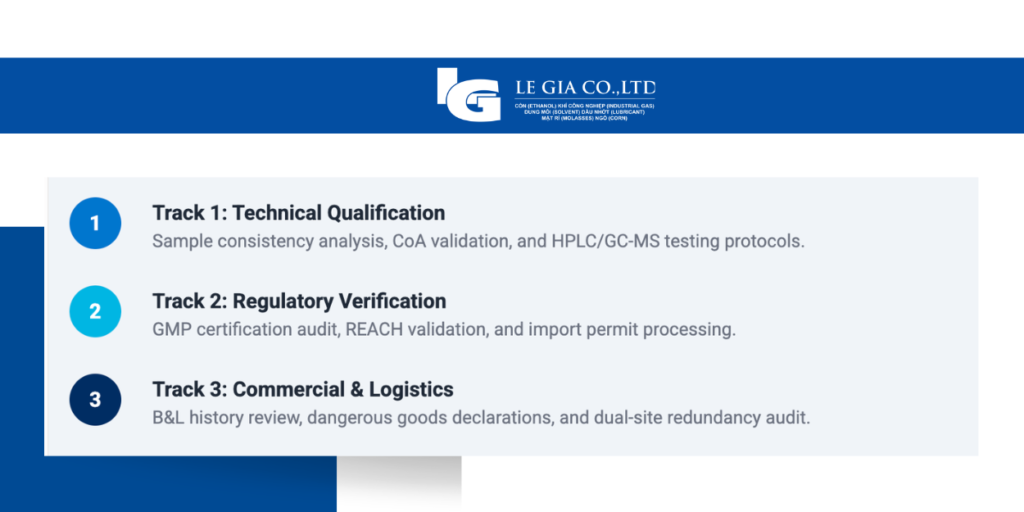
An optimized supplier qualification program runs on three parallel evaluation tracks to compress onboarding timelines without skipping critical verification steps. This multi-track method ensures your internal teams vet technical data, legal compliance records, and commercial pricing models simultaneously. Track one manages the technical qualification phase, analyzing laboratory sample consistency and validating Certificate of Analysis data. Track two runs parallel, focusing on regulatory affairs by verifying GMP credentials, processing local import permits, and conducting formal facility documentation reviews.
Track three handles the commercial and logistical vetting, finalizing total cost calculations, verifying maritime export histories, and executing strategic on-site or virtual factory audits.
What mistakes do procurement teams make when selecting ethanol suppliers
Even experienced procurement groups can encounter major sourcing problems if they overlook the unique characteristics of the global ethanol market. The most common mistake is over-prioritizing the base invoice cost while ignoring critical indicators of chemical quality and long-term regulatory compliance. Failing to thoroughly analyze a vendor’s feedstock sourcing strategies or communication patterns often leads to unexpected supply shortfalls, expensive production re-testing cycles, or severe customs non-compliance penalties at the border.
Why do buyers overlook traceability and ESG requirements
Many sourcing teams treat environmental, social, and governance (ESG) compliance as an optional corporate marketing initiative rather than a critical regulatory requirement. However, major global markets are rapidly enforcing strict supply chain environmental laws that mandate complete traceability back to the agricultural source. Failing to confirm clear carbon intensity metrics or verified sustainable farming practices can disqualify your materials from premium product markets.
Modern ethanol buyers must ensure their chosen manufacturers provide full transparency from field to finished chemical, protecting your supply chain against evolving carbon tariff structures and international sustainability mandates.
How does poor communication lead to supply disruptions
A breakdown in technical or operational communication between a buyer and a chemical supplier is a leading cause of preventable product contamination and missed deliveries. Minor misunderstandings regarding exact denaturant specifications or localized testing criteria can result in entire shipping containers of chemical solvents being rejected at your factory gates. Procurement managers must select vendors that provide dedicated, fluent technical account managers and commit to clear, written response timelines.
Establishing regular quarterly business reviews (QBRs) and shared rolling production forecasts ensures both organizations stay aligned on quality standards and upcoming shipment requirements.
Ready to shortlist qualified ethanol suppliers for your market
Establishing a bulletproof ethanol sourcing program requires executing a structured implementation roadmap that converts your theoretical scorecards into verified, risk-managed commercial contracts. Sourcing groups should budget a realistic six to twelve-week timeline to thoroughly complete the chemical qualification loop before moving away from legacy vendors.
Once your internal teams finalize minimum technical thresholds, authorize a trial import batch to fully test your supplier’s real-world logistics capabilities under active operational conditions.
How can Legia support your pharmaceutical and industrial ethanol needs
With over twenty years of industrial chemical manufacturing experience, Le Gia serves as a trusted premium partner for global enterprises requiring high-purity ethanol solutions. Operating modern manufacturing infrastructure with an annual supply capacity of 12,000,000 liters, Le Gia specializes in supplying premium food-grade, medical-grade, and industrial ethanol to a wide range of highly demanding industrial sectors. As a leading specialist in denatured ethanol formulations, Le Gia custom-engineers tailored solvent blends designed to satisfy complex international technical specifications and rigid customs standards.
Backed by verified GMP, ISO 9001:2015, and medical-device standard ISO 13485:2016 certifications, Le Gia maintains an active export presence across more than ten countries and territories, including South Korea, Australia, Taiwan, and Thailand. Contact our technical procurement team today at ethanol@legia.vn to access our comprehensive compliance datasets, request verified laboratory samples, and secure a resilient, long-term supply line tailored to your specific regional requirements.
FAQ
What is the difference between denatured and undenatured ethanol
Denatured ethanol contains chemical additives that render the alcohol completely unfit for human consumption, exempting it from high beverage excise taxes and making it ideal for industrial solvents or cosmetics. Undenatured ethanol is pure alcohol completely free of additives, which is mandatory for food, beverage, and specific pharmaceutical applications that require maximum chemical purity.
How long does international ethanol supplier qualification take
A standard enterprise-level qualification process typically requires six to twelve weeks to complete thoroughly. This timeline accommodates initial documentation reviews, independent laboratory testing of sample lots, regulatory import permit processing, and final commercial contract negotiations.
Can one supplier serve multiple ethanol grades and markets
Yes, an advanced manufacturer with multi-grade distillation columns and independent production lines can produce pharmaceutical, industrial, and food-grade ethanol simultaneously. However, buyers must explicitly verify that the supplier maintains strict cross-contamination protocols, holds verified certifications for each target market, and possesses documented export experience for your specific destination ports.