Vietnam consumed approximately 25 million tons of petroleum products in 2024, and that number continues to climb. With the government’s binding commitment to net-zero emissions by 2050 and a growing urgency to reduce dependence on imported fossil fuels, bioethanol has moved from an experimental additive to a strategic national energy priority. Seven industrial-scale ethanol plants operated by PetroVietnam (PVN) are now in production, and the roadmap to mandatory E10 blending by 2027 is accelerating investment across the entire supply chain.
For industrial buyers – whether you are a fuel blender, chemical manufacturer, pharmaceutical producer, or procurement manager at a refinery – understanding bioethanol in depth is no longer optional. The decisions you make today about sourcing, quality standards, and supplier relationships will determine your competitive position in a market undergoing rapid transformation.
This guide covers everything you need to know: the science behind bioethanol, its real-world industrial applications, the complete production process from raw material to finished product, the quality standards that govern trade in Vietnam and globally, and how to evaluate suppliers with confidence.
Understanding Bioethanol: Definition and Key Properties?
The Scientific Definition of Biological Ethanol
Bioethanol is ethanol – chemically identical to ethyl alcohol with the molecular formula C₂H₅OH – produced through biological fermentation of plant-based biomass rather than through petrochemical synthesis. The molecule consists of a two-carbon ethyl group bonded to a hydroxyl group (-OH), and it is this hydroxyl group that gives ethanol its characteristic solubility in both water and organic solvents, making it uniquely versatile across industrial applications.
The critical distinction between bioethanol and fossil-derived ethanol lies not in the molecule itself, which is chemically identical, but in its origin and carbon accounting. Bioethanol comes from renewable plant materials – sugarcane, cassava, corn, agricultural residues – that absorbed atmospheric CO₂ during growth. When burned, that same CO₂ is re-released, creating a theoretically closed carbon cycle. Fossil-derived ethanol, produced by hydrating ethylene from petroleum, introduces carbon that had been locked underground for millions of years, adding net new CO₂ to the atmosphere.
Bioethanol is broadly classified into three generations based on feedstock:
First Generation (1G): Produced from food crops – sugarcane, corn, cassava, sugar beet. This is the commercially dominant technology today, accounting for over 95% of global production. It is economically proven, uses established fermentation technology, and delivers consistent quality. The trade-off is competition with food supply chains for the same agricultural inputs.
Second Generation (2G): Produced from agricultural residues and lignocellulosic waste – rice straw, bagasse, corn stover, coffee husks, wood chips. This eliminates the food-versus-fuel conflict and utilizes material that would otherwise be burned in fields (a major source of particulate emissions in Southeast Asia). The technical challenge is breaking down the tough lignin-cellulose matrix, which requires advanced pretreatment and enzyme systems. Several 2G pilot plants are now operational globally, with commercial-scale viability improving annually.
Third Generation (3G): Produced from microalgae and seaweed. Algae can be cultivated on non-arable land using saline water, and certain strains produce fermentable sugars at very high yield per hectare. Currently at the research and demonstration stage, 3G bioethanol is not yet commercially competitive but holds transformative long-term potential.
Key Physical and Chemical Properties
For industrial buyers, understanding the physical and chemical properties of bioethanol is essential for proper handling, storage system design, blending calculations, and compatibility assessments.
| Property | Bioethanol (E100) | Gasoline (RON 95) |
| Energy content | 26.8 MJ/kg | 44.4 MJ/kg |
| Boiling point | 78.37°C | 27–225°C (range) |
| Octane number (RON) | ~108 | 95 |
| Density at 20°C | 0.789 g/cm³ | 0.720–0.775 g/cm³ |
| CO₂ lifecycle emissions | 40–90% lower (varies by feedstock) | Baseline |
| Corrosivity | Attacks some rubbers and metals | Lower |
| Water miscibility | Fully miscible | Immiscible |
| VOC emissions | Lower evaporative losses | Higher |
| Engine efficiency gain | +3–5% in optimized engines | Baseline |
Several properties deserve special attention for procurement and logistics decisions. First, bioethanol’s energy content is approximately 66% that of gasoline by weight – meaning a vehicle needs more ethanol to travel the same distance on pure ethanol, which is factored into blending ratios. However, the higher octane number (108 RON) partially offsets this by allowing higher compression ratios in modern engines, recovering some efficiency.
Second, ethanol is fully miscible with water, which creates both an opportunity (it dissolves in water-contaminated systems easily) and a challenge (water contamination causes phase separation in ethanol-gasoline blends, which can damage engines and pipeline infrastructure). This is why storage and transport systems for bioethanol must be kept completely dry and sealed – a non-negotiable requirement in tropical climates like Vietnam’s where humidity and rainfall are constant threats to quality.
Third, ethanol can corrode certain metals (zinc, aluminum alloys) and degrade some elastomers (natural rubber, certain nitrile rubbers). Industrial buyers must audit their existing storage tanks, pumps, hoses, and seals before scaling up bioethanol handling. Modern HDPE tanks and stainless steel 316L are compatible and recommended.
Major Industrial Applications of Bioethanol
Fuel Blending: E5, E10 and the Vietnamese Roadmap
The largest application of bioethanol by volume globally – and the one driving the most investment in Vietnam – is blending with conventional gasoline to produce gasohol (gasoline-alcohol blends).
E5 RON 92 (5% ethanol, 95% gasoline) became mandatory across Vietnam in 2018 under Decision 53/2012/QĐ-TTg. As of 2025, daily consumption of E5 fuel across the country runs approximately 15 million liters, and the blend has become the standard product at most retail fuel stations. Benefits for consumers include a price discount of 200–300 VND per liter versus premium gasoline, approximately 1.5% reduction in CO₂ tailpipe emissions, and marginal improvement in combustion completeness due to ethanol’s oxygen content.

E10 (10% ethanol) is the next mandated step, with full national deployment targeted by 2027 under Decision 177/QĐ-TTg. This transition will require an estimated 2–3 billion liters of bioethanol annually at current consumption levels – approximately double current domestic production capacity. The gap between domestic supply and projected demand represents a significant commercial opportunity for both domestic producers expanding capacity and importers of fuel-grade bioethanol from Brazil, the United States, and India.
For industrial fuel buyers, E10 procurement requires attention to three operational considerations: infrastructure compatibility assessment (tanks, pumps, seals), staff training on ethanol-specific handling procedures including water contamination detection, and updated quality control protocols to test incoming bioethanol against QCVN 01:2011/BCT before blending.
E85 and Flex-Fuel Vehicles (FFVs) represent the longer-term frontier. Brazil has already transitioned 73% of new vehicle sales to flex-fuel capability, and the United States operates over 20 million flex-fuel vehicles. Vietnam is currently in the research and pilot study phase for FFV adoption, with no binding timeline yet – but engineering decisions made now by fleet operators and automotive manufacturers will shape this market within this decade.
Globally, the transportation sector consumed approximately 120 billion liters of bioethanol in 2023, and the market continues to grow at 6.1% CAGR through 2030, driven by government mandates in Southeast Asia, India, and the EU.
Pharmaceutical and Chemical Manufacturing
Beyond fuel, bioethanol is an essential industrial chemical with applications across multiple high-value sectors. In Vietnam, pharmaceutical and cosmetic manufacturing accounts for an estimated 50 million liters of ethanol per year, a figure that grows in proportion to the domestic pharmaceutical industry’s expansion.
In pharmaceutical manufacturing, high-purity ethanol (95–99.5%) serves as a primary solvent for drug extraction, a carrier in liquid formulations including syrups, drops and injectable solutions, a disinfectant and antiseptic at 70–75%, and a preservative in multi-dose formulations. The COVID-19 pandemic demonstrated the systemic risk of over-reliance on a single source when global ethanol supply chains were disrupted simultaneously – a lesson that has driven many pharmaceutical manufacturers to diversify their supplier base and increase buffer stock.
In cosmetics, ethanol concentrations of 40–70% form the base of most fragrance products, toners, skin serums, hand sanitizers, and hairsprays. The distinction between pharmaceutical-grade and food-grade ethanol matters here: cosmetics sold in regulated markets (EU, Japan, South Korea) require suppliers to provide documentation proving the ethanol was not produced with synthetic denaturants that may irritate skin.
In industrial chemistry, bioethanol is a feedstock for producing acetic acid, ethyl acetate, ethylene (via dehydration), and bio-based polymers. As the chemical industry progressively decarbonizes, bio-derived ethanol is gaining preference over petroleum-derived ethylene as a feedstock for producing plastic precursors – a structural shift that is still early-stage but accelerating due to carbon pricing mechanisms in Europe.
Energy Security and National Strategic Value
For Vietnam specifically, bioethanol’s strategic importance extends well beyond its energy content. Vietnam currently imports approximately 60% of its refined petroleum products, representing a significant foreign exchange outflow and a geopolitical vulnerability. Scaling domestic bioethanol production to E10 blending nationally would displace approximately 2 billion liters of imported gasoline annually – generating estimated savings of 800 million to 1 billion USD per year in foreign currency expenditure.
The environmental case is equally compelling. Vietnam has committed to reducing greenhouse gas emissions by 43.5% from business-as-usual levels by 2030 as part of its Nationally Determined Contribution (NDC) under the Paris Agreement. The transportation sector, which accounts for roughly 18% of national emissions, is one of the most actionable targets. Bioethanol blending at E10 is estimated to contribute 10–12% toward the sector’s emissions reduction target – not a complete solution, but a significant and immediately deployable contribution while electric vehicle infrastructure is still being built out.
Globally, bioethanol production reached 170 billion liters in 2022, led by the United States (57% of global output), Brazil (30%), and the European Union (5%). Southeast Asia, including Vietnam, Thailand, and the Philippines, is among the fastest-growing regions, supported by abundant agricultural feedstocks and strong government mandates.
The Complete Bioethanol Production Process
For industrial buyers evaluating suppliers or considering backward integration, understanding the production process is essential for quality assurance, price negotiation, and risk assessment. Here is a step-by-step breakdown of how bioethanol is produced at an industrial scale.
Stage 1: Feedstock Selection and Pretreatment
The choice of feedstock is the most consequential decision in bioethanol production, determining cost structure, seasonal supply risk, and the complexity of downstream processing.
Vietnam’s primary commercial feedstocks currently are sugarcane and cassava. Sugarcane yields 70–80 tonnes per hectare with a fermentable sugar content of 12–15%, and the sugar in sugarcane juice can be fermented directly without a hydrolysis step, making it the most efficient first-generation feedstock globally. Brazil’s dominance in bioethanol is built almost entirely on sugarcane economics. Cassava (manioc) yields 20–25 tonnes of tubers per hectare with a starch content of 25–30%, and is the dominant feedstock for Vietnam’s existing industrial plants due to its adaptability to a wide range of soil and climate conditions. Sweet sorghum, yielding 50–60 tonnes per hectare with 15–18% sugar content, is gaining attention as a drought-tolerant alternative suited to central Vietnam’s drier regions.
For second-generation feedstocks, rice straw, sugarcane bagasse, and coffee husks are the most promising candidates given Vietnam’s agricultural profile. Rice straw alone generates approximately 43 million tonnes per year nationally, most of which is currently burned in open fields – a practice that generates enormous PM2.5 pollution but could instead supply cellulosic ethanol production at scale.
Pretreatment at the plant involves washing (removing soil and foreign material), size reduction to 2–5mm particle size (increasing surface area for enzymatic access), and either alkaline pretreatment (NaOH 1–2% at 120°C for 30 minutes) or dilute acid pretreatment (H₂SO₄) to disrupt the lignin-hemicellulose matrix for cellulosic feedstocks. Advanced plants are beginning to deploy nano-cellulose technology and recombinant fungal enzymes that improve hydrolysis efficiency by 15–20% compared to conventional enzyme preparations.
Stage 2: Hydrolysis – Converting Starch and Cellulose to Fermentable Sugars
The objective of hydrolysis is to break down complex polysaccharides (starch, cellulose, hemicellulose) into simple fermentable sugars (glucose, fructose, xylose) that yeast can metabolize.
For starch-based feedstocks (cassava, corn), the process runs in two sequential enzymatic steps. Liquefaction uses α-amylase at 90–95°C and pH 6.0–6.5 for approximately 2 hours, breaking long starch chains into shorter dextrin fragments. Saccharification then uses glucoamylase at 60°C and pH 4.0–4.5 for up to 48 hours, cleaving dextrins into individual glucose molecules. Optimized industrial processes achieve starch-to-glucose conversion rates of 90–95%.
For cellulosic feedstocks (second-generation), the process is more complex because cellulose’s crystalline structure resists enzymatic attack. A cocktail of cellulase and β-glucosidase enzymes operates at 50°C and pH 4.8 for 48–72 hours after pretreatment. Vietnamese research institutions reported achieving 37.33 g/L of fermentable sugar from lignocellulosic biomass in 2023 studies, indicating that domestic 2G technology is advancing but has not yet reached the efficiency thresholds required for commercial profitability at current feedstock prices.
Stage 3: Fermentation – Yeast Converting Sugar to Ethanol
Fermentation is the biological heart of bioethanol production, where microorganisms consume fermentable sugars and produce ethanol and CO₂ as metabolic byproducts. The simplified reaction: C₆H₁₂O₆ → 2C₂H₅OH + 2CO₂
The workhorse organism in virtually all commercial bioethanol production is Saccharomyces cerevisiae – the same yeast species used in baking and brewing for thousands of years, but now engineered for industrial performance. Modern industrial strains have been selected or genetically modified to tolerate ethanol concentrations of 18–20% (conventional strains struggle above 12–14%), operate efficiently at 35–37°C (reducing cooling costs), and resist contamination by lactic acid bacteria.
Optimal fermentation conditions for industrial production are a temperature of 30–35°C (optimal 32°C), pH of 4.5–5.5 (optimal 5.0), and strictly anaerobic conditions – the presence of oxygen diverts metabolism from ethanol production toward biomass growth and acetic acid formation, reducing yield significantly. Fermentation time is 48–72 hours for continuous-flow systems and up to 96 hours for batch systems.
At the end of fermentation, the resulting liquid (“beer”) contains 10–12% ethanol with conventional strains, or 14–18% with high-performance engineered strains. The remainder is water, yeast biomass, unconverted sugars, organic acids, and dissolved CO₂. Industrial fermenters in Vietnam’s operating plants range from 100–200 cubic meters in stainless steel vessels with automated temperature and pH monitoring systems.
The CO₂ produced during fermentation – approximately 1 tonne of CO₂ per tonne of ethanol – is increasingly being captured and sold to food and beverage manufacturers as a valuable byproduct, improving the overall economics of the process.
| Parameter | Batch Fermentation | Continuous Fermentation |
| Ethanol yield | 90–93% | 92–95% |
| Cycle time | 48–96 hours | Continuous |
| Capital cost | Lower | Higher |
| Operating complexity | Lower | Higher |
| Contamination risk | Lower | Higher |
| Best for | Smaller plants, varied feedstock | Large plants, uniform feedstock |
Stage 4: Distillation and Dehydration to Fuel-Grade Purity
Raw fermentation beer at 10–18% ethanol must be concentrated to 99.5%+ purity for fuel applications – a massive separation challenge given ethanol and water’s strong mutual affinity.
The distillation system operates in sequence across multiple columns. The beer column (stripping column) receives the fermentation beer and concentrates ethanol from ~12% to 50–60% in the overhead vapor stream, while the bottoms stream (stillage) goes to byproduct processing. The rectification column takes the beer column overhead and drives concentration to 95–96% v/v – the maximum achievable by conventional distillation due to the ethanol-water azeotrope at 95.6%.
Breaking the azeotrope to reach 99.5%+ (anhydrous ethanol) required for fuel blending requires a dehydration step. The two main industrial approaches are molecular sieve dehydration (zeolite 3A beds that selectively adsorb water molecules while allowing ethanol vapor to pass) and azeotropic distillation with an entrainer (adding a third component like cyclohexane to shift the azeotrope). Molecular sieve technology dominates modern plants due to lower energy consumption and the elimination of toxic entrainer chemicals.
Key operational parameters: distillation columns operate at 1–3 bar pressure, temperature ranges from 78°C at the ethanol-rich top of the rectification column to 100°C+ at the water-rich bottoms. Energy consumption for the distillation and dehydration stages is 2.5–3.5 kWh per liter of finished ethanol – making energy cost the single largest variable operating expense in bioethanol production and the primary driver for plants to integrate with biomass cogeneration systems.
Overall ethanol recovery from fermentation beer through distillation is 95–97% for well-operated plants. The stillage byproduct – the water-rich bottoms stream rich in yeast biomass, proteins, and minerals – is dried or processed into distillers dried grains (DDG), a high-protein animal feed ingredient with commercial value that partially offsets production costs.
Production Process Summary: Vietnamese Industrial Plants
| Stage | Key Equipment | Processing Time | Energy Use (kWh/L) | Water Use (L/L) |
| Pretreatment | Hammer mills, screw conveyors, heat exchangers | 2–4 hours | 0.8–1.2 | 2–3 |
| Hydrolysis | Enzymatic reactors, liquefaction tanks | 2–50 hours | 0.5–0.8 | 1–2 |
| Fermentation | 100–200m³ SS vessels, cooling coils | 48–96 hours | 0.3–0.5 | 5–8 |
| Distillation | 25–30 tray columns, reboilers | 4–8 hours continuous | 2.5–3.5 | 5–8 |
| Dehydration | Molecular sieve beds | 2–4 hours | 0.5–0.8 | 0.5–1 |
| Total | Full plant | – | 8–12 kWh/L | 15–20 L/L |
Note: Plants with biomass cogeneration systems can reduce net purchased energy to 4–6 kWh/L by burning stillage and bagasse on-site.
Quality Standards: What Every Industrial Buyer Must Know
QCVN 01:2011/BCT – Vietnam’s Mandatory Bioethanol Standard
Any bioethanol used for fuel blending in Vietnam must comply with QCVN 01:2011/BCT, the National Technical Regulation on Fuel Ethanol issued by the Ministry of Industry and Trade (MOIT). This is not optional guidance – it is a legally binding requirement, and non-compliant product cannot be legally blended into gasoline sold through licensed fuel stations.
The key specifications under QCVN 01:2011/BCT:
| Parameter | Requirement | Method |
| Ethanol content | ≥99.5% v/v | GC or density |
| Water content | ≤0.5% v/v | Karl Fischer |
| Methanol | ≤0.5% v/v | GC |
| Acidity (as acetic acid) | ≤0.007% by mass | Titration |
| Copper | ≤0.1 mg/kg | AAS |
| Sulfur | ≤10 mg/kg | XRF or combustion |
| Phosphorus | ≤0.5 mg/kg | ICP |
| Chloride ion | ≤1 mg/kg | IC |
Testing must be performed by laboratories accredited to ISO/IEC 17025. Certification is issued by provincial Departments of Industry and Trade, and each production batch requires documentation. Non-compliance carries penalties of 100–200 million VND, product seizure, and potential license revocation. Industrial buyers should insist on receiving the original test certificate (not a copy) for every incoming batch and cross-verify against their own in-house QC.
International Standards: ASTM D4806 and EN 15376
For buyers engaged in international trade or supplying customers with export-market requirements, familiarity with the two dominant international standards is essential.
ASTM D4806 (United States) governs denatured fuel ethanol for blending with gasoline. It requires ethanol content of ≥92.1% v/v for E85-grade material and ≥98% for E10 blending stock. A key ASTM-specific requirement is the use of approved denaturants – typically gasoline itself – at 1.96–4.76% to render the ethanol non-potable and tax-exempt.
EN 15376 (European Union) is more stringent on several parameters than either ASTM D4806 or QCVN 01:2011. It requires ethanol ≥98.7% v/v and limits water to ≤0.3% – tighter than Vietnam’s 0.5% threshold. Sulfur is capped at 10 mg/kg in alignment with EU fuel regulations.
| Parameter | QCVN 01:2011 (Vietnam) | ASTM D4806 (USA) | EN 15376 (EU) |
| Ethanol | ≥99.5% | ≥98.0% (E10) | ≥98.7% |
| Water | ≤0.5% | ≤1.0% | ≤0.3% |
| Methanol | ≤0.5% | ≤0.5% | ≤1.0% |
| Sulfur | ≤10 mg/kg | ≤30 mg/kg | ≤10 mg/kg |
| Chloride | ≤1 mg/kg | ≤32 mg/kg | ≤1 mg/kg |
| Acidity | ≤0.007% | ≤0.007% | ≤0.007% |
| Copper | ≤0.1 mg/kg | ≤0.1 mg/kg | ≤0.1 mg/kg |
The overall assessment: Vietnam’s QCVN 01:2011 is broadly competitive with international standards and significantly more stringent than ASTM D4806 on chloride content. The one area where QCVN is slightly less demanding is water content (0.5% vs EU’s 0.3%), which matters most in tropical storage environments where condensation risk is elevated.
In-Plant Quality Control and Supply Chain Integrity
For industrial buyers receiving bioethanol in bulk, the quality control journey does not end at the supplier’s gate. A robust incoming QC program should include sampling every incoming tanker or barge load using calibrated stainless steel sampling equipment, rapid field tests for ethanol concentration (portable hydrometer or inline density meter), water content (portable Karl Fischer or Aquatest strips for screening), and organoleptic check (color, odor – any yellow tinge or unusual smell is grounds for rejection pending lab analysis).
Full laboratory analysis including GC for methanol and trace organics should be performed on every batch before use in blending, with results filed against the supplier’s COA for traceability. Reputable suppliers will already have implemented lot-level traceability with QR codes linking to digital COA records – this is the emerging standard among major producers and should be a procurement requirement going forward.
Storage systems for bioethanol must use stainless steel 304/316 or HDPE tanks with floating roof seals to minimize evaporation and water ingress. Transport tankers should be certified for ethanol service, sealed between loading and delivery, and cleaned according to a validated protocol before each use. Any contamination with gasoline, water, or other chemicals can cause phase separation in the final blend and engine damage claims – a liability that falls on the blender, not the transporter.
Choosing a Bioethanol Supplier: What Industrial Buyers Should Demand
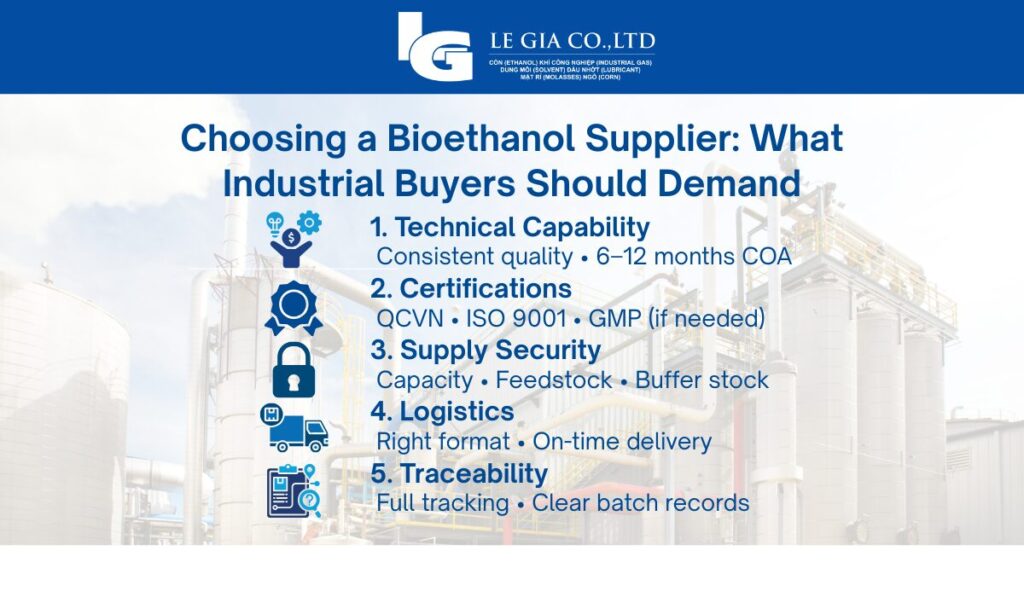
As the Vietnamese bioethanol market matures and E10 mandates approach, the quality gap between compliant and non-compliant suppliers is becoming commercially decisive. Here is a framework for evaluating potential bioethanol suppliers:
Technical capability: Can the supplier demonstrate consistent batch-to-batch quality within spec? Request 6–12 months of historical COA data. Look for standard deviation on key parameters – a supplier with wildly variable ethanol content or water readings is a risk regardless of average values.
Certifications and legal compliance: The minimum set for a Vietnamese fuel ethanol supplier is QCVN 01:2011/BCT certification, a valid hazardous chemicals production license under Decree 113/2017/NĐ-CP, and ISO 9001:2015 quality management certification. For pharmaceutical-grade ethanol applications, GMP-WHO certification and Dược điển Việt Nam compliance are additionally required.
Supply security: What is the supplier’s annual production capacity, and what percentage is already committed to existing contracts? Can they demonstrate access to multiple feedstock sources to reduce seasonal supply risk? Do they have buffer stock policies?
Logistics integration: Can the supplier deliver in your required format (bulk tanker, IBC, drums) on your required timeline? Do they operate their own logistics fleet or depend on third-party carriers? For critical production inputs, the supply chain is only as reliable as its weakest logistics link.
Transparency and traceability: Leading suppliers now provide digital batch records with full traceability from feedstock origin to finished product. This is not yet universal in Vietnam but is a standard requirement for pharmaceutical and food-grade buyers, and is increasingly expected by major fuel blenders as well.
Choosing the Right Bioethanol Supplier in Vietnam
In Vietnam’s complex and rapidly evolving ethanol market, Le Gia Co., Ltd stands out as one of the few suppliers that combines the technical capability, production scale, and supply chain expertise to serve demanding industrial buyers reliably.
Founded in 2001 and continuously growing over more than two decades, Le Gia has developed from a small production operation into Vietnam’s leading specialist in high-purity ethanol manufacturing and export. The company’s supply capacity of 12 million liters of ethanol per year provides the scale necessary to fulfill large, consistent purchase orders without the supply gaps that smaller producers inevitably experience during peak demand periods.
What genuinely differentiates Le Gia in the market is its specialized expertise in ethanol denaturation and custom blending. The ability to formulate denatured ethanol to the precise technical specifications required by each customer – and to ensure compliance with the regulatory requirements of each target market, whether Vietnam, Japan, South Korea, or Taiwan – is a capability that very few suppliers in the region possess. This means industrial buyers receive product ready for their specific application on the first delivery, without the costly trial-and-error that working with less experienced suppliers typically involves. Delivery is confirmed from 10 working days, backed by full supply chain control from production through blending to logistics.
Le Gia’s sustained export success to the demanding markets of Japan, South Korea, and Taiwan – countries where quality standards are among the most stringent in the world – provides third-party validation of product quality that no marketing claim can substitute for. If a supplier is consistently passing Japanese or Korean import inspection, their quality control is functioning at a verified international level.
The Future of Bioethanol: Trends Every Industrial Buyer Should Monitor
The bioethanol industry is evolving rapidly, and buyers who understand the direction of change will be better positioned to make sourcing decisions that remain sound over a 5–10 year horizon.
Second-generation technology commercialization is the most significant near-term development. As enzyme costs fall (driven by competition among major enzyme manufacturers including Novozymes, DSM, and domestic Southeast Asian producers) and pretreatment technologies improve, cellulosic ethanol from rice straw and bagasse will become commercially viable in Vietnam within this decade. Buyers who establish relationships with producers investing in 2G technology now will have access to a more sustainable and potentially lower-cost supply in the future.
Sustainable aviation fuel (SAF) is creating a new, high-value demand channel for ethanol. The ethanol-to-jet (ETJ) conversion pathway is technically proven and is attracting enormous investment from airlines facing decarbonization mandates in Europe and increasingly elsewhere. If ETJ scales commercially, it will compete with fuel blending for ethanol supply and likely put upward pressure on prices – a consideration for long-term supply contract negotiations.
Carbon markets and sustainability certification are adding a new dimension to ethanol procurement. Buyers in regulated markets increasingly need to demonstrate the carbon intensity of their fuel inputs. Certification schemes like the EU’s Renewable Energy Directive (RED II) requirements and the Roundtable on Sustainable Biomaterials (RSB) standard are becoming procurement prerequisites for international-facing buyers. Vietnamese producers who invest in life cycle assessment documentation and third-party sustainability certification will have a significant competitive advantage in export markets.
Conclusion: Why Bioethanol Matters for Industrial Buyers
Bioethanol is no longer a niche energy technology or an environmental aspiration – it is an industrial commodity with a growing mandatory market in Vietnam and a central role in the country’s energy security and decarbonization strategy. Understanding its chemistry, production process, quality standards, and supply chain dynamics is a fundamental competency for any industrial buyer active in the fuel, pharmaceutical, or chemical sectors.
The decisions that matter most are choosing suppliers with verified, consistent quality rather than price alone; implementing incoming QC protocols that catch non-conformance before it reaches your process or your customers; and building supply relationships with producers who have the scale, technical expertise, and transparency to be genuine long-term partners.
Looking for a reliable, high-volume supplier of industrial-grade or pharmaceutical-grade ethanol with verified international quality standards? Contact the Le Gia team for technical consultation and custom quotations.