Procurement managers, chemical sourcing directors, and environmental health and safety (EHS) specialists navigating the high-stakes world of bulk hazardous chemical acquisition understand that container selection is far more than a simple downstream logistics detail. When importing bulk volumes of highly volatile solvents, your choices directly dictate your operational risk profile, product purity margins, and legal liability. A single misstep in packaging specification can lead to disastrous supply chain consequences: flash fires triggered by electrostatic discharges during offloading, moisture contamination that ruins an entire multi-million dollar pharmaceutical run, or unexpected customs seizures at international entry ports due to invalid regulatory markings. Organizations running fast-paced manufacturing lines cannot afford to partner with unverified brokers or tolerate structural mismatches in their industrial containment setups. Safely navigating these complex global supply networks requires a balance of absolute regulatory compliance, strict material science, and rigorous total cost of ownership (TCO) management.
To insulate your enterprise from these operational hazards, you need a primary chemical manufacturer that blends rigorous technical precision with world-class international freight logistics. Lê Gia brings more than 20 years of proven manufacturing excellence to the international marketplace, operating advanced chemical production lines with a scalable capacity of up to 12,000,000 liters of high-purity bio-ethanol per year. By mastering the engineering mechanics of industrial liquid containment and aligning with strict international distribution frameworks, Lê Gia eliminates friction from cross-border shipping lanes. This definitive technical guide evaluates bulk packaging platforms to help your strategic sourcing team eliminate quality failures, maximize handling safety, and preserve your corporate bottom line.
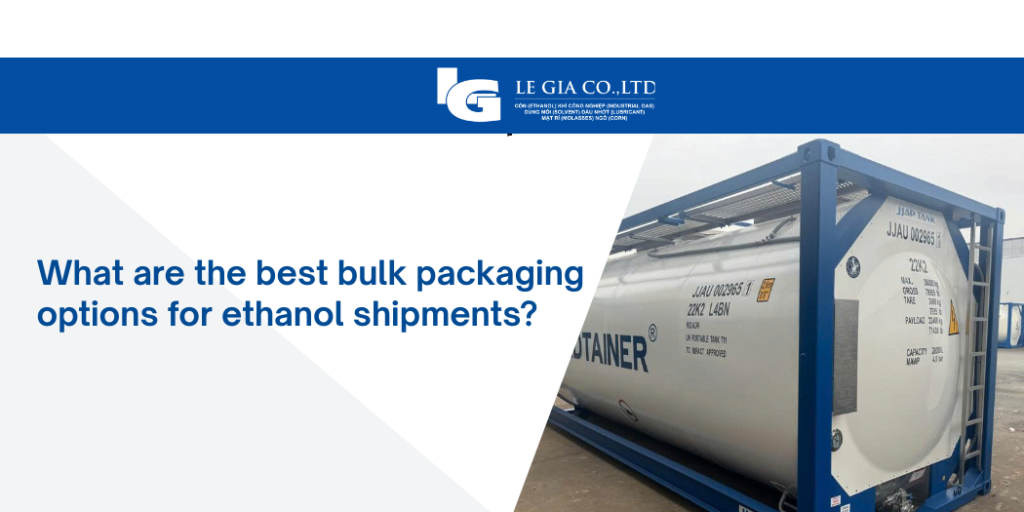
Selecting optimal bulk ethanol packaging requires matching shipping volumes and chemical purity grades with the correct intermodal container framework: ISO tank containers (20,000 to 26,000 liters) deliver maximum economies of scale for high-volume lanes; Intermediate Bulk Containers (IBCs, 1,000 liters) provide excellent regional handling flexibility; and standard 200-liter industrial drums serve lower-volume specialized distribution. Safe distribution demands strict compliance with UN1170 Class 3 flammable liquid regulations, ADR/IMDG shipping codes, and NFPA/OSHA facility storage requirements. Industry leader Lê Gia secures global supply chains through multi-market certified packaging systems that preserve the absolute integrity of food, pharmaceutical, and industrial ethanol grades.
What are the best bulk packaging options for ethanol shipments
| Bulk Container Type | Standard Volumetric Capacity | Primary Structural Materials | Optimal Transport Lane | Primary Target Sourcing Volume |
| ISO Tank Container | 20,000 – 26,000 Liters | 316 Stainless Steel (Insulated) | Intermodal (Ocean / Rail / Road) | Bulk Industrial & Enterprise Batches (>20,000 L) |
| Intermediate Bulk Container (IBC) | 1,000 – 1,040 Liters | Composite HDPE / Galvanized Steel Cage | Ocean Freight & Domestic Road Cargo | Mid-Tier Blending & Specialty Manufacturing |
| Industrial Drum | 200 Liters | Lined Carbon Steel / Heavy-Duty HDPE | Less-than-Container Load (LCL) / Box Truck | Low-Volume Laboratories & Local Scale-Ups |
When should you choose ISO tanks over IBCs or drums
The primary financial and operational breakpoint for selecting an intermodal ISO tank container centers on volume optimization and the reduction of per-liter freight costs. Procurement teams should prioritize transitioning to ISO tanks when single-destination batch orders cross the 10,000-liter threshold. Intermodal tank containers utilize the maximum legal payload capacity of standard ocean freight slots, reducing freight expenditures by up to 40% compared to multiple palleted drum configurations. This significant macro-saving directly optimizes raw material sourcing margins for large processing facilities.
Furthermore, ISO tanks streamline port logistics by completely eliminating the intensive manual labor associated with unloading, scanning, and moving dozens of individual drum units or IBC totes. This shift accelerates raw material throughput at receiving docks and reduces warehousing bottlenecks. However, utilizing these large vessels requires specialized infrastructure at both the loading and receiving facilities. Your plant must feature heavy-duty industrial pump networks, high-flow chemical transfer lines, and dedicated bulk storage containment fields capable of safely receiving a 24,000-liter intermodal delivery without risking environmental spills or vapor leaks. Sourcing managers must conduct an exhaustive engineering audit of facility capabilities before executing long-term ISO tank freight charters.
What capacities and materials suit food-grade vs industrial ethanol
Material compatibility represents a major technical challenge when managing high-purity ethanol formulations. Sourcing food-grade or pharmaceutical-grade ethanol requires using 316-grade stainless steel or virgin high-density polyethylene (HDPE) liners to prevent trace metal contamination. 316 stainless steel contains molybdenum, which provides enhanced resistance to chemical etching and preserves absolute product purity throughout long ocean journeys. This is critical for preventing cross-contamination in premium production environments.
Conversely, technical industrial ethanol or fuel-blending components can safely utilize more economical 304-grade stainless steel or specially lined carbon steel drums. Sourcing teams must ensure all polymer gaskets and seals consist of inert materials like PTFE or Viton to avoid elastomer degradation and subsequent product leakage. This careful alignment of material science with chemical composition is mandatory to prevent material degradation and maintain zero-defect quality parameters on the factory floor.
How do safety regulations affect bulk ethanol packaging choices
Ethanol is classified globally as a Class 3 flammable liquid with a low flash point of approximately 14°C, meaning it creates volatile vapors at normal ambient temperatures. This hazardous classification subjects bulk ethanol shipments to strict domestic and international legal frameworks. Sourcing teams must select packaging formats that strictly adhere to dangerous goods codes to prevent severe legal and financial penalties. Failing to ensure proper regulatory compliance leads directly to seized cargo at port checkpoints, extensive customs delays, and corporate exposure to environmental liabilities.
Regulatory alignment is not a static milestone; it is an ongoing operational constraint that influences container structural integrity, periodic inspections, and day-to-day handling workflows. Suppliers must guarantee that every container utilized has undergone rigorous hydrostatic pressure testing and certified structural verification. This ensures that when your high-volume shipment is subject to continuous transit vibrations on the open ocean or dramatic thermal expansion in tropical climates, the structural boundaries of the container remain completely intact, preventing catastrophic containment breaches and protecting local communities.
What UN, ADR, and IMDG requirements apply to flammable ethanol
All international shipments of bulk ethanol must carry clear UN marking verifications stamped into the container structure to show compliance with international transport protocols. Under the United Nations Dangerous Goods framework, ethanol is assigned code UN1170 and falls into Packing Group II or III based on concentration levels. Sourcing managers must closely audit these technical markers to ensure error-free documentation across diverse regulatory systems.
For intermodal maritime transit, the International Maritime Dangerous Goods (IMDG) code mandates the use of portable tanks designated with specific T-codes, typically T11 or T14, which feature pressure-relief valves and bottom-opening safety guards. For European road networks, the Agreement Concerning the International Carriage of Dangerous Goods by Road (ADR) specifies rigid construction limits and strict vehicle labeling models to ensure safety during transit.
UN 1170 Hazardous Shipping Compliance Checklist:
├── Container carries permanent, certified UN structural embossing
├── Class 3 Flammable Liquid diamond placards affixed to all four container sides
├── GHS-compliant warning labels prominently displayed in the local destination language
└── Pressure relief devices calibrated to IMDG/ADR safety specs
How do OSHA and NFPA codes impact US ethanol storage
For enterprises operating inside the United States, receiving bulk ethanol triggers strict oversight from the Occupational Safety and Health Administration (OSHA) and the National Fire Protection Association (NFPA). OSHA standard 1910.106 establishes firm volume limits for flammable liquid storage based on the architectural design of your warehouse. This prevents dangerous chemical accumulation inside non-insulated facilities.
Concurrently, NFPA Code 30 dictates specific placement, spill containment, and mechanical ventilation parameters for storing IBCs and drums inside commercial zones. Most importantly, NFPA 77 requires facilities to install verified grounding and bonding systems during any liquid transfer operation to dissipate hazardous static charges before they can trigger an explosion. Compliance with these protocols is non-negotiable for enterprise risk mitigation.
Why does ethanol grade matter for packaging selection
The chemical purity requirement of your end application dictates the level of containment isolation needed. Sourcing premium-grade raw materials requires using pristine, uncompromised packaging formats. Sourcing teams must distinguish between industrial, food, and pharmaceutical grades to match the liquid commodity with an appropriate container setup. Neglecting these grade-dependent storage requirements will lead to catastrophic cross-contamination, failed quality assurance audits, and ruined production runs. Working with a dedicated manufacturer like Lê Gia ensures that the packaging line matches the strict requirements of your target grade.
The choice of structural material directly determines whether the fluid will maintain its chemical configuration or absorb trace color compounds and impurities during its journey. Premium applications like medical extractives or spirit production cannot tolerate the slightest trace of volatile organic compounds or plasticizer leaching. Consequently, managing packaging selection across distinct purity grades requires an understanding of structural surface passivity and specialized chemical engineering principles.
What packaging prevents contamination in pharma-grade ethanol
Pharmaceutical-grade ethanol demands absolute chemical inertness to comply with United States Pharmacopeia (USP) and European Pharmacopoeia (EP) guidelines. To prevent contamination from volatile organic compounds or trace plasticizers, producers must ship pharma-grade ethanol in high-spec, electropolished 316L stainless steel ISO tanks or specialized glass-lined containers. This level of purity ensures that no residual compounds affect pharmaceutical manufacturing.
Every single reusable container must undergo rigorous, validated cleaning and passivation protocols backed by verifiable cleanliness certificates. Gaskets must use medical-grade, non-leaching PTFE compounds to preserve the absolute purity of the solvent over long ocean voyages. This exhaustive approach to material isolation forms the baseline of technical pharmaceutical supply chain management.
How does food-grade ethanol differ in container requirements
Food-grade ethanol destined for spirit distillation, food extraction, or flavor manufacturing must comply with FDA CFR Title 21 regulations. For these applications, composite Intermediate Bulk Containers (IBCs) must use virgin, BPA-free high-density polyethylene resins that are certified safe for human consumption lanes. This material selection prevents unwanted plastic scaling or chemical extraction into the raw bulk fluid.
Sourcing teams must verify that the supplier uses dedicated food-grade logistics loops. This means ensuring the container has never carried industrial pesticides, toxic surfactants, or non-food chemical compounds during its operational lifespan. Verifying this historical usage data is necessary to secure full Certificate of Conformity clearances at downstream facilities.
How can you optimize logistics costs across ISO, IBC, and drums
Type optimization across chemical supply chains requires an understanding of total cost of ownership (TCO) variables. Sourcing teams frequently select low upfront container prices, only to face heavy secondary expenses from manual handling labor, elevated product loss from evaporation, or high return freight fees. True cost optimization requires looking past initial procurement costs to calculate the exact per-liter expense of the container across its entire lifecycle. This includes tracking storage footprint efficiencies, loading times, and asset turn rates.
When evaluating these parameters, companies must contrast the capital expenditure of purchasing or leasing dedicated intermodal equipment against the operational flexibility of utilizing disposable packaging formats. Managing the trade-offs between bulk transportation and localized warehouse distribution requires a comprehensive mathematical approach to supply chain modeling. By optimizing these shipping configurations, companies can eliminate margin erosion and achieve a lean logistics loop.
What is the cost-per-liter difference between container types
When evaluating freight dynamics on long ocean routes, the ISO tank container provides the lowest per-liter transport cost. Packing up to 26,000 liters into a single intermodal slot maximizes container volume, yielding up to a 40% reduction in ocean freight costs compared to 200-liter drums packed into a standard dry box. This shipping layout maximizes bulk capacity while significantly dropping port congestion surcharges.
While a composite IBC tote carries a higher initial unit asset cost than a steel drum, it scales far better by utilizing space efficiently on standard shipping pallets and dropping local trucking fees. Sourcing managers must calculate these multi-layered spatial efficiencies when planning international material allocations across geographic regional processing facilities.
When does repackaging from ISO tank to drums make sense
Many global procurement teams use a hybrid logistics strategy known as liquid repackaging or decanting. This approach involves shipping high-purity ethanol over long international distances via bulk ISO tanks to achieve maximum ocean freight savings. This centralized approach keeps transport lanes lean and highly cost-efficient.
Once the cargo arrives at a regional distribution hub, the solvent is decanted into 1,000-liter IBCs or 200-liter drums under controlled, explosion-proof conditions. This strategy allows companies to capture high-volume shipping discounts while maintaining the flexibility to serve local plants that lack bulk-pumping infrastructure. It effectively balances long-haul shipping cost savings with agile, localized delivery speeds.
What do competitors miss about ethanol-specific packaging hazards
Generic industrial logistics guides routinely treat ethanol like standard bulk oils or non-hazardous aqueous solutions. This dangerous oversimplification overlooks the unique physical chemistry and thermodynamic properties of concentrated ethyl alcohol. Traditional suppliers frequently overlook subtle environmental vectors, which can lead to product degradation or safety incidents during international transit. Understanding these overlooked variables separates world-class dangerous goods operators from standard freight brokers.
Many procurement teams remain unaware that ethanol’s intense affinity for ambient moisture can systematically lower alcohol proof levels if standard container venting caps are utilized. When a container transitions through varying climatic zones, it undergoes a process known as ‘thermal breathing,’ drawing in humid ambient air that contaminates the solvent. By recognizing these hidden chemical characteristics, engineering teams can implement targeted protection methods that standard logistics vendors overlook.
Why is grounding and bonding critical for ethanol transfers
Ethanol features a low electrical conductivity, which allows significant static electricity charges to accumulate during rapid fluid pumping. If a transfer system lacks proper electrical bonding, the potential difference between the delivery nozzle and the container rim can generate an electrostatic spark. This electrical variance poses an immediate threat if left unmanaged.
Because ethanol vapors inside an unpurged container sit well within explosive limits at standard temperatures, this minor spark can trigger an immediate explosion. Competitors often ignore the requirement for heavy-duty grounding clamps with electrical resistance ratings under 10 ohms, leaving operations exposed to catastrophic fires. Implementing continuous bonding tracking is standard for top-tier manufacturing lines.
How do explosion-proof storage needs differ by market
Different international jurisdictions maintain completely unique legal definitions and enforcement models for explosion-proof facility designs. European operations enforce strict ATEX Directive zones, classifying storage fields based on the statistical likelihood of flammable vapors being present. This setup dictates explicit wiring, tooling, and containment spacing rules.
Conversely, the United States relies on the National Electrical Code (NEC) Class and Division framework. Sourcing teams must ensure their bulk supplier builds packaging configurations that easily adapt to these local structural engineering demands, avoiding costly retrofits at your receiving facilities. Aligning packaging with localized construction codes is key to smooth multi-market integration.
How does Lê Gia ensure compliance across US, UK, and APAC markets
With over two decades of expert chemical manufacturing experience, Lê Gia has developed a world-class dangerous goods logistics infrastructure. The company monitors evolving international compliance requirements across the US, UK, Europe, and the Asia-Pacific region. By combining top-tier manufacturing quality with validated logistics management, Lê Gia guarantees that your bulk ethanol orders arrive safely, on time, and fully compliant with all local laws. This deep expertise handles all regulatory burdens, keeping your supply chain completely friction-free.
Lê Gia’s manufacturing facilities feature advanced automated cleaning centers that ensure all bulk containers are completely free from cross-contaminants before entering the filling lines. This methodical approach to quality management allows the company to support the strict procurement needs of top-tier global brands such as Acecook, C.P. Group, Siegwerk, and Ajinomoto. By building strict safety protocols directly into its production process, Lê Gia stands out as an elite partner for enterprises requiring zero-defect chemical sourcing.
What documentation does Lê Gia provide for international shipments
Lê Gia ensures smooth customs clearance by providing a comprehensive, multi-language documentation packet with every international shipment. Your logistics team receives an exact, batch-specific Certificate of Analysis (CoA) demonstrating compliance with international purity standards and technical customer requests. This clear data loop prevents friction at arrival terminals.
Additionally, Lê Gia provides fully updated Safety Data Sheets (SDS) authored to match local GHS frameworks in your destination country. All hazardous cargo manifestations, clean-tank certificates, and UN conformity reports are meticulously prepared to prevent port delays. Having this paperwork set on hand minimizes border friction and maintains operational scheduling integrity.
How does 20 years of experience reduce supply chain risk
Two decades of specialized market experience allows Lê Gia to build highly resilient supply chains that withstand global logistics disruptions. The company operates advanced, highly flexible blending facilities that can tailor denatured ethanol formulas to your exact industrial specifications. This technical capability helps buyers save time while ensuring full alignment with structural design rules.
By controlling the entire process from sustainable raw material sourcing to final package sealing, Lê Gia maintains total quality control. This level of vertical integration eliminates third-party component failures and guarantees long-term supply security for your enterprise. Backed by an extensive commercial network, Lê Gia can execute fast, flexible international deliveries starting from just 10 working days.
What ROI can buyers expect from optimized ethanol packaging
Upgrading your chemical packaging configuration should be evaluated as a high-return capital optimization strategy. When procurement teams cooperate with Lê Gia to tailor container formats to their exact trade volumes, they unlock significant operational savings. Optimizing your packaging setup delivers immediate returns by reducing product shrinkage from evaporation, lowering disposal costs for single-use containers, and improving warehouse space utilization. Sourcing teams can directly model these structural savings to project precise long-term returns.
To mathematically analyze these long-term fiscal benefits, corporate finance departments utilize a standardized return on investment model tailored for supply chain assets:
ROI = ((Delta Savings – Investment) / Investment) * 100%
By applying this model to your container lifecycle, procurement groups can clearly track how reducing operational waste and minimizing material loss directly enhances corporate profitability year over year.

How much do reusable IBCs reduce total packaging costs
Transitioning from single-use 200-liter plastic or fiber drums to heavy-duty, reusable stainless steel IBC totes drastically alters your long-term cost trajectory. While stainless IBCs require a higher upfront capital layout, they deliver an operational lifespan exceeding 10 years and can handle dozens of supply chain cycles without structural degradation.
Amortizing the asset purchase over a three-year window typically yields a 35% reduction in total packaging expenditures by completely eliminating ongoing drum disposal fees and reducing residual product waste. This long-term durability reduces your business’s environmental footprint while steadily strengthening raw material procurement efficiency.
What case studies show savings from ISO tank consolidation
A major regional pharmaceutical manufacturer was sourcing high-purity medical ethanol in individual 200-liter steel drums to supply their cosmetics and sanitization lines. This approach required intensive manual labor to unload pallets, handle drums, and manage internal transfers, which limited their production throughput. By partnering with Lê Gia, the company re-engineered its supply chain to receive bulk ethanol via 24,000-liter ISO tank containers.
This container consolidation delivered immediate, measurable improvements across three key metrics: ocean freight expenses were reduced by 38% through optimal container volume utilization; receiving labor costs were cut by 75% by replacing manual drum handling with automated high-flow pumping systems; and product yield increased by 180 liters per batch by eliminating the residual liquid skin waste commonly left inside empty drums.
What mistakes should procurement teams avoid when ordering bulk ethanol
Sourcing industrial chemicals in bulk volumes leaves no room for guessing. Minor mistakes during the initial ordering phase can quickly balloon into major supply chain disruptions, expensive product rejections, or severe regulatory fines. Sourcing teams can protect their supply chain integrity by proactively avoiding common pitfalls during vendor evaluation and contract negotiation. Recognizing these key warning signs guarantees seamless integration with your plant’s existing setup.
Strategic sourcing managers must verify every part of a vendor’s supply chain before signing long-term container leases. If a vendor cannot supply certified batch logs, validated clean tank records, or unexpired UN engineering codes, your operation faces significant risks. By implementing strict auditing steps during vendor onboarding, procurement teams can protect their fast-moving production lines from unexpected compliance failures.
Why do incorrect container materials cause quality failures
Choosing an incompatible container material can permanently ruin high-purity chemical solvents. For example, shipping premium pharmaceutical-grade or food-grade ethanol in standard unlined carbon steel drums triggers immediate chemical oxidation and rust formation. This degradation creates long-term material failure vectors.
This material mismatch introduces trace heavy metal ions into the solvent, causing the batch to fail strict purity tests upon arrival. Sourcing teams must prioritize chemical compatibility validation to ensure the containment material preserves the exact grade of ethanol being shipped. Selecting correct passivated configurations prevents these costly cross-contamination issues.
What happens if UN marking requirements are overlooked
Neglecting to verify structural UN marking compliance on hazardous cargo containers has severe operational and legal consequences. If a maritime border checkpoint detects a bulk ethanol vessel optical tracking stamp that has expired or contains invalid codes, customs officials will immediately impound the entire container. This triggers severe logistical delays across the board.
Your company will face heavy financial penalties, expensive port demurrage fees, and long legal delays. More importantly, it leaves your business exposed to massive liabilities if a non-compliant container suffers a structural failure during transit. Verifying certified marking layouts remains an active rule for international dangerous goods transit.
Ready to source bulk ethanol in your preferred packaging format
Securing a safe, reliable, and cost-effective bulk ethanol supply chain requires working with an experienced manufacturer. Lê Gia combines 20 years of expert chemical production with premium intermodal logistics capabilities to support your operations. Whether your facility requires bulk ISO tank deliveries to maximize freight efficiency, or composite IBCs tailored for regional distribution, Lê Gia delivers high-purity solvents built to your exact technical specifications. Our robust production capacity guarantees total supply security year-round.
Don’t leave your chemical supply chain exposed to unnecessary compliance risks or hidden logistical costs. Partner with an industry leader that emphasizes long-term quality, safety, and operational transparency. Contact Lê Gia’s industrial sales team today at ethanol@legia.vn to receive a comprehensive technical consultation and a detailed, clear quote tailored to your exact application volumes.
How can you request a custom quote from Lê Gia
Lê Gia streamlines the procurement process through a highly structured, consultative sourcing framework. To receive an accurate, optimized quote, your sourcing team should prepare key operational details before contacting our team:
1. Required Purity Grade: Specify if your application requires Premium Food-Grade, Medical-Grade, or custom Industrial Denatured formulations.
2. Volumetric Requirements: Outline your target batch size and estimated annual volume demands.
3. Preferred Packaging Format: Select your ideal container setup from our UN-approved options, including ISO tanks, composite IBCs, or 200-liter drums.
4. Destination Port: Provide your target delivery location to receive an accurate freight cost breakdown using clear Incoterms.
What lead times apply for ISO, IBC, and drum orders
Lê Gia minimizes supply chain friction by maintaining efficient lead times across all product lines. Because the company controls its entire production and distribution network, standard stock packaging requests can be prepared for dispatch within 10 working days. For highly specialized denatured formulations or custom international shipping requirements, typical lead times range from 3 to 4 weeks. This agile production schedule allows your plant to maintain lean inventory levels without risking stock-outs.
FAQ: Bulk ethanol packaging questions answered
Can flexitanks be used for ethanol transport safely
No, standard polymer flexitanks cannot be safely or legally used to transport concentrated ethanol. Because ethanol is classified as a Class 3 flammable liquid with a low flash point, international shipping codes restrict its transport to rigid, grounded containers like ISO tanks or UN-approved steel drums to manage vapor risks.
What is the shelf life of ethanol in sealed IBCs
Under optimal storage conditions—shielded from direct UV exposure and maintained in a climate-controlled environment—high-purity ethanol has an operational shelf life exceeding 2 years. Sourcing teams must verify seal integrity to prevent the solvent from absorbing atmospheric moisture due to its highly hygroscopic nature.
How are empty ethanol drums and IBCs disposed or returned
Empty bulk chemical containers must be managed in strict compliance with local hazardous waste regulations. Reusable stainless steel IBCs can be returned to Lê Gia’s logistics network or sent to certified reconditioning facilities for industrial washing, while single-use drums must be processed by licensed recycling operations.
Does Lê Gia ship bulk ethanol to Thailand and Korea
Yes, Lê Gia operates an extensive international logistics network with established shipping routes across the Asia-Pacific region, including Thailand, South Korea, Taiwan, and Australia. The company ensures full compliance with local import standards, customs requirements, and hazardous chemical documentation in every destination market.