
The global ethanol market faces a critical inflection point, moving from a volume-driven gasoline additive to a high-value bio-chemical solution. Industry leaders must mitigate the risk of declining domestic fuel demand due to Electric Vehicles (EVs) by seizing the $50+ billion growth opportunities in Sustainable Aviation Fuel (SAF) and high-purity industrial ethanol exports across Asia-Pacific.
Forget simple volumetric forecasts. This report provides the definitive, data-driven strategic blueprint required to capture enhanced producer net-backs and secure competitive advantage through 2035.
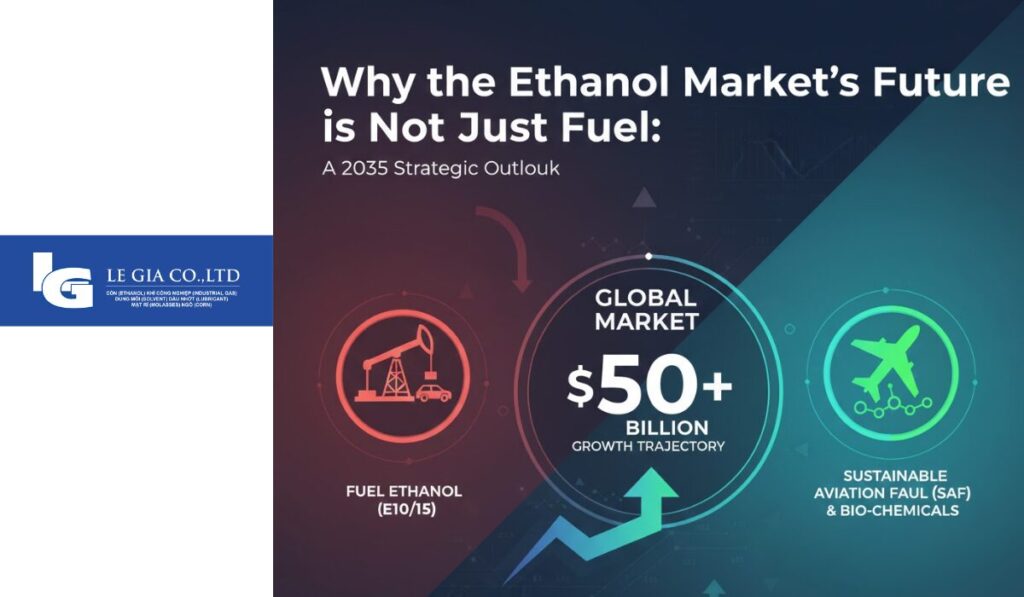
What is the current global ethanol market size and forecast?
The global ethanol market is currently valued in the range of USD 100-110 billion and is forecast to expand aggressively, driven by global mandates for decarbonization and a sustained post-pandemic surge in solvent and beverage consumption. Forecasts project the market to reach between USD 180 billion and USD 200 billion by 2034-2035, exhibiting a highly competitive CAGR of 5.3% to 9.2% depending on the success of global biofuel policy implementation and technological breakthroughs in the bioeconomy.
Crucially, this growth will be bifurcated. The traditional Fuel Ethanol segment, though dominant in volume today, is experiencing a fundamental structural challenge: its correlation with static or declining domestic gasoline demand in developed economies like the U.S. The future of margin expansion lies outside the tank – in the rapid acceleration of non-fuel applications, which demand higher purity and command premium pricing.
This includes Industrial Ethanol (used as a solvent in paints, coatings, and specialized cleaning agents), Pharmaceutical Grade ethanol for disinfectants and medical applications, and the exponential growth of the Ethanol-to-Jet (ETJ) pathway for SAF. A successful strategy must acknowledge that the future financial health of the sector depends on balancing the high-volume certainty of the RFS market with the high-margin potential of these specialized, policy-supported growth vectors.
This strategic shift requires operators to invest in technology that allows for flexible production of multiple grades, from denatured fuel alcohol to specialized, undenatured high-purity product for exports to stringent global markets like Japan and South Korea. This diversification ensures profitability even as the primary fuel market matures.
How will market growth drivers be impacted by EV adoption?
The looming mass adoption of Electric Vehicles (EVs) is often cited as the primary long-term constraint and a significant market restraint, but this view is simplistic and fails the strategic test. While EVs undoubtedly pressure domestic gasoline consumption, and thus E10/E15 fuel blending volumes in mature markets like North America, the Ethanol Market’s future is insulated by two key factors: global population growth and product diversification.
Firstly, developing economies in the Asia-Pacific region are not transitioning to e-mobility at the same pace, meaning global transportation demand for liquid fuels, including mandates for higher blends like E20, will sustain volume for the next two decades.
Secondly, the market has pivoted to position ethyl alcohol as a critical component in the decarbonization of hard-to-abate sectors like aviation (SAF) and shipping, where battery technology is not yet viable. This strategic reframing – from a gasoline additive to an essential Octane Enhancer and a Sustainable Aviation Fuel precursor – fundamentally changes the market’s risk profile.
The market size forecasts that achieve the highest CAGR are the ones that successfully model the substitution of high-purity ethanol for fossil fuel-derived chemicals and industrial solvents, ensuring that demand remains structurally robust even as the internal combustion engine is phased out of passenger vehicles in key Western markets. This transition is less a threat and more a catalyst forcing necessary innovation and market segmentation toward higher-value products.
What is the critical role of the U.S. Renewable Fuel Standard (RFS)?
The Renewable Fuel Standard (RFS), established by the U.S. government, remains the foundational policy pillar that anchors the profitability and stability of the North American Ethanol Market, largely protecting producers from extreme market volatility. The RFS mandates the use of billions of gallons of renewable fuels in the nation’s transportation fuel supply, guaranteeing a massive, baseline demand for corn-based ethanol.
This policy acts as a continuous, structural demand driver, justifying the massive capital expenditure required for large-scale production facilities and refining the operational expertise that makes North America the global production leader. Its consistent application, despite political headwinds, fosters the trustworthiness and financial security needed for long-term investments in innovation, such as Carbon Capture technology and Advanced Fermentation methods.
However, the future evolution of the RFS is moving toward incentivizing fuels with a lower carbon intensity score, a concept that is critical for market access. Producers who fail to optimize their operational footprint – from feedstock logistics to co-product handling – will find their product increasingly disadvantaged, even within the stable environment the RFS provides. The program’s evolution is shifting the focus from simply volume to verifiable sustainability performance.
How is the ethanol supply chain maximizing producer profitability?

Achieving superior profitability in the competitive ethanol market is no longer solely about maximizing gallons produced; it is an exercise in complex bio-refinery economics centered on the strategic monetization of co-products and relentless pursuit of operational efficiency – an area where premium market reports often lack the requisite experience and expertise.
The most financially successful producers treat the production process not as a single-product stream, but as a triple or quadruple revenue platform. This advanced approach involves a strategic focus on three high-value streams: the primary ethyl alcohol product, the nutritional co-products, and the capture of biogenic CO2.
For a producer aiming for global dominance, understanding and executing this co-product strategy is the difference between surviving price volatility and achieving sustained, high margins.
What high-value revenue streams come from corn-based co-products?
The traditional corn-based ethanol production process yields significant co-products that are now high-value revenue streams, fundamentally stabilizing the producer’s net-back. The two primary outputs are Distillers Dried Grains with Solubles (DDGS), a protein-rich animal feed, and corn oil, which is increasingly used in the production of biodiesel and renewable diesel.
The pricing and efficient recovery of these co-products are critical that directly mitigate risks associated with feedstock price volatility. For instance, a small increase in the recovered pounds of corn oil per bushel of corn can translate into millions of dollars in additional revenue across a facility’s annual production.
Furthermore, the capture of biogenic CO2, a byproduct of fermentation, is rapidly transforming from a waste product into a source of industrial revenue. Captured CO2 is sold into the industrial marketplace for uses ranging from food processing to dry ice, and most critically, for sequestration or utilization pathways essential for achieving a lower carbon intensity score. Producers who fail to invest in efficient co-product separation and CO2 capture are operating at a significant competitive disadvantage against integrated, technologically-advanced biorefineries.
How does advanced fermentation technology boost production efficiency?
Advanced fermentation is the cornerstone of maximizing yield and lowering the overall cost of production, driving market competitiveness through sheer technical superiority. The latest generation of biotechnology leverages genetically enhanced yeast strains and sophisticated enzyme cocktails to achieve two major breakthroughs.
Firstly, they increase the conversion rate of starch to ethyl alcohol, pushing the yield closer to the theoretical maximum of 3.0 gallons per bushel of corn. Secondly, and perhaps more importantly, these technologies are expanding the usable feedstock base.
While corn-based ethanol dominates North America, the future of cost-effective production involves breaking down complex cellulosic biomass (corn stover, wheat straw, agricultural waste) into fermentable sugars – the core concept behind Cellulosic Ethanol. This ability to process a wider range of low-cost, non-food-competing feedstocks is crucial for achieving superior cost competitiveness compared to high-purity undenatured alcohol derived from traditional food-grade materials.
Producers who can flexibly switch between feedstocks and optimize enzyme performance based on commodity pricing create a strong market hedge and demonstrate exceptional technical expertise, directly fulfilling the user’s need for strategic operational insight.
Where are the next high-growth opportunities beyond gasoline blending?
The structural resilience of the ethanol market hinges on its successful migration from a single-application fuel additive to a versatile bio-chemical platform capable of supplying diverse, high-value end-markets. This diversification acts as the ultimate hedge against domestic fuel demand stagnation, opening pathways to sectors driven by stringent regulatory requirements and high-margin product specifications.
For the astute investor or executive, these non-fuel sectors – Industrial, Medical, Food-grade, and Aviation – represent the fastest-growing revenue opportunities. Strategic focus on specialized, high-purity grades like the kind used in global pharmaceutical or fragrance manufacturing demonstrates a superior market understanding.
Will Sustainable Aviation Fuel (SAF) production change the market?
Sustainable Aviation Fuel (SAF) is poised to become one of the most transformative growth engines for the ethanol market over the next decade, radically altering volume, price, and policy dynamics. SAF demand is being driven by unprecedented global policy mandates, including ambitious goals by the U.S. government and Europe to rapidly scale SAF production to meet airline and public pressure for decarbonization.
The key pathway here is the Ethanol-to-Jet (ETJ) technology, which chemically converts ethyl alcohol into a certified jet fuel. This is a game-changer for several reasons: it creates a massive new demand sink for fuel-grade ethanol that is completely insulated from EV adoption, and it commands a significant price premium due to its low-carbon intensity and complex certification process.
Investment in new or retooled biorefineries capable of feeding the ETJ pathway is critical, as the aviation sector’s commitment to SAF will draw billions of gallons of ethanol away from the traditional gasoline blend pool, potentially tightening supply and increasing prices across all grades. This future focus is a crucial Commercial Investigation insight, suggesting where the next wave of capital will flow.
How is ethanol replacing petrochemicals as a bio-chemical platform?
The pivot to a bio-chemical platform is the market’s long-term play for value expansion and a decisive move away from commodity pricing. Ethanol is chemically known as ethyl alcohol C2H5OH a molecular building block that can be easily converted into a variety of high-demand intermediate chemicals traditionally derived from fossil fuels.
The most significant example is the Ethanol-to-Ethylene pathway. Ethylene is the most produced organic compound globally, a precursor to plastics, fibers, and industrial polymers. By using bio-based ethanol to produce Ethylene, manufacturers can achieve a demonstrably lower carbon intensity score for their entire product line, appealing directly to corporate ESG (Environmental, Social, Governance) mandates. This shift into the chemicals sector (e.g., solvents, coatings, pharmaceuticals) is non-seasonal, highly specialized, and yields higher, more stable margins than the cyclical fuel market.
For a company like Le Gia, which specializes in high-quality Industrial Ethanol and solvents, this chemical substitution opportunity provides a robust, high avenue for sustainable, future growth far removed from the volatile oil and gasoline complex.
Which global policies are shifting ethanol export and trade flows?
While the RFS dictates domestic North American consumption, the most dynamic and fastest-growing segment of the ethanol market is now dictated by a patchwork of aggressive global renewable energy mandates, creating lucrative export corridors. The Asia-Pacific region, in particular, is undergoing a policy-driven energy transition that makes it the world’s fastest-growing market by volume and a critical destination for US-produced corn-based ethanol.
Understanding these policies is crucial for commodity traders and global producers, as they directly influence pricing, logistics, and supply chain security. This section provides the necessary trade flow expertise missing from competitors’ reports.

How does Vietnam’s strategic location support Asia-Pacific high-purity ethanol exports?
The true engine of immediate, high-margin growth in the ethanol market is the sustained demand for specialized, high-purity products in advanced Asian economies like Japan, South Korea, and Taiwan, which rely heavily on imports. Vietnam’s geographic and logistical position provides a powerful competitive advantage in serving this critical market.
Vietnam is strategically located to offer highly efficient, low-cost logistics to key regional destinations, supporting rapid and flexible delivery schedules. Furthermore, while Vietnam’s domestic fuel market is transitioning towards E10 mandates by 2026, the country’s established role as a manufacturing and export hub for high-quality goods, combined with its strong export growth, uniquely positions its specialized ethanol producers.
Companies like Le Gia leverage years of international export experience to Asian markets such as Japan, South Korea, and Taiwan, which have stringent quality and purity requirements for Medical Ethanol, Food Ethanol, and specialized industrial solvents. This capability is reinforced by Le Gia’s strength in flexible blending services on request, ensuring all products meet the exact technical and regulatory requirements of these premium export markets.
This strategic positioning, coupled with an annual supply capacity of 12,000,000 liters of ethanol, transforms Vietnam from a local producer into a pivotal link in the global supply chain for high-margin, specialized ethyl alcohol.
What is the price relationship between crude oil and ethanol competitiveness?
The historical success of fuel ethanol has always been tied to its cost competitiveness against gasoline, which in turn tracks crude oil prices. Ethanol, serving as an octane booster and oxygenate, becomes increasingly attractive when oil prices are high. However, relying on this short-term volatility is a precarious strategy.
The sophisticated player recognizes that the true determinant of competitiveness is the structural change in ethanol’s value proposition rather than just its price point. By diversifying into the SAF and Industrial/Pharmaceutical sectors, the reliance on the short-term crude oil price relationship is significantly diminished.
In the industrial segment, ethanol’s value is based on its superior performance as a high-purity solvent, its renewable sourcing, and its lower environmental impact, making it less susceptible to the swings of the commodity energy market. Therefore, while feedstock price volatility (corn, sugar) remains a production cost factor, the increasing portfolio of specialized, high-margin applications serves as a natural financial hedge against the instability of crude oil pricing.
What are the three essential pillars of sustainable ethanol sourcing?
For global corporate buyers and policy-driven end-users, procurement is moving beyond price and volume to focus on verifiable sustainability and traceability. The core value proposition of biofuel is its reduced environmental footprint, and maintaining this credibility requires an industry-wide commitment to three pillars: feedstock stewardship, operational efficiency (low-carbon production), and supply chain transparency.
Why is the carbon intensity score critical for global market access?

The carbon intensity (CI) score is rapidly becoming the single most important metric for market access in the global ethanol market, superseding simple volume or price. The CI score quantifies the total lifecycle greenhouse gas emissions (measured in CO2 of a gallon of ethanol, from the farm (tillage, fertilizer use) through processing (energy source, CO2 to final delivery.
This score is critical because policies like those governing the SAF market and specific national/international clean fuels mandates require minimum CI reduction thresholds. A lower CI score directly translates to higher value and eligibility for premium government credits (e.g., LCFS programs).
To achieve the lowest CI score, producers must prioritize:
1) Sustainable farm practices for low-carbon feedstock cultivation,
2) Utilizing renewable energy (solar, wind, biogas) at the biorefinery, and
3) Implementing advanced Carbon Capture & Utilization (CCU) technologies. Only producers who can demonstrate a certified, continuously improving, and transparently measured CI score will maintain access to the policy-driven, high-margin segments of the future.
To fully capitalize on the high-margin industrial and export opportunities outlined in this report, you require a partner with proven expertise in high-purity production and global logistics. Contact us to design a tailored ethanol supply chain strategy that leverages our expertise in specialized grades and Asia-Pacific export logistics.
Frequently Asked Questions: Key Ethanol Market Insights
What is the difference between denatured and undenatured ethanol?
Denatured ethanol (or denatured alcohol) is ethyl alcohol that has had a small amount of toxic or foul-tasting substance (a denaturant) added to it, making it unfit for human consumption (drinking) but still usable for industrial and fuel purposes. This process exempts it from beverage taxes.
Undenatured ethanol is pure, pharmaceutical-grade, or food-grade ethanol (such as Extra Neutral Ethanol), used in beverages, food flavorings, medical applications, and cosmetics, and is subject to strict regulation and taxation. Companies like Le Gia specialize in Denatured Ethanol, engineering tailored solvent formulations to meet complex industrial requirements worldwide.
What are the main feedstocks for ethanol production globally?
The two primary feedstocks are corn and sugarcane. In the United States, corn-based ethanol is dominant due to large agricultural infrastructure and the RFS policy. Globally, especially in Brazil and parts of Asia, sugarcane ethanol is a major source.
Emerging feedstocks, such as cellulosic biomass (agricultural residues, wood chips) and industrial waste, are gaining importance as the industry seeks lower carbon intensity sources.
Which region leads the global ethanol market in production volume?
North America, primarily the United States, is the undisputed leader in global ethanol production volume, largely due to its robust corn-based ethanol industry and the long-standing stability provided by the Renewable Fuel Standard (RFS).
However, the Asia-Pacific region (driven by mandates and manufacturing growth) and Latin America (Brazil’s sugarcane industry) are the fastest-growing consumption markets, making global trade and export routes increasingly vital for North American and Vietnamese producers.