If you are evaluating Vietnamese ethanol as a supply origin in 2026, the first question is not price – it is which production tier your specification belongs to. Vietnam’s fuel-grade capacity is being absorbed by the nationwide E10 mandate that begins on 1 June 2026 under Circular 50/2025/TT-BCT. Specialty capacity for food, pharmaceutical, industrial and denatured grades sits on separate lines, with separate quality systems and separate lead times.
Buyers who approach the wrong tier get quoted on volume terms for a product that will not pass their impurity spec. This guide covers grades, certifications, tariff routes and supplier due diligence for the specialty side.
Who are the leading Vietnamese ethanol manufacturers for export?
Sourcing Vietnamese ethanol for export requires you to navigate two structurally different production tiers. The first tier is dominated by large-scale fuel-grade plants built to supply the domestic E10 mandate – volume-driven, low-margin, and not configured for specialty-grade impurity control. The second tier is a smaller group of high-purity manufacturers whose facilities, certifications, and QC infrastructure are purpose-built for pharmaceutical, food, cosmetics, and industrial export specifications. The Vietnam Biofuels Association records six fuel ethanol plants with a combined designed capacity of approximately 600,000 cubic meters per year, though utilisation varies significantly across sites. (Source: Vietnam Biofuels Association, 2026)
| Company | Focus | Capacity | Certifications | Export Markets |
| Le Gia Co., Ltd | High-purity, food, pharma, denatured ethanol | 12 million L/year | ISO 9001:2015, ISO 13485:2016, GMP, VietCert | Japan, South Korea, Taiwan, Australia, India |
| Tung Lam Bioenergy | Fuel-grade biofuel (cassava/corn) | >100 million L/year | Biofuel mandate compliance | Domestic E10 focus |
| Duy Minh JSC | Chemical trading & export logistics | Trading volume | Int’l chemical compliance (20+ countries) | Southeast Asia, export broker |
| PVOIL | Fuel distribution & blending infrastructure | National scale | State enterprise QC | Domestic fuel blending |
| Halico | Premium neutral spirits (beverage sector) | Est. 70,000 MT/year | Beverage-grade standards | Domestic beverage market |
| Saigon Petro | Southern Vietnam distribution network | Regional scale | Regional distribution | Mekong Delta & HCMC industrial |
| Dai Viet Biofuel | Industrial-grade ethanol, cassava feedstock | 40,000 MT/year | Industrial grade | Domestic industrial |
Sources: Vietnam Biofuels Association 2026; Industrial Info Resources 2025; Le Gia company data
Read more: Top 7 Leading Vietnamese Ethanol Suppliers in 2026
Why is Vietnam emerging as a strategic ethanol sourcing market?
Vietnam’s ethanol market reached USD 160.7 million in 2024 and is projected to grow to USD 234.7 million by 2033, at a CAGR of 4.08%. (Source: IMARC Group, 2024) Three structural factors drive this growth: abundant low-cost agricultural feedstock, a government-mandated fuel-blending program, and improving trade conditions.
Vietnam produces over 10 million tons of cassava annually, making it one of the world’s largest cassava producers. Cassava remains the primary ethanol feedstock, providing local manufacturers with a cost advantage over corn-based producers in the United States or grain-based producers in Europe. Sugarcane molasses is a secondary feedstock, particularly for food and beverage grade ethanol.
Proximity to high-demand Asian markets – Japan, South Korea, Taiwan – reduces freight costs compared to sourcing from Brazil or the U.S. Gulf Coast. Vietnam’s ports in Ho Chi Minh City handle ethanol exports efficiently in ISO tank containers and drums.
How does Vietnam’s E10 biofuel policy impact supply availability?
From June 1, 2026, all unleaded gasoline sold nationwide in Vietnam must be E10 – a 10% ethanol blend – under Circular 50/2025/TT-BCT issued by the Ministry of Industry and Trade. Decision No. 46/2025/QD-TTg, signed December 11, 2025, formally replaced the 2012 biofuel roadmap. (Source: VietnamNet, December 2025)
This mandate creates a critical supply dynamic for international B2B buyers to understand. The fuel-blending demand is enormous: Vietnam consumes approximately 1 million cubic meters of gasoline per month, which requires roughly 100,000 cubic meters of E100 ethanol per month for E10 blending. Domestic production currently covers only around 25,000 cubic meters per month; approximately 75,000 cubic meters per month must be imported. (Source: Vietnam Ministry of Industry and Trade, June 2026)
The practical implication for B2B procurement is straightforward: the fuel-grade pool is under pressure, while specialty-grade capacity from manufacturers like Le Gia remains available because it operates on a structurally separate production line that was never configured for fuel-grade output. The procurement risk is not shortage per se, but complacency – buyers who rely on spot orders into a tightening market will face longer lead times and less favourable pricing than those who establish rolling supply agreements in advance.
The Ministry of Industry and Trade has confirmed that E5 RON92 will remain available alongside E10 until December 31, 2030, providing a transition window. From 2031, the blend mandate is expected to rise to E15 or higher, which will further compress available export volumes from fuel-grade plants.
What makes cassava-based ethanol competitive globally?
Cassava’s feedstock economics are a genuine competitive advantage for Vietnamese ethanol producers. One metric ton of dried cassava chips yields approximately 280–350 liters of ethanol under industrial fermentation conditions, depending on starch content – which typically ranges from 65 to 70%. Molasses, the alternative feedstock, yields roughly 180 liters per ton, making cassava the higher-efficiency raw material. Vietnam produces over 10 million tons of cassava annually, concentrated in the Central Highlands and southeastern provinces – a geography that keeps feedstock transport costs short for producers in the south. For B2B buyers, this feedstock efficiency translates directly into a structural cost advantage over corn-based producers in the United States or sugar beet producers in Europe.
For B2B buyers, cassava-sourced ethanol offers a measurable carbon intensity advantage over petroleum-derived solvents. Bioethanol from cassava reduces greenhouse gas emissions by 20–50% per liter compared to conventional gasoline, a calculation cited by the International Energy Agency (IEA). This matters for buyers operating in markets with green chemistry or Scope 3 emissions targets.
The feedstock risk for buyers: cassava supply is seasonal, with prices rising sharply in off-harvest periods. Buyers negotiating long-term contracts should include price-adjustment clauses or work with suppliers who maintain molasses as a secondary feedstock to buffer seasonal variability.
What ethanol grades can you source from Vietnamese suppliers?
Vietnamese manufacturers produce four primary commercial grades. Matching the correct grade to your application is the first technical decision in any sourcing process – specifying the wrong grade triggers regulatory non-compliance or product failure.
| Grade | Purity (%) | Primary Applications | Key Standards | Availability in VN |
| Fuel-grade (E100) | ≥99.5 | Gasoline blending (E5/E10) | QCVN 01:2022/BKHCN | High – dedicated fuel plants |
| Industrial-grade | 96–99 | Solvents, paints, inks, electronics cleaning | ASTM D4052/D1209/D1613 | Moderate – multiple suppliers |
| Food-grade | 96–99.5 | F&B manufacturing, flavoring extraction, sanitizers | TCVN / ATVSTP / Codex | Available – specialty producers |
| Medical/Pharma-grade | 96–99.5 | Pharma formulations, wound care, disinfectants | USP, BP, EP, ISO 13485:2016 | Limited – Le Gia; Halico (spirits) |
| Denatured ethanol | 96–99.5 | Industrial solvents, cosmetics, specialty cleaning | Custom / customer spec | Available via specialist blenders |
How do fuel, industrial, and pharma-grade ethanol differ?
Fuel-grade ethanol (E100, ≥99.5% purity) is produced for gasoline blending. It is dehydrated using molecular sieves to remove water below 0.5% and may contain denaturants to prevent beverage use. It is not suitable for pharmaceutical formulations or food contact due to potential denaturant residues and less stringent impurity control for aldehydes and esters.
Industrial-grade ethanol (96–99%) covers the broadest application range. Typical specifications: alcohol strength 96% V/V minimum at 20°C (ASTM D4052), color Pt-Co < 10 (ASTM D1209), acidity as acetic acid ≤50 mg/L (ASTM D1613), water content ≤5.5% vol (ASTM E203), methanol ≤100 ppm, acetaldehyde ≤40 ppm (GC). This grade suits solvents, paints, inks, and electronics cleaning where trace impurities are acceptable within defined limits.
Pharmaceutical and food-grade ethanol requires tighter impurity profiles. At Le Gia, tested results on cassava-sourced ethanol show: methanol 32 ppm (spec: ≤100 ppm), acetaldehyde 10 ppm (spec: ≤40 ppm), ethyl acetate 15 ppm (spec: ≤100 ppm), iso-propanol 130 ppm (spec: ≤1,000 ppm), water content 4.6% vol (spec: ≤5.5%).
What specifications define high-purity denatured ethanol?
Denatured ethanol is undenatured ethanol to which one or more chemical agents – denaturants – have been added to render it unfit for beverage consumption while preserving its industrial or cosmetic function. The type and concentration of denaturant determines regulatory classification and downstream use.
- Isopropanol (IPA): Most common industrial denaturant. Concentrations of 2–5% are standard for solvents and cleaning applications.
- Methanol: Used in some industrial formulations. Restricted or prohibited in cosmetics and pharmaceutical formulations due to toxicity.
- Bitrex (denatonium benzoate): Bitter-taste denaturant at trace concentrations (≥10 ppm). EU-approved for cosmetic and topical applications.
- Ethyl acetate: Used in some cosmetic-grade denatured formulations.
Le Gia engineers denatured formulations to customer specification, confirming compliance with the relevant regulatory framework of the buyer’s market – EU Cosmetics Regulation 1223/2009, U.S. TTB Specially Denatured Alcohol (SDA) formulas, or custom industrial protocols. All denaturant additions are documented in batch-specific COAs with GC quantification.
Which Vietnamese supplier specializes in denatured ethanol expertise?
From a B2B buyer’s evaluation standpoint, Le Gia Co., Ltd stands apart from Vietnam’s broader ethanol producer base on a single structural criterion: the company has never operated a fuel-grade line.
Founded in 2001 and running continuously for over two decades, every liter produced at its Ho Chi Minh City facility – 108 Khuong Viet, Tan Phu Ward – is allocated to food-grade, pharmaceutical-grade, industrial, or custom denatured applications. That exclusivity is commercially significant: when E10 demand spikes and fuel-grade margins improve, Le Gia has no economic incentive to divert capacity away from specialty buyers.
The supply-security implication for buyers is concrete: Le Gia’s 12-million-liter annual output is not in competition with the fuel market for capacity. While fuel-grade producers face margin pressure to divert production toward E10 blending – particularly as domestic fuel demand grows – Le Gia’s business model is entirely indexed to specialty-grade contract buyers. This makes long-term supply planning more predictable for pharmaceutical and food-grade procurement teams operating on annual or multi-year agreements.
Product range: undenatured food-grade ethanol (International Standard and Vietnamese ATVSTP standard), medical-grade ethanol, industrial ethanol (various concentrations), and custom denatured ethanol formulations. Industrial gases – CO2, O2, Argon – are an ancillary product line.
Le Gia’s export footprint covers more than 10 markets: Japan, South Korea, Taiwan, Australia, Canada, Thailand, Laos, Cambodia, Indonesia, India, and Singapore. That geographic spread matters to procurement managers because it signals established freight routines, familiarity with destination-country import requirements, and experience preparing export documentation across different regulatory regimes.
Standard shipping formats are 200L blue HDPE drums and ISO tank containers – both appropriate for UN 1170 Class 3 flammable liquids. Buyers in the F&B, pharmaceutical, cosmetics, paint, and electronics sectors across these markets have used Le Gia as a long-term supply partner.
How does Le Gia control impurities using Gas Chromatography?
For regulated industries, a supplier’s Certificate of Analysis is only as credible as the analytical method behind it. Le Gia uses Gas Chromatography (GC) as its primary release-testing method – an instrument-grade technique that resolves individual volatile compounds in the ethanol matrix down to single-digit parts-per-million.
This matters because it eliminates subjectivity: the result is a quantified number, not a visual or olfactory pass/fail. Pharmaceutical buyers in particular should require GC-based COAs, since regulatory submissions to health authorities (FDA, EMA, TGA) require quantified impurity data rather than qualitative assessments.
Key impurities monitored on each COA:
- Methanol: Specification ≤100 ppm; Le Gia tested result: 32 ppm
- Acetaldehyde: Specification ≤40 ppm; Le Gia tested result: 10 ppm
- Ethyl acetate: Specification ≤100 ppm; Le Gia tested result: 15 ppm
- Isopropanol: Specification ≤1,000 ppm; Le Gia tested result: 130 ppm
- Alcohol strength at 20°C: Minimum 95% V/V; Le Gia tested result: 96.0%
What these numbers tell an experienced procurement manager is not just that the batch passed – it is that the process has headroom. When methanol tests at 32 ppm against a 100 ppm specification, the supplier is not barely compliant; they are operating at less than one-third of the limit. That kind of margin absorbs seasonal feedstock variability without pushing a batch into non-conformance.
When auditing any new Vietnamese ethanol supplier, request three consecutive production-batch COAs and compare the tested values, not just the specification columns. Inconsistent results across batches, even within spec, signal process instability that will surface eventually in your supply chain.
What denaturant formulations meet pharma and cosmetics standards?
Regulatory acceptance of denatured ethanol depends on the specific denaturant formula, its concentration, and the destination market’s regulatory body. Le Gia engineers formulations to customer specification after confirming the applicable standard:
- EU Cosmetics Regulation (1223/2009): Accepts ethanol denatured with IPA (5%), Bitrex, or ethyl acetate. Methanol is prohibited as a denaturant.
- U.S. TTB SDA Formulas: Multiple approved formulas (e.g., SDA 40-B uses tert-butyl alcohol; SDA 23-H uses acetonitrile for lab applications). Le Gia supplies to customer spec upon RFQ.
- ASEAN cosmetics standard: Follows similar principles to EU; IPA and Bitrex are widely accepted.
- Industrial cleaning/electronics: IPA at 2–5% concentration; no beverage-restriction requirement beyond basic denaturant presence.
What quality certifications should you require from Vietnamese exporters?
Certifications are the primary proxy for quality system maturity when you cannot conduct an on-site audit. The minimum certification set depends on your application. Fuel-grade buyers have different requirements from pharmaceutical procurement managers.
| Certification | Scope | Required For | Le Gia Status |
| ISO 9001:2015 | Quality Management System | All export-grade applications | Certified (Certificate No. 764894) |
| ISO 13485:2016 | Medical Device QMS (covers medical ethanol) | Pharma / medical ethanol | Certified (Certificate No. 848, April 2027) |
| GMP | Good Manufacturing Practice | Pharma, food, cosmetics applications | Certified (Certificate No. N711875) |
| VietCert | Vietnamese product quality certification | ATVSTP food-grade / national compliance | Certified – QCVN 6-3:2010/BYT |
| COA per batch | Certificate of Analysis (GC, ASTM methods) | All applications – mandatory per shipment | Issued on every production batch |
| SDS/MSDS | Safety Data Sheet per GHS/OSHA | All hazardous goods export | Available (SDS No. 012022, January 2022) |
Which ISO, GMP, and HACCP standards apply to ethanol?
ISO 9001:2015 is the foundational standard – it certifies that a quality management system exists, is documented, and is audited by an accredited third party. For ethanol, it covers raw material testing, in-process monitoring, finished product analysis, and documentation control. It does not guarantee a specific purity level; that comes from the COA.
ISO 13485:2016 extends quality management to medical device production, including the alcohol used in pharmaceutical formulations and medical disinfectants. It requires documented traceability from feedstock to final batch, stricter change-control procedures, and risk management under ISO 14971. This certification is non-negotiable for buyers supplying ethanol into EU or FDA-regulated pharmaceutical supply chains.
GMP (Good Manufacturing Practice) certification – as held by Le Gia under Certificate No. N711875, issued by Guardian Independent Certification Ltd – covers facility design, contamination control, personnel hygiene, calibration, and batch record management. It overlaps with ISO 13485 requirements but is referenced more widely in food and cosmetics procurement specifications.
How do you verify supplier compliance before ordering?
Requesting a certificate document is not the same as verifying it. Use this five-step due diligence process before committing to a first purchase order:
- Request copies of all claimed certifications. Check the certificate number, issue date, expiry date, scope statement, and certifying body’s name.
- Verify the certifying body’s accreditation. For ISO 9001 and 13485, confirm the certifier is IAF-accredited (look for the IAF mark on the certificate). Guardian Independent Certification Ltd is IAF-accredited.
- Request three consecutive batch COAs. Consistency across batches – not just a single good result – demonstrates process control. Check tested values against specification limits for all GC parameters.
- Request an SDS/MSDS for every product. Compare hazard classifications, transport UN numbers, and packaging requirements against your import country’s chemical regulations.
- Consider a remote audit or factory video call. Review the distillation setup, QC lab, and storage tanks. Ask to see calibration records for GC equipment and balances.
Le Gia provides all documentation listed above on request and supports remote supplier qualification procedures for buyers who cannot conduct in-person factory audits.
What are the tariffs and trade conditions for Vietnamese ethanol?
Vietnam’s ethanol export conditions improved significantly between 2023 and 2025 through a series of MFN tariff reductions and existing FTA provisions. Understanding these conditions helps buyers calculate landed cost accurately and choose whether to import from Vietnam under MFN or FTA terms.
| Trade Framework | Countries Covered | Ethanol Tariff | Notes |
| MFN (Decree 73/2025) | All WTO members including USA | 5% | Down from 10% (2023); effective March 31, 2025 (HS 2207.20.11/.19) |
| CPTPP | Japan, Australia, Canada, NZ, etc. | 0–5% | Progressive elimination schedule; check specific HS code schedules |
| EVFTA | European Union | 0% | Ethanol included in preference schedule; requires Form EUR.1 or REX |
| ASEAN-Korea FTA | South Korea | 0–5% | Applies to undenatured and denatured ethanol with CO Form AK |
| ASEAN-Japan AJCEP | Japan | 0–5% | ASEAN-Japan Comprehensive Economic Partnership |
| RCEP | ASEAN + China, Japan, Korea, NZ, AU | 0–5% | Phased tariff elimination across member states |
| Vietnam-UK FTA (UKVFTA) | United Kingdom | 0% | Similar to EVFTA provisions; check origin rules for ethanol |
Sources: USDA FAS VM2025-0014 (March 2025); U.S. Grains Council (2023); Vietnam-Briefing.com (April 2025)
How do MFN rates affect denatured vs undenatured imports?
A critical point for international buyers: the tariff discussed here is Vietnam’s own import duty on ethanol coming into Vietnam – not the rate your country charges on Vietnamese-origin ethanol. For what your country charges, consult the FTA table above and your customs broker. That said, Vietnam’s Decree 73/2025/ND-CP, effective March 31, 2025, reduced the MFN import tariff on ethanol (HS codes 2207.20.11 and 2207.20.19) from 10% to 5%, which affects the cost of ethanol that Vietnamese producers import as feedstock or intermediate product – and by extension their input cost structure. (Source: USDA FAS, April 2025)
For buyers importing Vietnamese-origin ethanol into their country, the applicable rate depends on their domestic tariff schedule for HS 2207.10 (undenatured, ≥80% alcohol) or HS 2207.20 (denatured). In most markets, denatured ethanol attracts a lower import tariff than undenatured ethanol, since denaturation eliminates the beverage-use concern. Buyers should confirm HS classification and any excise duty treatment with their customs broker before finalizing a supply agreement.
What trade agreements benefit international ethanol buyers?
CPTPP (Comprehensive and Progressive Agreement for Trans-Pacific Partnership) covers Japan, Australia, Canada, New Zealand, Mexico, Singapore, Brunei, Malaysia, Chile, Peru, and Vietnam. Under CPTPP, ethanol tariffs follow a phased elimination schedule. Japanese buyers in particular benefit from preferential access, as Japan is already a primary destination for Le Gia’s exports.
EVFTA (EU-Vietnam Free Trade Agreement) grants 0% tariff on Vietnamese ethanol entering the EU, subject to Rules of Origin requirements. The primary documentation tool is the EUR.1 movement certificate or the Registered Exporter (REX) declaration. EU cosmetics manufacturers are among the primary beneficiaries.
RCEP (Regional Comprehensive Economic Partnership) covers the ASEAN bloc plus China, Japan, South Korea, Australia, and New Zealand – collectively Vietnam’s most important trading partners. RCEP simplifies origin rules and provides a single framework across 15 member economies, which reduces administrative complexity for buyers managing multi-country sourcing.
What risks should B2B buyers consider: For HS classification, certificate of origin forms and shipping documentation, see our Vietnam ethanol export guide.
What risks should B2B buyers consider when sourcing from Vietnam?
Every sourcing origin carries structural risks. Vietnam’s ethanol supply chain has three areas that procurement managers should assess explicitly before contract execution.
How stable is Vietnam’s ethanol production capacity?
Vietnam operates six fuel-ethanol plants with a combined designed capacity of approximately 600,000 cubic meters per year. Only two have operated consistently – the Dong Nai plant (Tung Lam Bioenergy) and the Dak Nong plant (Duc Giang-Dak Nong Chemical). The Dung Quat plant (Binh Son Refining, 100,000 m³/year designed capacity) was mothballed for over 10 years and is being restarted to serve E10 demand. (Source: Industrial Info Resources, October 2025)
For high-purity ethanol buyers, this instability is less relevant – Le Gia’s facility is entirely separate from the fuel-ethanol plant infrastructure and has maintained consistent production since 2001. The risk to monitor is feedstock price volatility: cassava is highly seasonal, and prices spike during off-harvest periods, potentially compressing supplier margins.
What supply chain safeguards protect against disruption?
Practical risk-mitigation strategies for B2B buyers sourcing from Vietnam:
- Multi-supplier strategy: Consider maintaining Le Gia as a primary high-purity supplier and a secondary backup from another ASEAN market (e.g., India or Thailand) for contingency.
- Volume commitments with advance booking: Le Gia can hold reserved capacity for buyers who commit to rolling 3-month purchase volumes. This is more effective than spot purchasing.
- Force majeure and penalty clauses: Include clear definitions, notice periods, and substitute-supply obligations in your supply agreement.
- Buffer inventory: Ethanol stored in sealed containers (SS tanks or HDPE drums) maintains quality for 12–24 months if stored below 25°C, away from direct sunlight and ignition sources. (Source: Le Gia SDS No. 012022)
- Price-adjustment mechanisms: Link contract pricing to a reference feedstock index (cassava CIF price or molasses price) with quarterly adjustment caps.
How do you evaluate and shortlist Vietnamese ethanol suppliers?
A structured evaluation framework reduces the risk of selecting a supplier who cannot consistently deliver your specification. The framework below works for both first-time and experienced ethanol buyers.
What questions should your RFQ include?
- What is your annual production capacity, and what percentage is dedicated to our grade (food/pharma/industrial/denatured)?
- What is your minimum order quantity (MOQ) and standard lead time from order confirmation to FOB Ho Chi Minh City?
- What certifications do you hold? Please attach current ISO 9001, ISO 13485, GMP, and any VietCert certificates.
- What is your standard COA format? Please provide three consecutive batch COAs for the most recent production lots of our required grade.
- What GC testing equipment is on-site, and what is the detection limit for methanol and acetaldehyde in your standard method?
- What denaturant formulations do you offer, and which have been supplied to EU, U.S., or Japanese buyers previously?
- What are your standard payment terms, and do you offer letters of credit (L/C) or open account for established buyers?
- What packaging formats are available (ISO tank, IBC 1,000L, drum 200L, jerry can 5L/20L), and what are FOB prices for each?
What documentation and COA data should you request?
Mandatory documentation checklist for every initial order:
- Certificate of Analysis (COA): Batch number, production date, tested values for alcohol strength, color, acidity, pH, water content, methanol, acetaldehyde, ethyl acetate, isopropanol; test methods cited.
- Safety Data Sheet (SDS/MSDS): UN 1170 Class 3 flammable liquid; must include hazard statements, first-aid, fire-fighting, handling/storage, and disposal per GHS format.
- Export License / Business Registration: Confirm the supplier is legally authorized to export ethanol from Vietnam.
- Certificate of Origin (CO): Form D (ASEAN), Form AK (ASEAN-Korea), Form CPTPP, EUR.1 (EU), or REX declaration – depending on your import market FTA requirements.
- Packing List and Bill of Lading (B/L): Verify container type (ISO tank T11 or T14 for bulk ethanol), gross/net weight, and consignee details.
- Insurance certificate: Confirm marine cargo insurance coverage for CIF terms, or arrange your own for FOB.
Le Gia provides all the above documentation as standard for every export shipment. For new buyers, request a documentation sample pack before placing a first order.
Ready to source Vietnamese ethanol for your business?
Vietnam offers a well-developed ethanol supply base, improving trade terms, and at least one manufacturer – Le Gia Co., Ltd – with 20 years of demonstrated capability in high-purity and denatured ethanol export. The E10 mandate strengthens Vietnam’s production infrastructure over the long term, even as it tightens short-term availability for fuel-grade supply.
For procurement managers evaluating Vietnam as a sourcing origin, the practical next steps are:
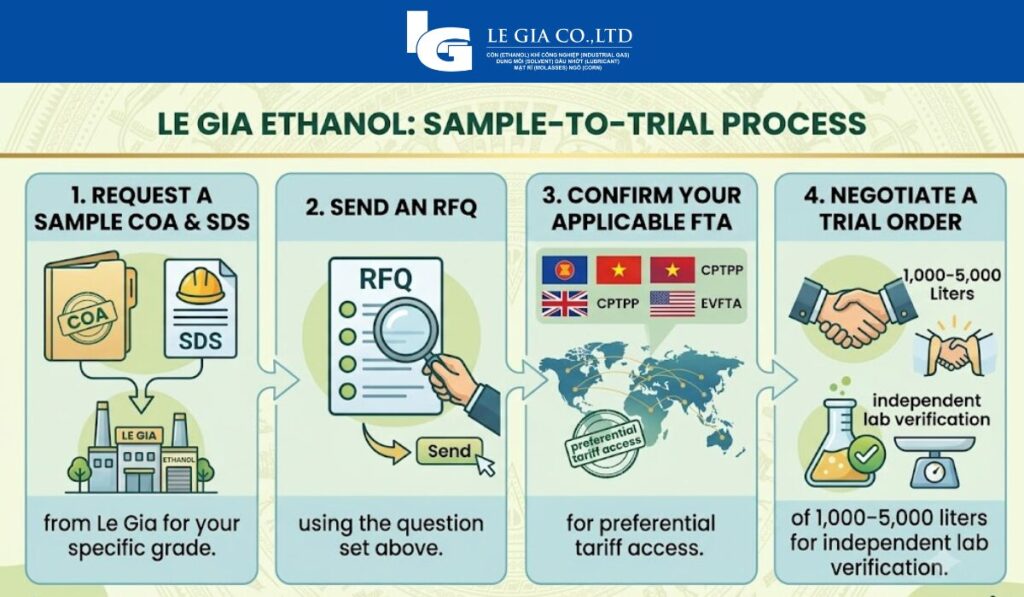
| Request a sample COA and pricing now Contact Le Gia Co., Ltd for pharmaceutical, food-grade, industrial, or denatured ethanol: Email: ethanol@legia.vn | Phone: (+84) 028 3865 2804 WhatsApp: (+84) 0908 769 151 (Mrs. Tham) | Website: legia.vn Address: 108 Khuong Viet, Tan Phu Ward, Ho Chi Minh City, Vietnam |
FAQ
Is Vietnamese ethanol suitable for pharmaceutical applications?
Yes – from manufacturers who hold ISO 13485:2016 and GMP certification and produce to BP/USP/EP impurity limits. Le Gia’s cassava-sourced ethanol achieves methanol at 32 ppm and acetaldehyde at 10 ppm (both well within pharma-grade limits), with documented GC testing on every batch. Verify current certifications and request a pharma-specific COA before committing to a supply agreement. Not all Vietnamese ethanol suppliers hold the required pharmaceutical certifications.
What minimum order quantities do Vietnamese exporters require?
MOQs vary by supplier and grade. Le Gia accepts orders from approximately 1,000 liters (5 x 200L drums) for specialty grades, scaling to 20,000+ liters per ISO tank for bulk orders. Fuel-grade producers like Tung Lam typically require full-container loads (20–24 MT per ISO tank). Confirm MOQ and packaging options in your RFQ – minimum orders are often negotiable for buyers committing to rolling purchase agreements.
How does Vietnamese ethanol pricing compare to U.S. or Brazil?
Vietnam’s average ethanol export price in 2024 was approximately USD 1.1 per liter FOB, according to IndexBox data. This is broadly comparable to Brazilian and U.S. prices at origin, but Vietnam’s freight advantage to Asian buyers (Japan, South Korea, Taiwan, Australia) typically yields a lower landed cost than Atlantic-origin supply. Cassava-based production and lower energy costs support competitive pricing for industrial and food grades. Request an FOB quote and calculate landed cost including freight, insurance, and applicable import tariffs for an accurate comparison.
What are typical lead times for a first order from Vietnam?
Le Gia delivers from 10 working days for standard grades, based on order volume and production schedule. For first-time buyers, allow 15–20 working days to accommodate documentation preparation (COA, CO, SDS, packing list) and any pre-shipment inspection. ISO tank shipments to Japan and South Korea typically transit in 5–7 days; to Australia approximately 10–14 days. Factor these transit times into your total replenishment lead time.
What are standard payment terms for Vietnamese ethanol exporters?
Most Vietnamese ethanol exporters – including Le Gia – accept T/T (telegraphic transfer) with 30–50% advance deposit and the balance due against shipping documents. For established buyers, open account terms (net 30–60 days) are negotiable. Letters of credit (L/C at sight) are acceptable for large orders and provide additional payment security. USD is the standard transaction currency for export orders; VND is used for domestic orders.
Can Le Gia provide halal or kosher-certified ethanol?
Halal and kosher certification requirements for ethanol vary by certifying body and destination market. For buyers in markets where these certifications are required (e.g., Indonesia, Malaysia, Middle East), specify this requirement at the RFQ stage. Certification can typically be arranged if the buyer provides the relevant certifying authority’s requirements in advance.
How should ethanol be stored after import?
Ethanol (UN 1170, Class 3 flammable liquid) must be stored in tightly sealed containers in a cool, dry, well-ventilated area away from heat sources, open flames, sparks, and oxidizing agents. Storage temperature should remain below 25°C. Take precautionary measures against static discharge. Use only non-sparking tools. Wear protective gloves and eye protection when handling. Full storage requirements are detailed in Le Gia’s SDS No. 012022, available on request.
USDA Foreign Agricultural Service, GAIN Report VM2025-0014 – Vietnam Eliminates and Reduces MFN Import Tariff Rates on Select Agricultural Products, 31 March 2025. fas.usda.gov
Ministry of Industry and Trade of Vietnam – Circular 50/2025/TT-BCT on the biofuel blending roadmap, issued 7 November 2025. moit.gov.vn