
USP ethanol is ethyl alcohol (CAS 64-17-5) that conforms to a United States Pharmacopeia monograph, either Alcohol at 94.9-96.0% by volume or Dehydrated Alcohol at no less than 99.5% by volume. To buy it correctly, name the monograph and proof in your order, require a lot-specific Certificate of Analysis (COA) that lists assay, impurity results and denaturing status, and confirm that packaging and shipping documents suit a UN 1170 flammable-liquid cargo. This guide shows how to compare grades, qualify a supplier, avoid failed incoming QC, and request a quotation from Le Gia, a Vietnam-based ethanol manufacturer and exporter with 20 years of experience.
What is USP ethanol and why does compendial compliance matter
USP ethanol is ethanol that meets a quality standard published in the United States Pharmacopeia-National Formulary (USP-NF), the compendium that pharmaceutical regulators and auditors widely reference. A monograph defines what the product must be, through assay, specific gravity and identification tests, and what it must not contain, through limits on residue and impurities.
Compliance matters because a named standard gives your quality team something objective to test against. Without it, “pure” or “pharmaceutical quality” is only a sales description, and a dispute with a supplier has no agreed reference point. The 3 sections below cover the purity definitions, how USP compares with other grades, and the denaturing question that many buyers get wrong.
What purity standards define USP-grade ethanol
USP publishes two main bulk ethanol monographs, and buyers often merge them. Alcohol must contain 94.9-96.0% ethanol by volume (92.3-93.8% by weight), with a specific gravity of 0.812-0.816 at 15.56 °C. Dehydrated Alcohol must contain at least 99.5% by volume (99.2% by weight), with a specific gravity of no more than 0.7962 at the same temperature.
| Monograph | Ethanol content (v/v) | Specific gravity at 15.56 °C | Approx. US proof |
| USP Alcohol | 94.9–96.0% | 0.812-0.816 | 190–192 |
| USP Dehydrated Alcohol | ≥ 99.5% | ≤ 0.7962 | ≥ 199 (sold as 200 proof) |
Beyond assay, the monographs set purity tests such as non-volatile residue, UV absorbance and volatile impurities, and the USP Alcohol preview lists a non-volatile residue limit of 2.5 mg from a 100 mL sample. As a practical reference, one published 190-proof USP/NF supplier specification lists acetal plus acetaldehyde at 10 ppm maximum, benzene at 2 ppm maximum, and all secondary peaks combined at 300 ppm maximum. Treat those as one supplier’s published limits rather than the monograph text, and check them against the current USP-NF edition before you write them into a purchase specification.
How does USP differ from ACS, FCC, BP, and Ph. Eur. grades
Each designation comes from a different standard-setting body and answers a different regulatory question. USP and the British and European Pharmacopoeias (BP and Ph. Eur.) are pharmacopeial standards for medicines, ACS refers to American Chemical Society reagent specifications for laboratory chemistry, and FCC refers to the Food Chemicals Codex for food ingredients. A single product can carry several designations, as a published listing for 200-proof ethanol shows with a USP/BP/EP/JP grade claim.
| Designation | What the name refers to | Question to put to the supplier |
| USP | United States Pharmacopeia–National Formulary | Which monograph and which edition was this lot tested against? |
| BP / Ph. Eur. | British Pharmacopoeia / European Pharmacopoeia | Is the requirement the 96% ethanol or the anhydrous ethanol monograph? |
| ACS | American Chemical Society reagent specifications | Is analytical-lab purity really required, or is a process-scale grade enough? |
| FCC | Food Chemicals Codex | Does the finished food product’s regulation name FCC or another food standard? |
The practical rule is to buy to the standard that your regulator, customer or auditor will actually check, rather than to the grade that sounds highest. Paying for a laboratory specification in a bulk process, or relying on a food standard for a drug excipient, are both avoidable mistakes. Put the designation, the monograph and the edition on the purchase order so that nobody has to guess later.
Is USP ethanol always undenatured for pharmaceutical use
The two bulk monographs, Alcohol and Dehydrated Alcohol, describe pure ethanol, so a denatured product is a different category. Denatured spirits are spirits to which approved denaturants have been added, and US regulators approve denaturants that make the spirits unfit for beverage or internal human medicinal use.
USP does, however, have a finished-product monograph for a denatured preparation. Rubbing Alcohol is made with specially denatured alcohol Formula 23-H, contains 68.5–71.5% dehydrated alcohol by volume, and carries a bitterant such as sucrose octaacetate or denatonium benzoate. So the letters “USP” on a label do not by themselves tell you whether a product is denatured.
This is why denaturing status belongs on the COA and on the purchase order. For regulated spirits, tax-free alcohol in the United States is described by the Alcohol and Tobacco Tax and Trade Bureau (TTB) as undenatured alcohol used for non-beverage purposes, such as research and medicinal use by educational organizations, hospitals and laboratories. If your process needs a pure pharmacopeial solvent, state “undenatured” in writing, and if it only needs a flammable solvent, ask about denatured ethanol instead.
What proof and concentration should you specify for your application
Proof and concentration are the two numbers that most often cause misunderstandings between buyer and supplier. A quotation can state strength as proof, as percent by volume, or as percent by weight, and the three are not interchangeable.
The monograph ranges give you two defined starting points, and the right choice depends on how much water your own process can tolerate. The sections below cover the 190 versus 200 proof decision, the unit conversion, and how to choose between extraction and formulation use without guessing.
When should you choose 190 proof vs 200 proof USP ethanol
Choose 190 proof when your process accepts the water content that the USP Alcohol range allows, and choose 200 proof when your specification demands dehydrated ethanol. A published 190-proof USP/NF listing names hydroalcoholic gels, pharmaceuticals and solvent use among its applications, which shows how widely the lower concentration is used.
Many buyers assume that 200 proof is simply “better”, but a higher concentration is only better if your process needs it. Dehydrated Alcohol is defined by a tighter assay and a lower specific gravity limit, and that normally means a more demanding specification to maintain from production to your receiving dock.
Injectable use is a separate matter, because USP covers it in a distinct monograph, Dehydrated Alcohol Injection, which is Dehydrated Alcohol suitable for parenteral use. Do not source bulk solvent for that purpose without confirming that the supplier’s product meets that specific monograph.
How do you convert ethanol proof to volume percentage
In the US system, proof is twice the alcohol-by-volume percentage, so 190 proof equals 95% v/v and 192 proof equals 96% v/v. Anhydrous ethanol is called 200 proof, but real product is specified by its minimum assay, and USP Dehydrated Alcohol requires at least 99.5% by volume.
| Proof | Approx. ABV (v/v) | Position against USP monographs |
| 190 | 95% | Within the USP Alcohol range |
| 192 | 96% | At the upper limit of the USP Alcohol range |
| 199 | 99.5% | At the lower limit of USP Dehydrated Alcohol |
| 200 | about 100% (specified as ≥ 99.5%) | Sold as Dehydrated Alcohol |
The USP definitions also show why units matter, because 99.2% by weight corresponds to 99.5% by volume for dehydrated ethanol. Always confirm the unit before comparing two offers, since a figure quoted by weight describes a different strength from the same figure quoted by volume.
Which concentration works best for extraction vs formulation
There is no universal answer, and a supplier who gives you one without asking about your process is guessing. The better approach is to let your own validated process decide, using water tolerance as the deciding question.
| If your process… | Then start with… |
| Already contains water as part of the formula | A concentration inside the USP Alcohol range, then confirm with a trial lot |
| Sets a maximum water content or requires anhydrous conditions | USP Dehydrated Alcohol, with the water limit written into the specification |
| Is new or being scaled up | A small trial at each concentration, using your own yield and residue data |
| Must satisfy a customer or regulator standard | The grade and monograph that standard names, stated on the purchase order |
A one-drum or small-lot trial costs far less than discovering a mismatch at full volume. Record the assay, the water result and the process outcome for every trial, so that your later supplier approval has your own data behind it rather than only the supplier’s claim.
Which industries require USP ethanol and for what applications
Demand for USP ethanol comes from any process where the solvent’s quality can be audited. At Le Gia, we supply ethanol as a raw material to pharmaceuticals, food and beverage, cosmetics, paint and electronics, which illustrates how many sectors share the same base product while asking for different documents.
What unites these buyers is documentation pressure rather than a shared chemistry. The same product may enter a drug file in one plant and a consumer formulation in another, and each customer will ask a different question about it.
How is USP ethanol used in pharmaceutical manufacturing
In pharmaceutical manufacturing, ethanol is purchased against a monograph so that the quality team has a fixed, objective reference. The supplier file that accompanies it usually matters as much as the liquid itself, because the plant has to defend its raw materials during audits.
A strong supplier file typically contains the following items:
- A lot-specific COA that names the monograph and edition
- A safety data sheet for the grade and packaging supplied
- A written statement of denaturing status
- A commitment to notify you of changes in process, raw material or site
- Evidence of batch history rather than a single passing result
Impurities such as benzene, methanol and acetaldehyde are tracked in specifications because the published supplier limits for them are expressed in ppm. Ask for historical batch data, since a supplier that can show a run of results gives your approval decision a much stronger basis than one passing certificate.
Why do cosmetic and F&B producers specify USP grade
Producers often specify a named grade because it gives them an auditable benchmark that retailers, customers and inspectors recognize. A written reference to a defined standard is easier to defend than an internal description of purity.
USP is not automatically the correct standard for every finished product, however. Food products may be governed by food-specific rules, and our own portfolio reflects this, with Food Ethanol to an international standard and to a Vietnamese standard alongside Medical and Industrial Ethanol.
Before paying for a grade, check which regulation governs your finished product and which standard it names. A single approved ethanol for several product lines can simplify purchasing, but only if that one grade satisfies the strictest standard among them.
What role does USP ethanol play in botanical extraction
In botanical extraction, ethanol is used as the solvent that carries the target compounds out of plant material, and any impurity in the solvent can travel into the extract. That is the reason extraction buyers ask for the same documents as pharmaceutical buyers, namely a lot-specific COA, an impurity profile and a stated denaturing status.
Extraction also tends to run at larger volumes, so supply continuity and packaging format matter alongside grade. The concentration you select should come from your own validated process, as described in the proof section above, rather than from a general rule.
If you run recurring batches, agree the specification, the sampling plan and the acceptance limits with the supplier before the first order. A stable written specification protects both sides when a result falls outside expectations.
How do you qualify a reliable USP ethanol supplier
Supplier qualification turns “USP” from a claim into evidence. The goal is to prove three things before the first order: the product meets the monograph, the supplier can repeat that quality, and the paperwork will survive an audit.
This section covers the COA fields to demand, the audit questions to ask, and the traceability and continuity checks that protect you from surprises. If you want to test a supplier against this checklist, ask for a sample specification sheet and COA first.
What should a Certificate of Analysis include for USP ethanol
A usable COA is lot-specific, signed, dated and tied to a named monograph. A published 190-proof USP/NF specification lists identification tests, apparent specific gravity, assay, acidity or alkalinity, clarity, color, ultraviolet absorbance, limit of non-volatile residue and volatile impurities, and your COA should report results for the same kinds of tests.
| COA field | What it lets you confirm | Red flag if missing |
| Lot or batch number | The certificate belongs to your delivery | Generic or undated certificate |
| Monograph and edition | The standard actually tested against | Only “USP grade”, with no reference |
| Assay (% v/v) | Correct concentration | Strength given only as proof, with no method |
| Specific gravity and identification | Identity and strength | Not reported |
| Volatile impurities (for example methanol, benzene, acetaldehyde) | Control of impurities named in the specification | Only “conforms”, with no values |
| Non-volatile residue and UV absorbance | Cleanliness of the solvent | Not reported |
| Denaturing status | Undenatured or denatured | Not stated |
| Test date and authorized signature | Accountability for the result | Unsigned certificate |
A COA with the right numbers and the wrong lot number is still a failed document, so match the lot number on the certificate to the label on every drum or tank before you accept delivery.
Which audit questions should QA/QC teams ask suppliers
Ask questions that force specific answers, because vague answers are the real warning sign. The most useful ones test how the supplier controls quality, not just what it claims on a product page.
Start your questionnaire with these items:
- Which USP monograph and edition do you test against, and who performs the testing?
- Do you manufacture the ethanol, blend it, or only distribute it?
- How are lots assigned, and can you trace a drum back to its production batch?
- What is your change-notification policy for raw materials, process or site?
- Can you share your retained-sample and complaint-handling procedures?
- What is your typical lead time, and what happens when a shipment is delayed?
A supplier that manufactures and blends in-house can often answer these questions in more detail than a pure trader, because it controls more of the process. At Le Gia, we control the whole chain from production to trading to blending, and we encourage you to put these same questions to us as you would to any other supplier.
How do you verify batch traceability and supply continuity
Traceability means you can follow a drum or tank from your warehouse back to a production lot and its test data. Test it before approval by asking for the COA, the batch-record summary and the shipping documents for a recent delivery, then check that the lot numbers line up end to end.
Continuity is a separate question: can the supplier keep supplying at your volume through feedstock changes, plant shutdowns and shipping disruption? Look for stated annual capacity, feedstock sourcing, stock-holding policy and a second delivery route.
Le Gia’s supply capacity is 12,000,000 liters of ethanol per year, and we can deliver from 10 working days thanks to full supply-chain control and a wide commercial network. As with any supplier, confirm figures like these against a shipment history and, where your volume justifies it, a site audit.
Next step: Send Le Gia your target monograph, proof, annual volume and destination, and ask for a specification sheet and a sample COA before you commit to a trial order.
Contact: ethanol@legia.vn | (+84) 0908 769 151
How can custom denatured ethanol meet specific industrial specs
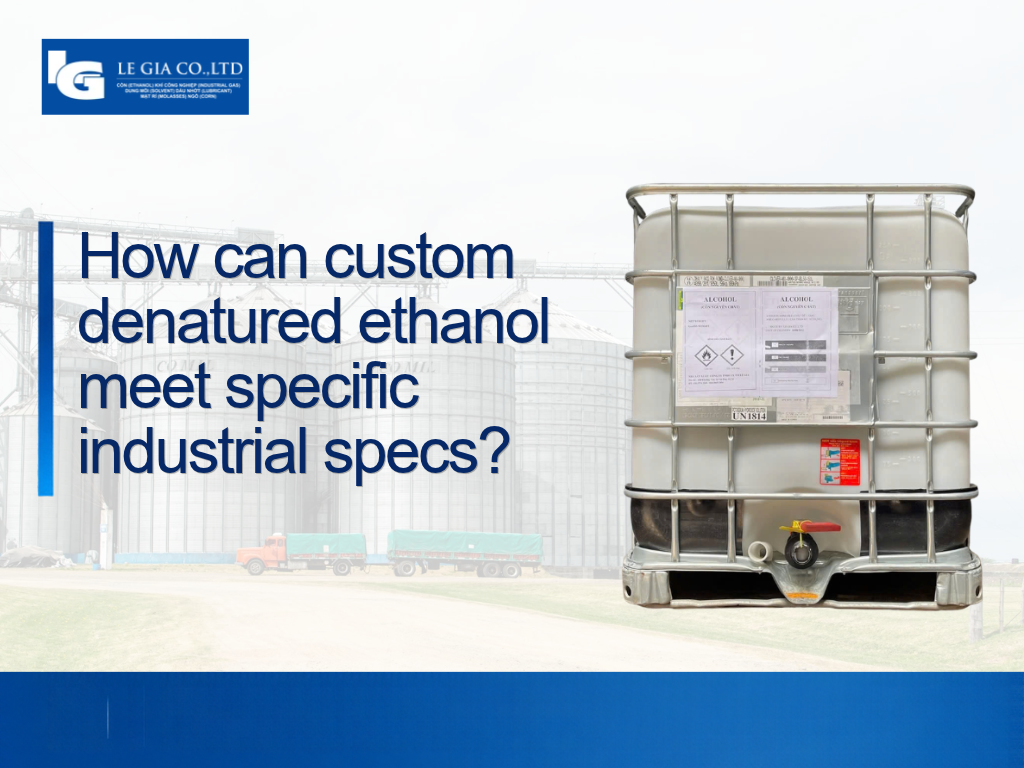
Not every application needs a pharmacopeial solvent. Many industrial processes need ethanol that is shaped to a particular formula, made unfit for drinking, and documented for the destination market.
That is where denatured ethanol comes in. It is the same base alcohol with approved additives, and the formula you choose should be driven by your end use and by the rules of the country where the product will be used.
What denaturing formulas are available for non-pharmaceutical use
Denaturing formulas are set by regulation, and the choices depend on the country of use. In the United States, regulators recognize two types of denatured spirits, completely denatured alcohol and specially denatured alcohol, and approve denaturants that make the spirits unfit for beverage or internal human medicinal use.
A concrete example is Formula 23-H, which USP’s Rubbing Alcohol monograph describes as 8 parts by volume of acetone, 1.5 parts by volume of methyl isobutyl ketone and 100 parts by volume of ethyl alcohol. TTB publishes the two rubbing alcohol formulas that start from that base, adding either sucrose octaacetate or denatonium benzoate.
Because rules differ by market, define the destination country and the end use first, then select the formula. A formula that is accepted in one country may not be accepted in another, and your supplier should be able to explain the regulatory basis for the one it proposes.
How does Le Gia customize denatured ethanol to client specifications
Our mission at Le Gia is to be a trusted specialist in ethanol denaturation, providing naturally sourced ethanol (up to 99.5% purity) and tailored formulations for complex industrial demands worldwide. Flexible blending to a customer’s exact specification is one of our core strengths, which saves clients the time of blending in-house.
In practice, the process starts with your target formula or functional requirement, such as odor, water tolerance or regulatory category. For every order, confirm the strength, the unit it is expressed in (volume or weight) and the target monograph on the specification sheet before you place the order.
Because we control production, trading and blending ourselves, changes to a formula can be handled without passing through several intermediaries. Ask us for a specification sheet and a COA for the formula you request, so that the documentation matches the batch you will receive.
Sourcing USP Ethanol from an Experienced Vietnamese Manufacturer
In ethanol procurement, most problems show up at the edges of the process: documentation, packaging, shipping and timing. A manufacturer with a long operating history has usually met those problems before you do, which means its routes and documents are more likely to be proven.
Le Gia is a bio-ethanol manufacturer with its own production facility in Vietnam. For 20 years we have specialized in ethanol denaturation and blending to customer specification, and our products are available in more than 10 countries and territories, including Taiwan, South Korea, Australia, Canada, Thailand, Laos, Cambodia, Indonesia, India and Singapore.
Experience is a strong signal, but it does not replace verification. Ask any supplier, including us, for references, a recent shipment file and a batch-specific COA tested against the monograph you require. Where your volume justifies it, add a site audit.
To make our first reply a real quotation rather than a list of questions, include the following in your enquiry:
- Monograph and proof: for example USP Alcohol or USP Dehydrated Alcohol
- Volume: annual and per-shipment, plus preferred packaging
- Destination: country and port or delivery address
- Documents: COA, safety data sheet, origin statement
- Timing: target delivery date
Pricing depends on grade, volume, packaging and destination, so we prepare each quotation individually. Delivery can start from 10 working days once your specification is confirmed.
Contact Le Gia: ethanol@legia.vn | (+84) 0908 769 151 | (+84) 028 3865 2804
108 Khuong Viet, Tan Phu Ward, Ho Chi Minh City | legia.vn
Frequently asked questions about USP ethanol procurement
The answers below are short by design. For jurisdiction-specific or regulatory decisions, confirm the details with your customs broker, regulator or qualified person.
Can USP ethanol be imported under tax-exempt industrial use programs
Eligibility is set by each country’s rules and by customs, so confirm it before ordering. As an example, TTB describes US tax-free alcohol as undenatured alcohol for non-beverage scientific and medicinal use by educational organizations, hospitals and laboratories, and that permit does not allow using it to make products for sale.
What storage conditions prevent USP ethanol degradation
Follow the safety data sheet and local flammable-liquid rules for the grade and packaging you receive, and ask your supplier for its written storage and handling instructions with the quotation.
How long is a USP ethanol COA valid for regulatory submission
A COA applies to the specific lot that was tested, and whether it is accepted for a submission is decided by the receiving regulator or customer. Ask your regulatory affairs team for their requirement, and ask the supplier for the lot’s retest or expiry date.