You sourced a batch of ethanol. The price looked right. The documentation seemed complete. Then your first production run came back with off-flavors, a solvent note in the finish, and a methanol reading that failed your QA threshold. The batch had to be destroyed.
This scenario is not rare. It happens when procurement teams treat ethanol as a commodity-interchangeable by price, rather than a precisely specified input. In beverage manufacturing, the ethanol grade you choose determines everything: flavor neutrality, regulatory compliance, batch consistency, and your brand’s reputation on shelf.
This guide is written for procurement managers, R&D leads, and master distillers sourcing Neutral Grain Spirit (NGS) for commercial beverage production. You will learn exactly what NGS is, how it differs from ENA, rectified spirit, and industrial ethanol, what impurity thresholds matter, what compliance standards apply across the EU, US, and Australia, and how to qualify a supplier before you place your first container order.
What Is Neutral Grain Spirit (NGS) and How Is It Produced?
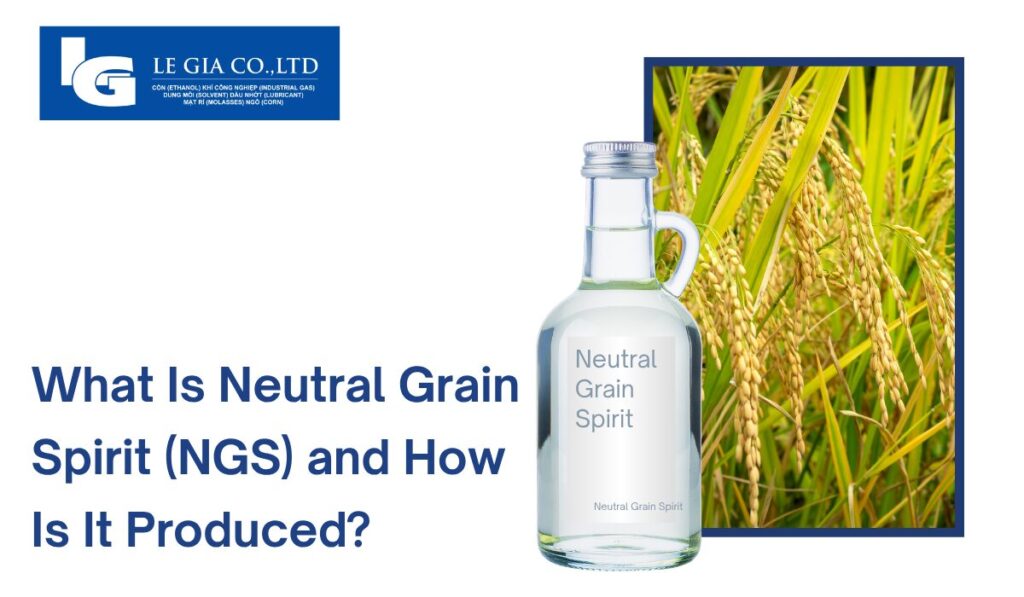
Neutral Grain Spirit (NGS) is a high-purity, grain-derived ethyl alcohol distilled to a minimum of 95% ABV, producing a liquid that is colorless, odorless, and virtually flavor-free. That sensory neutrality is the defining characteristic – and the primary reason NGS is the preferred ethanol base for vodka, gin, ready-to-drink (RTD) beverages, and liqueur production globally.
The production process begins with fermentation. Grain feedstock – typically corn, wheat, barley, or rye – is mashed, cooked, and fermented using yeast to convert sugars into a wash of roughly 8-12% ABV. That wash then passes through a multi-column continuous distillation system, where successive columns strip congeners, higher alcohols, and volatile impurities until the output reaches 95-96.5% ABV. The final stage – rectification – refines purity further by removing residual fusel oils and esters that would otherwise introduce flavor.
The result is an ethanol that carries no grain character of its own. That blank sensory profile allows downstream manufacturers to control flavor with precision — whether through botanical infusion (gin), dilution to bottling strength (vodka), or flavoring (liqueurs and RTDs).
ABV and purity are not interchangeable descriptors. A spirit reaching 95% ABV through a single-column distillation may still carry congener loads that exceed beverage thresholds. Multi-column rectification is what separates true NGS from a lower-grade high-proof spirit.
NGS is also sold under the term Grain Neutral Spirit (GNS), the two names refer to the same product category. Regional terminology varies, but specifications define the product, not the label.
What Grains Are Used to Make NGS?
The feedstock grain directly influences the organoleptic baseline of the NGS, even after full rectification. Most commercial producers use corn, wheat, barley, or rye – each with distinct implications for cost, regional availability, and sensory profile.
| Grain | Regional Dominance | Sensory Profile After Rectification | Cost |
|---|---|---|---|
| Corn | United States | Clean, slightly sweet base | Lower |
| Wheat | EU, Australia | Slightly creamy mouthfeel, smooth | Medium |
| Barley | EU, UK | Malty character possible at lower rectification | Medium |
| Rye | Eastern Europe | Spice notes can persist if rectification is incomplete | Medium-high |
| Cassava | Southeast Asia | Neutral, cost-competitive for export | Lower |
For vodka production, wheat and corn-based NGS are the most widely specified. Gin producers often prefer wheat-based NGS because the mouthfeel integrates more smoothly with botanical distillation. RTD brands sourcing at volume typically optimize for cost, making corn and cassava-derived NGS the most common base for that application.
For buyers sourcing from Vietnam or Southeast Asia, cassava-derived NGS is a commercially significant and cost-competitive option. Le Gia’s LGCS (Cassava) grade ethanol at 96% ABV meets beverage-grade impurity thresholds as demonstrated in its published COA – methanol at 32 ppm against a 100 ppm specification limit, acetaldehyde at 10 ppm against a 40 ppm limit.
Always request a COA that specifies the feedstock. “Grain-based” is not a sufficient disclosure for premium beverage applications.
What ABV and Proof Define Beverage-Grade NGS?
Beverage-grade NGS must reach a minimum of 95% ABV (190 proof) to qualify as a neutral spirit under US TTB standards, while EU Regulation 2019/787 sets the minimum at 96% ABV for Extra Neutral Alcohol (ENA). Below those thresholds, congener concentrations rise significantly, making the ethanol unsuitable for products that depend on flavor neutrality.
Key reference benchmarks:
- 95% ABV / 190 proof: regulatory minimum for neutral spirit classification in the US (TTB)
- 96% ABV: EU ENA minimum; also the typical commercial specification for export-grade NGS with a lower congener load than minimum-grade product
- 96.5% ABV: pharmaceutical-adjacent purity, used where downstream dilution and sensory requirements are most stringent
For buyers: specify minimum ABV on your purchase order and request COA confirmation per batch. Do not rely on a supplier’s general product specification alone.
How Does NGS Differ From ENA, Rectified Spirit, and Industrial Ethanol?
NGS, ENA (Extra Neutral Alcohol), and rectified spirit all refer to high-purity ethanol intended for beverage or food applications, but they are not interchangeable in every regulatory jurisdiction, and industrial ethanol is in a completely different category that cannot legally be used in beverage production.
The terminology problem is real. A procurement team in the EU will search for ENA. A US buyer will search for NGS or GNS. An Australian manufacturer may request neutral spirit or food-grade ethanol. Behind the regional labels, the core specification is similar – but the compliance documentation, permitted feedstocks, and impurity limits can differ meaningfully.
| Parameter | NGS (US/Global) | ENA (EU) | Rectified Spirit | Industrial Ethanol |
|---|---|---|---|---|
| ABV minimum | 95% | 96% | Typically 96%+ | Varies (can be lower) |
| Beverage permitted | Yes | Yes | Yes | No |
| Denaturant added | No | No | No | Often yes |
| Methanol limit | Per product spec (COA) | Max 30 mg/100ml pure alcohol (EU Reg 2019/787) | Varies by national standard | Not specified for food use |
| Key regulation | TTB 27 CFR 5 | EU Reg 2019/787 | National food standards | OSHA / REACH (industrial) |
| COA required | Yes | Yes | Yes | Not food-applicable |
The most dangerous substitution error occurs when a buyer unknowingly sources denatured industrial ethanol in place of beverage-grade NGS. Denatured ethanol contains chemical additives – methanol, isopropanol, bitrex – that are toxic at beverage consumption levels. Using denatured ethanol in a food or beverage product is a criminal offense in every major market.
Impurity thresholds are the real differentiator between grades. Two products can both reach 95% ABV but have vastly different congener loads. The COA, not the ABV figure is where you verify whether a product is genuinely beverage-grade.
Need a bulk NGS quote with full COA documentation? Contact Le Gia: (+84) 0908 769 151 or ethanol@legia.vn
Can GNS and NGS Be Used Interchangeably?
Yes, GNS (Grain Neutral Spirit) and NGS (Neutral Grain Spirit) are synonymous. The terms refer to the same product category. GNS is more commonly used in supplier documentation and trade contexts; NGS appears more frequently in beverage manufacturing specifications and US regulatory language.
The practical rule is: never qualify a product by its name alone. Always request and validate the COA against your specific impurity and ABV thresholds. A supplier calling their product “NGS” or “GNS” without accompanying documentation provides no verifiable quality assurance.
Which Ethanol Type Is Best for Vodka, Gin, or RTDs?
The right ethanol grade depends on the application’s flavor, regulatory, and cost requirements:
- Vodka: Highest-purity NGS, minimum 96% ABV. Wheat or corn base preferred. Any congener residue is detectable because vodka has no botanical or flavor masking.
- Gin: NGS at 96% ABV, grain-neutral to allow botanicals to express cleanly. The base spirit must not compete with the botanical charge. Wheat-based NGS preferred by many craft distillers.
- RTDs (Ready-to-Drink): Beverage-grade NGS at 95–96% ABV. Cost efficiency is a key driver. Cassava or corn base is viable. Compliance documentation still required even for flavored RTD formats.
- Liqueurs and cream liqueurs: Medium-grade food-grade ethanol acceptable if flavor contribution from added ingredients dominates. Verify regional compliance for the specific liqueur category.
- Alcohol-based flavoring extracts: Food-grade ethanol meeting national food safety standards. Le Gia’s food-grade ethanol (international standard) serves this application for F&B manufacturers.
What Specifications Should Beverage-Grade NGS Meet?
A beverage-grade NGS must meet minimum purity and impurity thresholds across at least eight parameters — ABV, methanol, higher alcohols, aldehydes, esters, acidity, color, and sensory profile — before it can legally enter food and beverage production.
Specifications exist to protect both product quality and consumer safety. The most dangerous impurity is methanol – a neurotoxin that cannot be removed from a finished beverage after blending. The most commercially disruptive impurities are fusel oils (higher alcohols) and aldehydes, which create harsh, solvent-like sensory notes that no filtration step can fully correct downstream.
Below is a reference specification framework for beverage-grade NGS, based on Le Gia’s published LGCS (Cassava) Certificate of Analysis (February 2026). Use this to evaluate COAs from any prospective supplier.
| Parameter | Unit | Spec Limit | Le Gia LGCS Result | Test Method |
|---|---|---|---|---|
| Alcohol strength at 20°C | % V/V | Min 95 | 96.0 | ASTM D4052 |
| Appearance | – | Clear & bright | Clear & bright | – |
| Color (Pt-Co) | – | Max 10 | <5.0 | ASTM D1209 |
| Acids (as acetic acid) | mg/L | Max 50 | 8.6 | ASTM D1613 |
| pH | – | 6.6–7.6 | 7.4 | ASTM D4623 |
| Water content | % Vol | Max 5.5 | 4.6 | ASTM E203 |
| Ethyl acetate | ppm | Max 100 | 15.0 | GC |
| Acetaldehyde | ppm | Max 40 | 10.0 | GC |
| Methanol | ppm | Max 100 | 32.0 | GC |
| Isopropanol | ppm | Max 1000 | 130.0 | GC |
Le Gia’s COA results fall well within specification limits, not just at the threshold but with significant margin, indicating consistent process control.
The margin between result and limit matters as much as the result itself. A methanol reading of 98 ppm against a 100 ppm limit is technically compliant but represents minimal process headroom. A reading of 32 ppm indicates meaningful quality control buffer – important for batch-to-batch consistency over a long supply relationship.
What Impurity Thresholds Matter for Spirit Production?
Each impurity class affects the final spirit differently. Understanding the mechanism helps you prioritize which parameters to scrutinize first on a COA:
- Methanol (max 100 ppm in Le Gia’s product spec; max 30 mg/100ml pure alcohol under EU ENA standard): Toxic at consumption levels. Cannot be reduced in the finished product. Le Gia result: 32 ppm.
- Higher alcohols / fusel oils: Cause harsh, burning, solvent-like flavor in the finished spirit. Survive dilution and filtration. Most common quality complaint from distillers using substandard ethanol.
- Acetaldehyde (max 40 ppm in Le Gia spec): Produces green-apple, solvent, and sharp chemical aromas. Detectable at very low concentrations in neutral spirits. Le Gia result: 10 ppm.
- Ethyl acetate (max 100 ppm in Le Gia spec): At low levels, adds a neutral ester note. Above threshold, contributes nail-varnish off-aromas. Le Gia result: 15 ppm.
- Acidity as acetic acid (max 50 mg/L in Le Gia spec): Indicates microbial contamination during fermentation or storage. Le Gia result: 8.6 mg/L.
- Isopropanol (max 1000 ppm in Le Gia spec): Solvent-like, bitter. Le Gia result: 130 ppm.
When reviewing a COA, check the test method column. Credible results reference ASTM standards (D4052 for ABV, D1209 for color, D1613 for acidity, D4623 for pH, E203 for water content) or GC (gas chromatography) for volatile organic compounds. Absence of test method references on a COA is a red flag.
What Documentation Should a Supplier Provide (COA, SDS)?
Every commercial shipment of beverage-grade NGS must be accompanied by a minimum of three documents: Certificate of Analysis (COA), Safety Data Sheet (SDS), and proof of applicable food-grade certification.
Documentation checklist for procurement teams:
- COA (Certificate of Analysis): Batch-specific test results against specification limits. Must include test method references. Should be issued per shipment, not reused across batches.
- SDS (Safety Data Sheet): Handling, storage, transport, and emergency response information. Required for hazardous goods classification (ethanol is UN 1170, Class 3 flammable liquid, Packing Group II).
- Food-grade certification: GMP certificate, ISO 9001:2015 (quality management). Le Gia holds GMP and ISO 9001:2015 certifications for the manufacturing and trading of ethanol alcohol. ISO 13485:2016 is also held for medical-grade ethanol.
- Origin certificate: Required for customs clearance and tariff purposes in most import markets.
- Kosher / Halal certificate: Required if your end market or retailer mandates this.
- Traceability records: Feedstock origin declaration, production batch number linkage.
What Mistakes Happen When Using Substitute Ethanol in Alcohol Production?
The five most costly substitution mistakes in commercial spirit production all stem from the same root cause: treating ethanol as a fungible commodity rather than a precisely specified ingredient.
Consider an illustrative scenario common in the contract manufacturing space. A beverage brand sources ethanol from a new supplier offering a price reduction. The product arrives with a COA showing 95% ABV. What the COA does not show, because the buyer did not request it – is that fusel oils exceed safe thresholds. The first two production batches pass internal QA at diluted ABV. Consumer complaints begin arriving two weeks after market launch: “harsh finish”, “chemical burn”, “not smooth.” The brand pulls the product, reformulates, and loses weeks of production.
The direct cost: batch destruction, reformulation, and delayed launch. The indirect cost: brand perception takes months to recover.
The 5 most common substitution mistakes:
- Using industrial or denatured ethanol: Contains denaturing agents (methanol, isopropanol, bitrex) that are toxic in beverages. Illegal in every market. Can result in product seizure, recall, and criminal liability.
- Ignoring methanol content: Relying on ABV specification without requesting GC-based impurity data. Methanol cannot be tasted or smelled at levels that still create health risk.
- Overlooking fusel oil thresholds: Accepting a COA that does not specify higher alcohol content. Fusel oils are the primary cause of “hot” or “harsh” spirit character.
- Inadequate supplier vetting: Accepting a supplier’s general specification sheet in place of per-batch COA data. Specifications describe what the supplier targets; COAs confirm what they actually shipped.
- Cost-cutting with uncertified sources: Sourcing from brokers or traders who cannot provide manufacturer-direct documentation or traceability back to the production facility.
How Does Wrong Ethanol Affect Flavor, Odor, and Compliance?
Wrong ethanol creates three categories of damage simultaneously: sensory failure, compliance failure, brand failure, and they arrive in that order.
Flavor impact: Fusel oils and higher alcohols produce a harsh, burning sensation on the mid-palate that no amount of filtration, carbon treatment, or dilution can fully eliminate once blended into the finished spirit. Acetaldehyde contributes a sharp, green-apple or solvent character that trained tasters identify immediately. These notes persist through dilution to bottling strength.
Odor impact: Sulfur compounds – present when fermentation hygiene is poor, create a rotten-egg note detectable at very low concentrations. Elevated ethyl acetate produces a nail-varnish aroma. Both are unacceptable in any neutral spirit application.
Compliance impact: If your finished product fails TTB, EU, or FSANZ (Food Standards Australia New Zealand) chemical analysis at import inspection, the entire shipment may be refused entry, held in bond, or destroyed. Re-exporting is often not permitted. The direct financial loss is the value of the shipment; the indirect loss is the importer-of-record relationship.
For RTD brands and private-label distillers, the downstream cost of a single non-compliant ethanol batch can far exceed the price difference between premium and economy-grade ethanol sourcing.
What Are the Regulatory Risks of Using Non-Beverage-Grade Ethanol?
Using non-beverage-grade ethanol in food or beverage production exposes your company to product recall, import refusal, regulatory fines, license suspension, and – in methanol contamination cases – criminal prosecution.
Regulatory consequences by severity:
- Product seizure and destruction: Regulatory agencies (TTB, FSANZ, EU customs) have authority to seize shipments that fail specification at the border or in post-market surveillance.
- Recall orders: If non-compliant product reaches retail, mandatory recalls create significant financial and reputational damage.
- Fines and license revocation: Penalties vary by jurisdiction and violation type.
- Criminal liability: In cases involving methanol contamination that causes consumer harm, criminal prosecution of company officers has occurred in multiple jurisdictions including Southeast Asia and Eastern Europe.
- Brand damage: A recall event tied to ethanol quality can result in extended periods of reduced consumer trust, affecting reorder rates and distribution partner relationships.
The risk-adjusted cost of buying certified, documented, beverage-grade ethanol from a qualified supplier is consistently lower than the potential cost of these compliance failure scenarios.
How Do EU, US, and Australia Compliance Standards Differ for NGS?
The EU, US, and Australia each maintain distinct regulatory frameworks for beverage-grade ethanol, with different terminology, impurity limits, labeling requirements, and testing protocols – a supplier that complies in one market may not automatically comply in another.
| Compliance Dimension | EU | US | Australia |
|---|---|---|---|
| Primary regulation | EU Reg 2019/787 | TTB 27 CFR 5 | FSANZ Food Standards Code |
| Term used | ENA (Extra Neutral Alcohol) | Neutral Spirits / GNS | Neutral Spirit / Food-Grade Ethanol |
| Min ABV | 96% | 95% (190 proof) | 95% |
| Methanol limit | Max 30 mg/100ml pure alcohol | Per TTB regulations [VERIFY] | FSANZ Standard 2.7.1 [VERIFY] |
| Feedstock disclosure | Required on label for claims | “Grain spirits” or “neutral spirits” | Source declaration if premium claimed |
| Non-GMO / Organic | Mandatory GMO disclosure | Voluntary | Voluntary |
| Testing frequency | Per batch recommended | Per batch required for import | Per batch for import clearance |
| Key documentation | EU health certificate, COA, SDS | TTB-compliant COA, CBP import forms | FSANZ compliance statement, COA, SDS |
The most significant practical difference for international suppliers is the EU’s methanol limit. The EU ENA standard (EU Reg 2019/787) sets a maximum of 30 mg per 100 ml of pure alcohol – a measurement expressed relative to the absolute alcohol content of the product, not the product volume. Always confirm your supplier’s COA reports methanol in a unit that allows direct comparison with this limit.
For brands selling simultaneously into EU and non-EU markets, specify the EU ENA methanol limit (30 mg/100ml pure alcohol) on all purchase orders. This creates a single, stricter specification that reduces compliance risk across multiple destination markets.
What Labeling and Origin Requirements Apply by Region?
Labeling and origin requirements vary significantly across regions and affect both the supplier’s documentation obligations and the beverage manufacturer’s product claims.
- Grain type must be declared if used as a marketing claim (e.g., “wheat vodka”)
- Country of origin of the agricultural raw material must be disclosed on request
- GMO status must be declared for feedstocks containing GMO-derived material
- ENA classification must appear on customs and health certificates
US requirements:
- “Neutral spirits” or “grain spirits” designation on the label
- “Made from [grain type]” is permitted but not required unless making a specific claim
- Country of origin declaration required for imports
- TTB Certificate of Label Approval (COLA) required before market entry
Australia requirements:
- Country of origin declaration required on consumer packaging
- If premium grain claim is made, feedstock documentation must support it
- FSANZ compliance required; importers bear responsibility for verifying supplier compliance
- Health certificate from country of origin required for ethanol imports
For beverage manufacturers exporting to multiple markets, align your supplier’s documentation capabilities with all target market requirements before signing a supply agreement.
How Should Beverage Manufacturers Evaluate and Qualify NGS Suppliers?
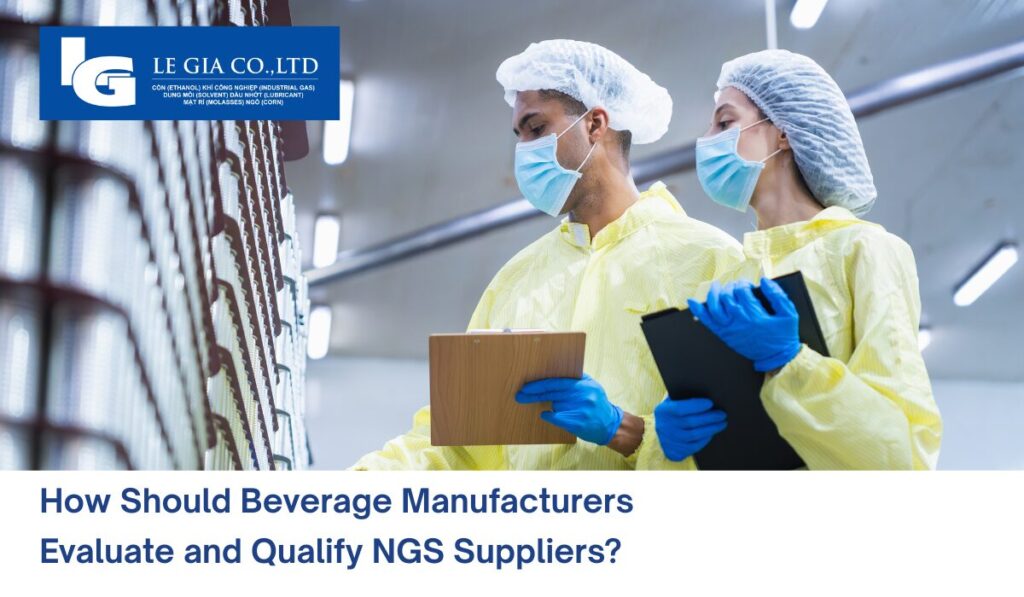
Qualifying an NGS supplier requires a structured five-stage evaluation: certifications audit, production capacity confirmation, sample testing with independent lab verification, logistics and documentation review, and commercial terms alignment.
Most procurement failures in ethanol sourcing happen at stage three – teams skip independent lab verification and rely solely on the supplier’s own COA. An independent test on your received sample against your specification is the only verification that confirms what you are actually receiving, not what the supplier claims to ship.
Five-stage supplier qualification process:
- Certifications audit: Verify GMP, ISO 9001:2015, and any food-grade certifications are current. Request certificate copies with expiry dates. Confirm the certification body is accredited.
- Production capacity confirmation: Confirm the supplier manufactures directly rather than trading ethanol from unknown sources. Request facility registration documents or production license. Ask for annual capacity and current utilization rate.
- Sample testing: Request a pre-commercial sample. Submit to an accredited third-party laboratory for full impurity panel analysis before placing a container order.
- Logistics and documentation review: Confirm the supplier can issue all required export documentation: COA, SDS, certificate of origin, health certificate, and packing declaration. Verify experience with Incoterms relevant to your import arrangement (CIF, FOB, DAP).
- Commercial terms alignment: Confirm MOQ, pricing structure, payment terms, and lead time by destination. For long-term supply relationships, discuss pricing review mechanisms tied to feedstock commodity indices.
What Procurement Checklist Ensures Supply Consistency?
Use this checklist for every new supplier evaluation and as an annual vendor review framework for existing suppliers:
Documentation:
- COA received and reviewed against specification for each shipment?
- SDS current and compliant with GHS classification?
- Food-grade certification valid and from accredited body?
- Certificate of origin available for customs?
- Kosher/Halal certificate (if required by market)?
Quality:
- Independent lab test conducted on pre-commercial sample?
- COA test methods reference ASTM or equivalent published standards?
- Methanol result reviewed against both product spec and EU ENA limit (30 mg/100ml pure alcohol)?
- Fusel oil and higher alcohol results confirmed on COA?
- Batch-to-batch variation reviewed across at least 3 consecutive shipment COAs?
Logistics:
- Packaging type confirmed (drums, IBC totes, ISO tanks — appropriate for your operations)?
- Lead time from order to arrival at your facility confirmed?
- UN 1170 hazmat shipping compliance confirmed?
- Insurance coverage for transit loss or contamination in place?
Compliance:
- Supplier documentation satisfies all target market import requirements?
- Backup supplier identified for supply continuity?
Why Does Export Capability and Bulk Packaging Matter?
Export-capable NGS suppliers provide more than product, they provide the documentation infrastructure, logistics coordination, and packaging formats that determine whether your supply chain operates smoothly or stalls at customs.
Export capability encompasses:
- Experience with multi-country export documentation requirements
- Relationships with accredited freight forwarders for hazardous goods (Class 3 flammable liquid)
- Ability to issue health certificates, certificates of conformity, and destination-specific compliance statements
- Familiarity with Incoterms and ability to support CIF, FOB, and DAP arrangements
Bulk packaging options matter because they directly affect per-liter cost and operational efficiency:
| Packaging Format | Best Application | Key Consideration |
|---|---|---|
| 200L drums | Small batch, trial orders | Higher per-liter handling cost |
| IBC totes | Mid-volume production | Efficient for regular replenishment cycles |
| ISO tanks | High-volume production, export | Lowest per-liter cost; requires dedicated unloading infrastructure |
For international buyers, larger-format packaging is the most cost-effective option for high-volume shipments. Always request a tank cleaning certificate before accepting a bulk shipment to verify the vessel was properly inspected before filling.
Why Is Le Gia a Trusted Neutral Grain Spirit Supplier for Global Markets?
Le Gia has manufactured and exported high-purity ethanol since 2001 – over 20 years of continuous production experience with a current annual capacity of 12 million liters and active export to more than 10 countries including Japan, South Korea, Taiwan, Australia, and Canada.
That operational track record matters in ethanol sourcing because consistency is the hardest quality attribute to verify from a COA alone. A supplier that has maintained production across two decades, through raw material supply disruptions and demand cycles, has demonstrated the operational resilience that matters for long-term supply relationships.
Le Gia’s documented differentiators:
- GMP certified for manufacturing and trading of ethanol alcohol (Guardian Independent Certification Ltd, Certificate No. N711875)
- ISO 9001:2015 quality management system for ethanol manufacturing and trading
- ISO 13485:2016 medical device quality management standard — applicable for medical-grade ethanol supply
- VietCert food-grade certification for ethanol under QCVN 6-3:2010/BYT (Vietnamese food safety regulation)
- 12 million liters/year production capacity — sufficient for large beverage manufacturers and contract distillers requiring annual volume commitments
- Delivery from 10 working days on standard orders via full supply chain control (production → trading → blending)
- Export experience across Asia-Pacific, plus Australia and Canada — with established freight forwarding relationships for hazardous goods
Clients include major F&B and industrial groups: Ajinomoto, Nutifood, CP Group, Acecook, Nippon Paint, and Siegwerk.
Request a sample COA and pricing now: ethanol@legia.vn
What Production Capacity and Export Experience Does Le Gia Offer?
Le Gia produces 12 million liters of ethanol annually across food-grade, medical-grade, industrial, and denatured product lines, with established export logistics to more than 10 markets across Asia-Pacific and beyond.
Production and export specifics:
- Annual capacity: 12,000,000 liters ethanol/year
- Export markets: Japan, South Korea, Taiwan, Australia, Canada, Thailand, Laos, Cambodia, Indonesia, India, Singapore
- Standard delivery: from 10 working days on domestic and regional orders
- Certifications covering export documentation: COA, SDS, certificate of origin, food-grade certification
For beverage manufacturers sourcing from Southeast Asia, Le Gia’s established export experience — including hazardous goods freight coordination and multi-country compliance documentation — reduces a significant sourcing risk. Many ethanol producers in the region have production capability but limited export infrastructure. Le Gia manages both ends of the supply chain.
How Does Le Gia Customize Ethanol Specifications for Clients?
Le Gia’s core commercial specialty is custom ethanol formulation and denaturation — blending ethanol to each client’s exact specification, including ABV level, denaturant type, and packaging format — a capability that extends to beverage-grade NGS specification adaptation.
Customization capabilities:
- Custom ABV: Ethanol supplied at specified concentrations, with COA confirming the exact measured strength per batch
- Denatured ethanol specialty: Le Gia formulates custom denaturation formulas for industrial, cosmetics, and pharma clients — with purity up to 99.5% — useful for brands that need denatured ethanol for non-beverage applications alongside food-grade supply
- Cassava-derived food-grade ethanol (LGCS grade): Documented with full COA and traceability, compliant with international food-grade standards
- Packaging flexibility: Drums and bulk tank formats — selection based on buyer’s operational requirements and volume
- Documentation support: COA, SDS, and certification documentation provided per shipment
For private-label beverage brands, craft distilleries scaling production, and contract manufacturers handling multiple client specifications, Le Gia’s flexibility in both product specification and documentation reduces procurement complexity.
Ready to Source Beverage-Grade NGS? Request a Quote Today
Your ethanol specification is not a detail — it is a production decision that affects every batch, every consumer experience, and every compliance audit your brand will face. The difference between a supplier who provides a general specification sheet and one who delivers per-batch COA data, certified documentation, and over 20 years of export experience is not a commodity price gap. It is a risk management decision.
Le Gia supplies beverage-grade ethanol at 12 million liters per year capacity, with GMP and ISO certification, full export documentation, and delivery from 10 working days on standard orders.
Next steps to begin sourcing:
- Contact Le Gia to discuss your volume requirements and target specification
- Request a sample COA showing full impurity panel results
- Submit the sample to your internal or third-party lab for verification
- Confirm packaging format, Incoterms, and lead time for your destination
- Place a trial order to validate batch-to-batch consistency before committing to annual volume
Contact Le Gia:
- Email: ethanol@legia.vn
- Phone: (+84) 0908 769 151
- Website: legia.vn
FAQ
Is Neutral Grain Spirit the Same as Grain Neutral Spirit?
Yes — Neutral Grain Spirit (NGS) and Grain Neutral Spirit (GNS) are synonymous terms referring to the same product: high-purity, grain-derived ethyl alcohol distilled to a minimum of 95% ABV for beverage applications. The term NGS is more common in US beverage industry and regulatory contexts; GNS appears frequently in supplier and trade documentation. The terminology difference is regional preference only. Always verify the actual specification — ABV, methanol, fusel oil content — from the COA rather than relying on the product name as a quality indicator.
Can NGS Be Used for Pharmaceutical or Cosmetic Applications?
NGS can be suitable for cosmetic applications if it meets the relevant national food-grade or cosmetic-grade ethanol standard. Pharmaceutical applications require stricter compliance — typically USP (United States Pharmacopeia) or EP (European Pharmacopoeia) grade certification, with tighter limits on specific impurities than food-grade NGS standards. Le Gia holds ISO 13485:2016 certification and produces a dedicated medical-grade ethanol product line for pharmaceutical-adjacent applications. Always confirm with your supplier that the specific grade supplied meets the regulatory standard required for your product category and target market.
What Is the Minimum Order Quantity for Bulk NGS Supply?
Minimum order quantities vary by supplier and packaging format. Contact Le Gia directly at ethanol@legia.vn to discuss MOQ options for your target volume and destination market. For buyers new to a supplier, a trial order with independent lab verification is strongly recommended before committing to full container volumes. Per-liter unit cost decreases at higher volumes, making bulk ordering cost-effective for manufacturers with consistent demand.
How Long Does International NGS Shipping Typically Take?
International NGS shipping lead time depends on destination and transport mode. From Vietnam (Le Gia’s production base), ocean freight transit to Japan and South Korea typically takes 5–10 days, Taiwan 3–5 days, and Australia 10–18 days. Add time for export documentation processing and customs clearance at destination. Le Gia’s standard delivery commitment from order confirmation is 10 working days for domestic and short-haul regional orders. For international shipments, plan procurement cycles well in advance, especially for inaugural orders where documentation review may add processing time.