What are the critical requirements for industrial ethanol storage and handling? Safe management of Ethanol requires strict compliance with ISO 45001:2018 and NFPA 30 codes.
Essential protocols include: (1) Utilizing Class I, Division 1 explosion-proof electrical systems, (2) Implementing mechanical lower-level ventilation, (3) Mandatory “Bonding and Grounding” during transfer, and (4) Storing in fire-rated zones with secondary containment. With 20 years of expertise supplying leaders like Acecook and Ajinomoto, Le Gia provides premium industrial ethanol that meets global safety benchmarks, ensuring zero-risk operations for your facility in 2026.
Key Takeaways for HSE Managers:
- Flash Point: 13°C (55°F) – Requires temperature-controlled storage.
- LEL/UEL: 3.3% – 19% – Vapor detection sensors are mandatory.
- Storage: Use Stainless Steel or HDPE; avoid PVC.
- Compliance: Always maintain an accessible 16-section GHS SDS.
Why is Proper Ethanol Storage a Critical Priority?
What are the primary risks of improper handling?
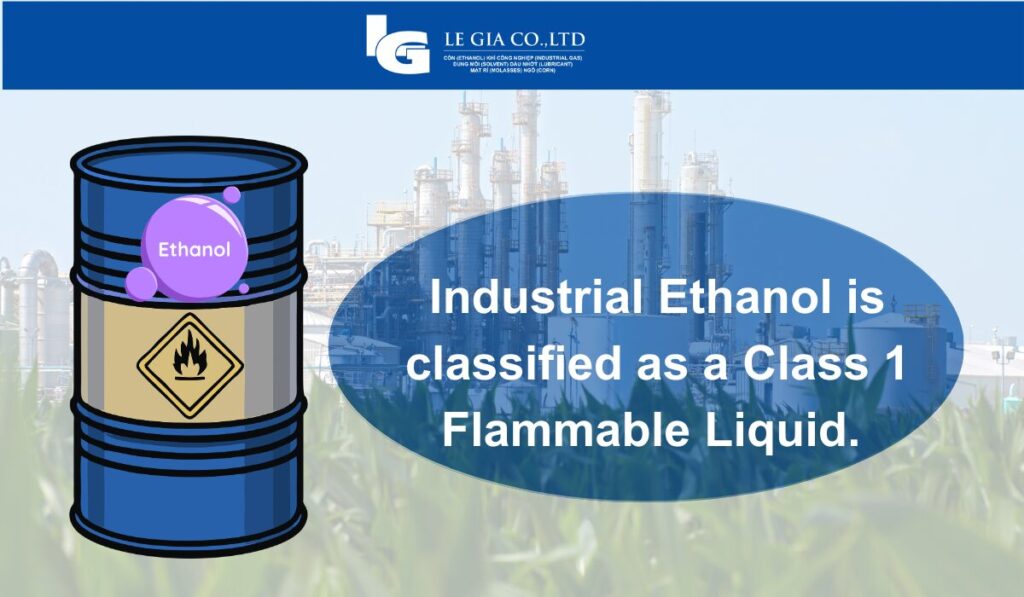
Industrial Ethanol is classified as a Class 1 Flammable Liquid. Unlike other chemicals, its dangers are often invisible to the naked eye, leading to a false sense of security in the workplace.
- Vapor Density Hazard: Ethanol vapors are 1.5 times heavier than air. They do not dissipate upward; instead, they “crawl” along the floor and can pool in pits or drains, creating an invisible explosion path far from the source.
- The “Invisible Flame”: Pure ethanol burns with a pale blue flame that is virtually invisible in bright sunlight. Workers may not realize a fire has started until they feel the heat, making early detection systems vital.
Ethanol vs. Methanol: Which poses a higher toxic risk?
While Ethanol is primarily a fire hazard, many industrial blends contain Methanol as a denaturant. Methanol is a potent neurotoxin that can cause blindness or death. Proper storage and handling protocols at Le Gia ensure that denatured blends are clearly labeled to prevent accidental inhalation or skin absorption.
What International Standards Govern Ethanol Handling?
To achieve “Top Tier” safety status and pass international audits, factories must adopt these benchmarks:
- NFPA 30: The global gold standard. It limits “Maximum Allowable Quantities” (MAQ) per control area and dictates the fire-resistance rating of storage cabinets.
- TCVN 5507:2002: (For Vietnam-based operations) Specifies requirements for distance, lightning protection, and spill dikes.
- GHS Labeling: Every drum must display the “Flame” and “Exclamation Mark” pictograms under the Globally Harmonized System.
What are the Technical Requirements for Safe Storage?
1. How should ventilation and atmosphere be controlled?
Standard AC units are insufficient. Storage areas must feature forced-air mechanical ventilation. Because vapors settle low, exhaust intakes must be located within 12 inches (30 cm) of the floor. Systems must maintain vapor levels below 25% of the Lower Explosive Limit (LEL).
2. Why are explosion-proof electrical systems mandatory?
Standard lighting, switches, and forklifts generate micro-sparks. In an ethanol-rich atmosphere, these are ignition sources. All hardware must be Class I, Division 1 or 2 rated. This includes using sealed conduit and “Intrinsically Safe” handheld devices.
3. How do you implement the “Bonding and Grounding” protocol?
Static electricity is the #1 cause of fires during liquid transfer.
- Bonding: Physically connecting the source drum to the receiving container with a wire to equalize electrical potential.
- Grounding: Connecting the entire system to the earth’s “ground” to bleed off accumulated charges.
- Personal PPE: Personnel should wear 100% cotton or specialized ESD-rated clothing. Synthetic fabrics (polyester/nylon) are prohibited as they generate high static.
How to Manage Emergency Response and Spill Control?
What are the steps for an Ethanol spill?
Never use water to wash a spill into a public drain. This only spreads the flammable hazard.
- Stop the Leak: Only if specialized PPE is worn.
- Eliminate Ignition: Prohibit all electronic use and hot work within 50 feet (15m).
- Absorb: Use inert, non-combustible sorbents like vermiculite, dry sand, or specialized pillows.
- Dispose: Treat as “Hazardous Waste” per local environmental regulations.
Which fire suppression systems are effective?
Standard water sprinklers may fail as Ethanol is water-soluble. Use Alcohol-Resistant Aqueous Film-Forming Foam (AR-AFFF) or large-scale CO2 extinguishers. These work by “smothering” the oxygen supply rather than cooling the fuel.
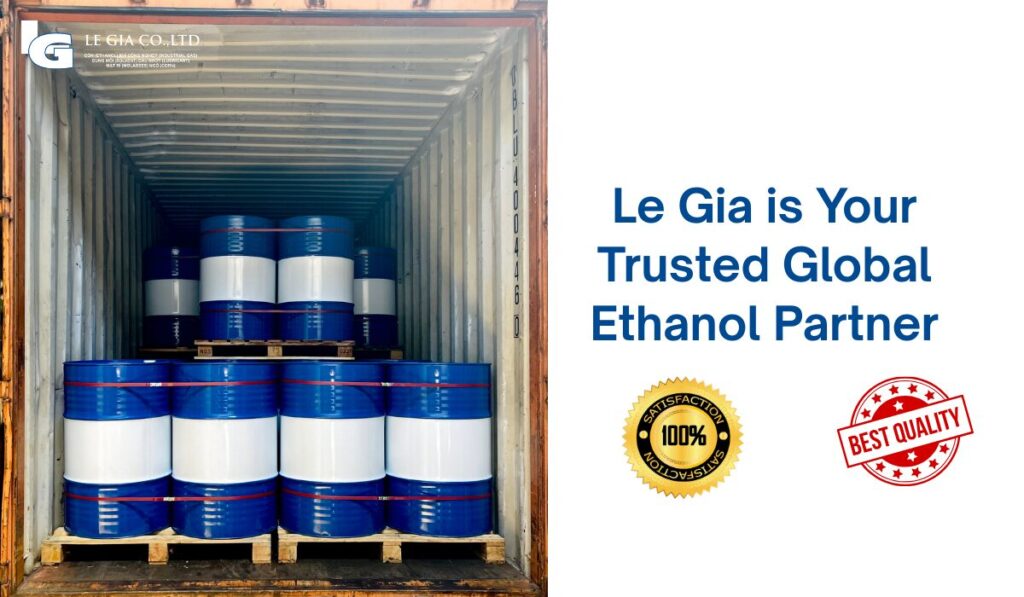
Why Le Gia is Your Trusted Global Ethanol Partner
At Le Gia, we don’t just supply chemicals; we provide a foundation for your factory’s safety and sustainability.
- Certified Quality: Our ISO 9001:2015 production ensures your ethanol is free from reactive contaminants.
- Global Reach: Serving 10+ countries including Australia, Canada, and South Korea.
- Lean Logistics: We deliver within 10 working days, allowing you to maintain lower inventory levels and reduce onsite fire load.
- Expert Documentation: Every shipment includes a Certificate of Analysis (COA) and a detailed GHS-compliant SDS.
Upgrade your industrial solvent supply chain today: Contact Le Gia at (+84) 0908 769 151 or visit legia.vn to consult with our chemical safety experts.
FAQ: Industrial Ethanol Storage and Handling
1. What is the safest container for bulk ethanol?
Stainless Steel (304/316) or HDPE (High-Density Polyethylene) drums are the industry standard. Avoid PVC and regular rubber gaskets, as ethanol can dissolve them, causing catastrophic leaks.
2. Can I store ethanol near other industrial chemicals?
No. Ethanol must be segregated from Strong Oxidizers (Nitric Acid, Peroxides) and Compressed Gases. Always consult Section 10 (Stability and Reactivity) of your Le Gia SDS for a full list of incompatible materials.
3. Does Le Gia provide custom denatured formulations?
Yes. We specialize in engineering tailored Denatured Ethanol blends (using IPA, Methanol, or MEK) that meet your specific production needs while ensuring your facility remains within safety compliance.