A sanitizer grade ethanol supplier is a manufacturer able to supply ethanol meeting the purity, documentation and traceability requirements of alcohol-based hand rub production – typically 95% v/v or higher, with methanol controlled to a defined ppm limit, supported by a batch-specific Certificate of Analysis, a current 16-section Safety Data Sheet and an auditable quality management system.
Choose one by verifying four things in order: the specification limits (not just the reported test results), the certificate scope and validity dates, the destination-market regulatory pathway (FDA OTC monograph, EU Biocidal Products Regulation Product-Type 1, or the local equivalent), and the supplier’s ability to hold that specification across repeat batches.
“Sanitizer grade” is not a pharmacopoeial designation. The contract, not the label, defines what you actually receive.
Introduction
Every procurement manager who has sourced ethanol for sanitizer production knows the same quiet fear. The first shipment tests beautifully. The third arrives with a different odour, a slightly different evaporation profile, and a Certificate of Analysis that looks suspiciously like a photocopy of the first one.
Nothing on paper has changed. Everything on the production line has.
This is the real risk in ethanol sourcing, and it is almost never the risk buyers screen for. Most RFQ processes optimise for price per litre and lead time. Very few interrogate the two questions that actually predict failure: what are the supplier’s specification limits, and what happens when a batch drifts toward them.
Four criteria separate a reliable sanitizer grade ethanol supplier from a broker with a warehouse:
- Specification transparency: published upper limits for methanol, acetaldehyde, higher alcohols and water, not merely a favourable one-off result.
- Documentation integrity: batch-specific COAs traceable to a named analytical method, plus an SDS revised within the last three years.
- Certified process control: a quality management system whose certification scope covers ethanol manufacturing, evidenced by in-date certificates from an accredited body.
- Structural supply capacity: production volume and packaging formats that make your annual requirement a routine order rather than a stretch.
The rest of this guide turns each criterion into a procurement-ready check.
What makes a supplier truly sanitizer grade ethanol compliant
Here is the uncomfortable opening truth: there is no regulatory grade called “sanitizer grade” anywhere in the world.
The United States Pharmacopeia publishes an Alcohol monograph. The European Pharmacopoeia publishes Ethanol (96 per cent). The US FDA regulates the finished hand rub through its over-the-counter antiseptic framework. Vietnam regulates food alcohol through QCVN 6-3:2010/BYT. None of them defines “sanitizer grade.” The phrase is procurement shorthand invented by buyers, and it means whatever the supplier on the other end of the email decides it means.
That ambiguity is where sourcing failures are born. Two suppliers can both answer “yes, this is sanitizer grade” while offering products that differ by an order of magnitude in impurity load.
Compliance in practice is therefore built from three layers:
- Input quality: the ethanol must meet a written specification with numeric limits. The WHO guide to local production of handrub formulations is explicit that only pharmacopoeial quality reagents should be used, and specifically not technical grade products.
- Process control: the ethanol must be produced under a certified quality system whose scope actually names ethanol manufacture.
- Market pathway: the finished sanitizer must satisfy the destination regulator, and the ethanol you buy must be capable of supporting that claim.
Red flags that a supplier is not genuinely compliant
- A generic, undated COA reused across batches
- Results reported with no stated method – no ASTM, no GC, no pharmacopoeial reference
- Refusal to disclose specification limits, offering only the latest results
- Certification logos displayed without certificate numbers or issuing bodies
- A claim of “USP grade” unsupported by a full organic-impurities profile
- Marketing copy that contradicts the supplier’s own technical annexes
That last point deserves emphasis. If marketing claims “less than 10 ppm total impurities” while the COA reports isopropanol at 130 ppm, the discrepancy is not a rounding error. It is a documentation control failure, and an auditor will treat it as one.
Sanitizer-use ethanol compared with general industrial ethanol
| Attribute | Sanitizer-use ethanol | General industrial ethanol |
| Typical strength | 95% v/v or higher, commonly 96% | 92–99.9%, application-dependent |
| Methanol control | Critical; specification-limited and batch-tested | Often uncontrolled or loosely limited |
| Documentation | Batch COA + SDS + certification pack | SDS often sufficient |
| Denaturant | Only regulator-approved formulas, if any | Any cost-effective denaturant |
| Traceability | Feedstock and batch traceable | Rarely required |
| End-use liability | Human skin contact; recall exposure | Process solvent; low consumer exposure |
The decisive row is methanol. It is the one impurity in ethanol that has caused documented fatalities through sanitizer use, and it is the one every serious buyer must specification-limit in writing.
Which certifications should sanitizer ethanol suppliers provide
Certifications are not trophies. Each answers a different auditor question, and a certificate that answers the wrong question is worth nothing to your dossier.
| Certification | What it actually proves | Procurement relevance |
| ISO 9001:2015 | Documented, audited quality management system | Baseline – process repeatability |
| ISO 13485:2016 | QMS appropriate to medical device manufacture | High – signals medical-adjacent discipline |
| GMP | Manufacturing conforms to Good Manufacturing Practice | High – often expected for sanitizer inputs |
| QCVN 6-3:2010/BYT conformity (Vietnam) | Food alcohol meets Vietnam’s national regulation for alcoholic beverages | Medium – a food-safety purity signal, not a sanitizer approval |
| Halal / Kosher | Feedstock and process meet dietary law | Market-specific (Middle East, ASEAN, Israel) |
| Certificate of Origin (Form D, Form AJ) | Country of origin for tariff preference | High — directly affects landed cost |
Lê Gia’s documented certification set covers ISO 9001:2015 (Certificate No. 764694), ISO 13485:2016, GMP (Certificate No. N711875, issued by Guardian Independent Certification Ltd) and VietCert conformity to QCVN 6-3:2010/BYT.
One precision point worth making to buyers, because most suppliers blur it: QCVN 6-3:2010/BYT is Vietnam’s national technical regulation for alcoholic beverages, covering food alcohol used in beverage production. It is a meaningful purity and food-safety signal. It is not, and should not be presented as, an approval for sanitizer use.
The single most under-used verification step: read the scope line. A certificate reading “Manufacturing and Trading of Ethanol Alcohol” covers you. A certificate reading “Trading of Chemical Products” does not — it certifies the office, not the still. Lê Gia’s ISO 13485:2016 scope covers the manufacture and trading of medical alcohol, nasal spray and physiological saline, which is a different and narrower scope than the ISO 9001 certificate.
What purity levels are required for sanitizer manufacturing
Purity requirements are set by arithmetic, not preference. If your target is a WHO Formulation I hand rub at 80% v/v ethanol, feedstock strength determines your dilution ratio, your batch yield and your cost per finished litre.
Working backwards from the finished product:
- Strength – 95% v/v is the practical floor. At 96% v/v, one litre of feedstock yields roughly 1.2 litres of finished 80% v/v rub. Below 95% you erode yield and complicate in-process assay.
- Methanol – the safety-critical parameter, and the one FDA has enforced against.
- Acetaldehyde – drives off-odour and can affect skin tolerance.
- Higher alcohols (isopropanol, n-propanol, isoamyl alcohol) – contribute the fusel odour consumers reject even where efficacy is unaffected.
- Water content – determines the accuracy of your dilution arithmetic and the stability of the finished formulation.
The USP Alcohol monograph organic impurity limits, for reference
| Impurity | USP Alcohol limit | Why it matters |
| Methanol | NMT 200 µL/L | Acute toxicity; blindness and death on ingestion |
| Acetaldehyde + acetal (as acetaldehyde) | NMT 10 µL/L | Odour; irritation potential |
| Benzene | NMT 2 µL/L | Carcinogen; drove multiple sanitizer recalls in 2021 |
| Sum of all other impurities | NMT 300 µL/L | Aggregate cap covering higher alcohols and esters |
Note the unit. The monograph expresses limits in µL/L (volume/volume); most commercial COAs report ppm. The two are close but not identical, and a QA reviewer comparing a supplier COA against a pharmacopoeial limit should confirm the basis before concluding compliance.
Representative batch data – Lê Gia LGCS (cassava feedstock) undenatured ethyl alcohol, COA dated 03 February 2026
| Parameter | Unit | Lê Gia spec limit | Batch result | Method |
| Alcohol strength at 20°C | % v/v | min 95 | 96.0 | ASTM D4052 |
| Appearance | — | — | Clear & bright | Visual |
| Colour (Pt-Co) | — | max 10 | <5.0 | ASTM D1209 |
| Acids as acetic acid | mg/L | max 50 | 8.6 | ASTM D1613 |
| pH | — | 6.6–7.6 | 7.4 | ASTM D4623 |
| Water content | % vol | max 5.5 | 4.6 | ASTM E203 |
| Ethyl acetate | ppm | max 100 | 15.0 | GC |
| Acetaldehyde | ppm | max 40 | 10.0 | GC |
| Methanol | ppm | max 100 | 32.0 | GC |
| Isopropanol | ppm | max 1000 | 130.0 | GC |
Read that table the way an auditor would, because the honest reading is more useful than the marketing one.
- The methanol position is strong. Lê Gia’s own specification limit of 100 ppm is half the USP threshold, and the measured result of 32 ppm sits comfortably inside it. That is the claim worth making.
- The acetaldehyde result sits at the compendial line, not below it. At 10.0 ppm it meets rather than beats the USP limit for acetaldehyde and acetal combined.
- Isopropanol consumes a large share of the aggregate cap. At 130 ppm it counts toward the 300 µL/L “sum of all other impurities” ceiling, leaving limited headroom for the remaining higher alcohols.
- Benzene is not on the panel. The COA reviewed does not report benzene. For sanitizer buyers this is a live question, because benzene contamination triggered several finished-product recalls in 2021.
How do you verify supplier documentation COA SDS GMP
Documentation verification is the cheapest risk control available to a procurement team, and the most frequently skipped. Five steps close most of the gap.
- Request the specification sheet before the COA. The COA tells you what one batch did. The specification tells you what every batch is contractually required to do. Suppliers who lead with results and resist sharing limits are telling you something.
- Check batch specificity. A legitimate COA carries a batch or lot identifier, a production date, a testing date and a signature. If two shipments six months apart produce identical decimal values across ten parameters, the document is a template, not a test report.
- Confirm the method for every number. “Methanol: 32 ppm” is a claim. “Methanol: 32 ppm, GC” is a result. Methods such as ASTM D4052 for density-derived strength and ASTM E203 for Karl Fischer water content are verifiable and reproducible in your own laboratory.
- Audit the SDS for all 16 GHS sections. A compliant SDS runs from Section 1 (identification) through Section 16 (other information) with none skipped. For ethanol it must show UN 1170, Class 3 flammable liquid, Packing Group II, and a flash point in the region of 13–14°C.
- Independently validate the certificates. Certification bodies maintain verification channels. Certificate numbers, issue dates and expiry dates are checkable, and checking takes minutes.
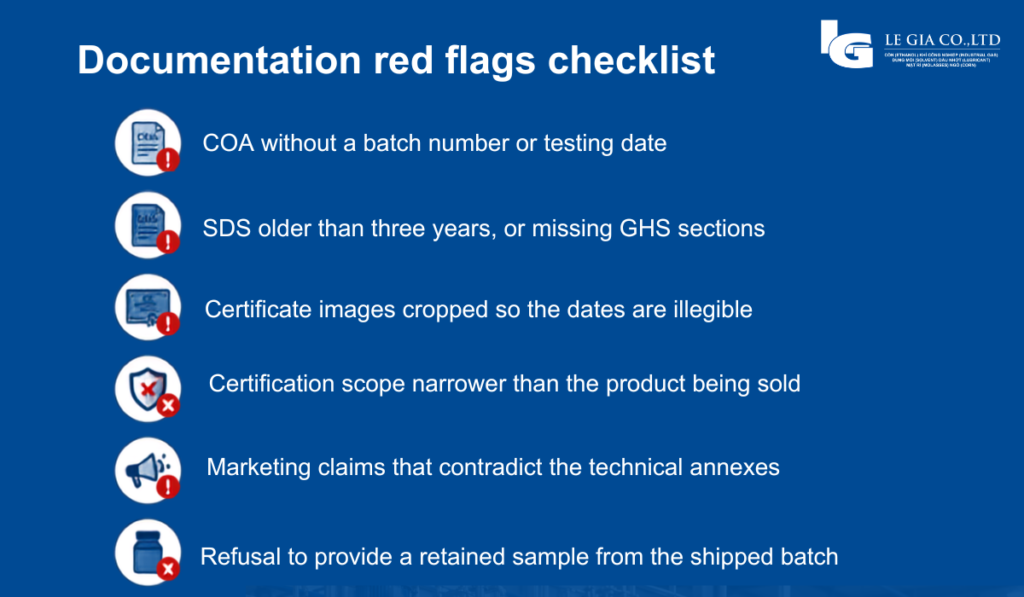
Documentation red flags checklist
- COA without a batch number or testing date
- SDS older than three years, or missing GHS sections
- Certificate images cropped so the dates are illegible
- Certification scope narrower than the product being sold
- Marketing claims that contradict the technical annexes
- Refusal to provide a retained sample from the shipped batch
What should a certificate of analysis include for ethanol
A defensible ethanol COA is not a marketing document. It is a record that must survive a regulatory inspection two years after the product it describes has been consumed.
At minimum it should carry:
- Identification block: commodity description, product code and grade or feedstock designation. Lê Gia’s format identifies the commodity as “Undenatured Ethyl Alcohol, Alcoholic Strength 95 PCT UP” with product code LGCS (Cassava).
- Batch and date block: batch or lot number, production date, sampling date, testing date and issue date, forming a logical sequence.
- Full test panel: strength, appearance, colour, acidity, pH, water content, and the organic impurity set.
- Three-column results structure: specification limit, actual result and test method, side by side. A COA that omits the limits column is only half a document.
- Authorisation: name, title and signature of the releasing authority, plus the company seal.
Two interpretation habits separate experienced QA reviewers from novices. First, they read the gap between limit and result, because a result sitting at 95% of its limit signals a process running close to its edge. Second, they compare results across three consecutive batches, because consistency reveals process capability in a way a single certificate never can.
How to validate ISO 9001 and ISO 13485 compliance
Validation is a four-step sequence, and each step disqualifies a different category of unreliable supplier.
- Confirm the issuing body and its accreditation. A certificate is only as strong as the accreditation behind it. Lê Gia’s ISO 9001:2015 and GMP certificates are issued by Guardian Independent Certification Ltd; the ISO 13485:2016 certificate is issued through the Vietnamese institute ISSQ.
- Verify the certificate number against the issuer’s register. Numbers such as 764694 (ISO 9001) and N711875 (GMP) are lookup keys, not decoration.
- Match the scope to your purchase. “Manufacturing and Trading of Ethanol Alcohol” is the scope wording you want for ethanol supply. A separate ISO 13485 scope covering medical alcohol indicates that at least part of the plant’s output runs under medical-device discipline.
- Check dates and surveillance status. Certificates carry an initial certification date, an issue date and an expiry date. A three-year cycle with annual surveillance audits is standard. Request the most recent surveillance audit summary for contracts above your risk threshold.
For annual commitments at scale, a supplier visit remains the highest-value verification available. Photographs of a facility prove a building exists. Standing in front of a rectification column proves a process exists.
What ethanol grades suit different sanitizer formulations
Grade selection is a regulatory decision disguised as a technical one. The right answer depends less on your formulation chemistry than on the jurisdiction where the finished product will be sold.
| Grade | Typical strength | Denatured | Best-fit application | Key constraint |
| Pharmacopoeial (USP / Ph.Eur.) | 95-96% v/v | No | Medical antiseptics, pharma excipient | Highest cost; full impurity profile required |
| Food-grade / neutral | 96% v/v | No | Sanitizer, cosmetics, F&B extraction | Excise duty applies in most markets |
| Denatured (SDA / EU formula) | 95-99% v/v | Yes | Commercial and institutional sanitizer | Denaturant must match destination market |
| Industrial | 92-99.9% | Usually | Solvent, cleaning, non-skin-contact | Not suitable for skin-contact products |
The commercial driver is excise. Undenatured ethanol attracts alcohol duty in most jurisdictions; denatured ethanol generally does not. On a container-scale order that single difference can dominate landed cost, which is why denaturant selection deserves as much procurement attention as purity does.
Formulation warning worth pinning above the mixing tank: always specify strength in the same unit as your finished-product claim. WHO Formulation I is defined at 80% v/v. Published efficacy work has found that a modified formulation at 80% w/w performs differently against European surgical hand-preparation standards. Volume percent and weight percent are not interchangeable, and confusing them is a common cause of failed efficacy testing.
Sanitizer grade vs USP vs denatured which do you need
Use this decision path. Start with the question: where will the finished product be sold?
- United States. The FDA over-the-counter antiseptic monograph text specifies ethyl alcohol at 60 to 95 percent by volume in aqueous solution, denatured in accordance with the applicable Treasury regulations. Your ethanol must be denatured to an accepted formula and must be methanol-tested; FDA has been explicit that ethanol procured on the market must be tested for methanol before use in sanitizer production. Note also that FDA’s 2019 final rule deferred the final effectiveness determination for ethanol, isopropyl alcohol and benzalkonium chloride, so the regulatory position remains open rather than settled.
- European Union. Hand sanitizer is a biocidal product under the BPR, Product-Type 1. In February 2026 ECHA’s Biocidal Products Committee adopted opinions supporting approval of ethanol as an active substance for Product-Type 1 (human hygiene), Product-Type 2 (surface disinfection) and Product-Type 4 (food and feed areas). Crucially, under Article 95 your active-substance supplier must appear on ECHA’s list of approved suppliers – a requirement that disqualifies many otherwise capable manufacturers.
- Medical or pharmaceutical application, any market. You need pharmacopoeial ethanol with a full organic-impurities profile, not a commercial grade with favourable spot results.
- ASEAN, Middle East, Africa or domestic commercial use. A high-purity food or commercial grade with a documented specification is generally sufficient, subject to local registration.
The pattern to notice: in three of four pathways the documentation determines eligibility, not the molecule. Ethanol is ethanol. Market access is paperwork.
What concentration works best for hand sanitizer production
Efficacy and evaporation pull in opposite directions, and the optimum sits in a narrower band than most buyers assume.
WHO Formulation I produces final concentrations of ethanol at 80% v/v, glycerol at 1.45% v/v and hydrogen peroxide at 0.125% v/v. This is the global reference point, and it is where most contract manufacturers anchor.
| Finished concentration | Antimicrobial performance | Practical trade-off |
| Below 60% v/v | Insufficient – outside recognised guidance | Not marketable as an antiseptic rub |
| 60-70% v/v | Effective against many enveloped viruses and bacteria | Slower kill; longer contact time needed |
| 70-80% v/v | Broad efficacy window | Widely used commercial sweet spot |
| 80% v/v (WHO Formulation I) | Reference formulation | Higher raw-material cost per unit |
| Above 90% v/v | Diminishing returns | Evaporates before adequate contact time |
The counter-intuitive finding worth writing into your formulation brief: higher is not better. Water participates in protein denaturation, which is why near-anhydrous ethanol underperforms an aqueous 70–80% solution against pathogens. Buyers who instinctively specify 99.9% ethanol for a hand rub are paying a premium for reduced efficacy.
Dilution arithmetic from 96% v/v feedstock: producing 1,000 L of 80% v/v rub requires approximately 833 L of 96% v/v ethanol, plus glycerol, hydrogen peroxide and purified water to volume. Always confirm final strength by in-process assay rather than by calculation alone, because volume contraction on mixing ethanol with water is real and non-linear.
How has Le Gia delivered ROI for sanitizer manufacturers
Rather than assert savings percentages that cannot be independently verified, this section sets out the framework a buyer can use to model return, populated only with documented capabilities.

The four ROI levers in ethanol sourcing
- Unit cost. Ex-works price plus duty, freight and packaging, expressed per litre of finished product rather than per litre of feedstock.
- Consistency cost avoidance. The value of batches not reworked, deviations not investigated and shipments not delayed. Model as your historical rework rate multiplied by batch value.
- Process cost transfer. The labour, equipment time and QC assay burden removed by buying pre-blended material instead of blending in-house.
- Continuity value. The cost of a production stoppage multiplied by its probability, reduced by supplier capacity headroom.
Capacity headroom is the figure worth dwelling on. Against 12 million litres of annual capacity, a buyer consuming 240,000 litres per year represents two percent of output – which means a doubling of your requirement is a routine scheduling adjustment rather than a capacity crisis.
Contact Lê Gia Co., Ltd
Sales contact: Mrs. Thắm · Phone / WhatsApp: (+84) 0908 769 151 · Office: (+84) 028 3865 2804
Email: ethanol@legia.vn · Website: https://legia.vn/
Office: 108 Khuong Viet, Tan Phu Ward, Ho Chi Minh City, Vietnam
Factory: 63A Nguyen Van Bua Street, Xuan Thoi Thuong Commune, Hoc Mon District, Ho Chi Minh City
FAQ
What is the difference between food grade and sanitizer grade ethanol
Food grade ethanol meets national standards for alcohol intended for human consumption, such as Vietnam’s QCVN 6-3:2010/BYT. “Sanitizer grade” is a procurement term rather than a regulatory grade, describing ethanol suitable for topical antiseptic manufacture – high strength, low methanol, fully documented and often denatured for excise and safety reasons. Their purity requirements overlap heavily; the meaningful differences are denaturant status, duty treatment and the documentation set the destination regulator requires.
Does Le Gia ship ethanol to North America and Europe
Canada is included in Lê Gia’s documented export market list, alongside Taiwan, South Korea, Australia, Thailand, Laos, Cambodia, Indonesia, India and Singapore. No European Union country and no United States shipments are documented in the current company profile, and no REACH or TSCA registration status is on record. Buyers targeting the EU or US should raise the regulatory pathway explicitly with the sales team before committing, because market access there depends on registration arrangements as much as on product quality.
What documentation comes with each bulk ethanol shipment
Each shipment is accompanied by a batch Certificate of Analysis, a 16-section GHS Safety Data Sheet, a commercial invoice, a packing list, the Bill of Lading or Air Waybill, a Certificate of Origin where a trade preference applies, and dangerous goods documentation covering UN 1170, Class 3, Packing Group II. Quality system certificates are available on request for your supplier qualification file.
How fast can Le Gia deliver after order confirmation
Production begins from 10 working days after order confirmation, supported by integrated control across production, blending and trading. Total delivery time then depends on destination: roughly one to two weeks of ocean transit for ASEAN markets, and two to four weeks for Oceania and North America, plus two to five days for export documentation and clearance. Custom blended formulations require an additional one to two weeks for first-article development and approval.