To buy Vietnamese ethanol in bulk, shortlist manufacturers that hold ISO 9001, GMP and VietCert QCVN 6-3:2010/BYT certification, request a batch-specific Certificate of Analysis with gas chromatography impurity data, then issue an RFQ specifying grade, purity, denaturant, packaging and destination port.
Vietnam’s fuel-grade ethanol is now absorbed by domestic E10 blending, the country imports roughly 75,000 m³ per month to meet the mandate, so export supply available to international buyers sits mainly in food-grade, medical-grade, industrial and denatured material. Typical bulk formats are ISO tank (approx. 21,000–26,000 L), IBC (1,000 L) and 200 L steel or HDPE drums. Ethanol ships as UN 1170, Class 3, Packing Group II, so flexitanks are generally not accepted and dangerous-goods documentation is mandatory. Le Gia Co., Ltd operates at 12,000,000 litres per year and ships from Ho Chi Minh City.
Quote requests: ethanol@legia.vn | (+84) 0908 769 151.
You have a specification sheet, a budget and a plant that cannot stop. What you do not have is confidence that the drum arriving in ninety days will match the sample that arrived last month.
That is the real problem with sourcing ethanol from a new origin. It is not price. It is variance, the 40 ppm methanol reading that fails your incoming QC, the ISO tank that sits at port because the dangerous-goods declaration was filled in wrong, the supplier who quotes 99.9% purity and delivers 96%.
This guide is written for procurement managers, supply chain leads and technical directors buying 20,000 litres and up. It covers the supplier landscape, grade selection, real price benchmarks, RFQ construction, packaging economics, export documentation, policy risk and supplier verification.
One warning before you read further: the single most repeated claim about Vietnamese ethanol on the open web is wrong. Vietnam is not a bulk fuel-ethanol origin in 2026. It is a net importer of fuel ethanol. What Vietnam exports competitively is something different, and more valuable to most readers of this page. Section six explains why that distinction protects your supply plan.
Who are the top Vietnamese ethanol suppliers for bulk export?
Vietnam’s ethanol export supply comes from three distinct supplier types, and only one of them reliably serves international B2B buyers of high-purity material. The three groups are integrated fuel-ethanol plants, beverage-alcohol distilleries, and specialist high-purity manufacturers and blenders. Choosing the wrong group costs you months.
Integrated fuel-ethanol plants operate at the largest scale and produce E100 for gasoline blending. Since Vietnam’s E10 mandate took effect on 1 June 2026, their output is absorbed domestically. Their material is typically anhydrous fuel grade and unsuitable for pharmaceutical or food applications without further processing.
Beverage-alcohol distilleries produce neutral spirit for domestic drinks manufacturing. Export volumes are small, allocation is seasonal, and specification sheets are written for the beverage trade rather than for industrial QC.
Specialist high-purity manufacturers and blenders: the group that includes Le Gia – produce and blend food-grade, medical-grade, industrial and denatured ethanol to customer specification. They hold the quality-system certifications that international buyers audit against, and they are structured for containerised export rather than domestic pipeline supply.
| Supplier type | Typical grades | Export orientation | Buyer fit |
| Integrated fuel-ethanol plants | E100 fuel grade, anhydrous | Low – domestic E10 demand absorbs output | Fuel blenders only |
| Beverage distilleries | Neutral spirit, 96% v/v | Low to moderate, seasonal | Beverage manufacturers |
| High-purity manufacturers & blenders | Food, medical, industrial, denatured | High – containerised, documented | Pharma, F&B, cosmetics, coatings, electronics |
For a first-time buyer, this table is the shortlist filter. If your application is pharmaceutical, cosmetic, food, coatings, ink or electronics cleaning, you are shopping in row three. Ignore capacity headlines from row one – that capacity is not available to you.
What makes Le Gia a trusted bulk ethanol exporter?
Le Gia Co., Ltd is a Ho Chi Minh City ethanol manufacturer and exporter founded in 2001, operating at a supply capacity of 12,000,000 litres per year and holding four independently issued quality certifications (Source: Le Gia Company Profile, 2025).
The verifiable credentials matter more than the narrative:
- ISO 9001:2015, Certificate No. 764894, issued by Guardian Independent Certification Ltd. Scope: manufacturing and trading of ethanol alcohol. Certificate on file shows issue 07 Feb 2023, expiry 11 Jan 2026, initial certification 16 Jan 2017.
- ISO 13485:2016, the medical-device quality management standard, issued by ISSQ (Viện Nghiên cứu Phát triển Tiêu chuẩn Chất lượng), certificate ref. YT 848 / 848-24-01/99. Scope: production and trading of medical alcohol, nasal spray solution and physiological saline. Validity on file: 26 Apr 2024 to 25 Apr 2027.
- GMP Certificate No. N711875, issued by Guardian Independent Certification Ltd, for manufacturing and trading of ethanol alcohol. Certificate on file shows issue 03 Feb 2023, expiry 04 Feb 2026.
- VietCert conformity certificate against QCVN 6-3:2010/BYT, Vietnam’s national technical regulation for alcoholic beverage products, issued by VietCert Certification and Inspection Centre.
Le Gia’s named industrial customer base includes Acecook, Ajinomoto, Nutifood, CP Group, Lotteria, Nippon Paint and Siegwerk. That list is useful evidence for a different reason than it looks: it spans instant noodles, seasoning, dairy, quick-service food, coatings and printing inks. A supplier that passes incoming QC at both a Japanese seasoning plant and a German ink manufacturer is running consistent specification control, not a single lucky batch.
Stated lead time is from 10 working days for production and dispatch.
How do Vietnamese suppliers compare by capacity and certification?
Compare Vietnamese suppliers on certification scope and documentation discipline first, and on nameplate capacity second, because capacity you cannot access is worth nothing to your production schedule.
Use four comparison axes:
- Certification scope. ISO 9001 alone certifies a quality *system*, not product purity. Look for GMP for pharmaceutical and cosmetic use, ISO 13485 for medical applications, and a national food-alcohol conformity certificate such as VietCert QCVN 6-3:2010/BYT for food contact.
- Batch COA discipline. Ask whether the supplier issues a COA per production batch or a generic type-approval sheet. Only the former is auditable.
- Accessible export capacity. Nameplate capacity minus domestic contractual commitment. Ask directly: what volume is uncommitted for export in the next two quarters?
- Documentation capability. Can they issue a dangerous-goods declaration, certificate of origin (Form D, Form AK, Form VJ or Form E depending on destination), and an SDS in the format your customs authority accepts?
| Comparison axis | What to request | Red flag |
| Certification scope | Scanned certificates with number and issuing body | Logos on a website with no certificate numbers |
| COA discipline | Two COAs from different production dates | One undated “typical values” sheet |
| Export capacity | Uncommitted volume statement, next 2 quarters | Nameplate figure quoted with no allocation breakdown |
| Documentation | Sample DG declaration and SDS | “We will arrange it later” |
| Need a bulk ethanol quotation with a batch-specific COA attached? Contact (+84) 0908 769 151 or ethanol@legia.vn. |
What ethanol grades can you source from Vietnam?
Vietnam exports four commercially distinct ethanol grades: food grade, medical grade, industrial grade and denatured ethanol, with fuel-grade E100 largely absorbed by the domestic blending market. Grade is defined by impurity profile and documentation, not by a single purity percentage.
This is the point where most procurement errors begin. Buyers specify “99.9% ethanol” when their process actually requires “ethanol with methanol below 200 ppm and no residual denaturant” – two entirely different purchase orders with a large price gap between them.
| Grade | Typical strength | Defining requirement | Common applications |
| Food grade | 95–96% v/v | Conformity to national food-alcohol regulation; low aldehyde and methanol | Flavour extraction, vinegar, seasoning, beverage manufacturing |
| Medical grade | 95–96% v/v, or diluted to 70% | GMP-manufactured; controlled impurity profile | Antiseptics, medical device cleaning, pharmaceutical intermediates |
| Industrial grade | 95–96% v/v | Consistent water content and colour; cost-optimised | Solvents, printing inks, coatings, cleaning agents |
| Denatured | To customer spec | Denaturant type and concentration compliant with destination country rules | Cosmetics, industrial cleaning, duty-exempt industrial use |
| Fuel grade (E100) | ≥ 99.5% v/v, anhydrous | Water content low enough to avoid phase separation in gasoline | Gasoline blending — limited export availability from Vietnam |
Le Gia’s published product range covers ethanol, food ethanol to international standard, food ethanol to Vietnamese standard, medical ethanol and industrial ethanol, alongside industrial gases and molasses.
Which purity levels suit pharmaceutical vs industrial applications?
Pharmaceutical and food applications are governed by trace impurity limits, while industrial applications are usually governed by water content and cost – which is why the same 96% v/v ethanol can be correct for one and wrong for the other.
Here is a real, published impurity profile so you can see what an auditable specification looks like. Le Gia’s Certificate of Analysis for undenatured ethyl alcohol, code LGCS (cassava), dated 3 February 2026, reports:
| Parameter | Specification limit | Test result | Method |
| Alcohol strength at 20°C | Min 95% v/v | 96.0% v/v | ASTM D4052 |
| Appearance | – | Clear & bright | – |
| Colour, Pt-Co | Max 10 | < 5.0 | ASTM D1209 |
| Acids as acetic acid | Max 50 mg/L | 8.6 mg/L | ASTM D1613 |
| pH | 6.6–7.6 | 7.4 | ASTM D4623 |
| Water content | Max 5.5% vol | 4.6% vol | ASTM E203 |
| Ethyl acetate | Max 100 ppm | 15.0 ppm | GC |
| Acetaldehyde | Max 40 ppm | 10.0 ppm | GC |
| Methanol | Max 100 ppm | 32.0 ppm | GC |
| Isopropanol | Max 1,000 ppm | 130.0 ppm | GC |
Read that table the way an auditor would. The headline “96%” tells you almost nothing. The four GC lines tell you everything: methanol at 32 ppm against a 100 ppm limit, acetaldehyde at 10 ppm against 40 ppm. Those margins are what determine whether your incoming QC passes on a Tuesday in eighteen months’ time.
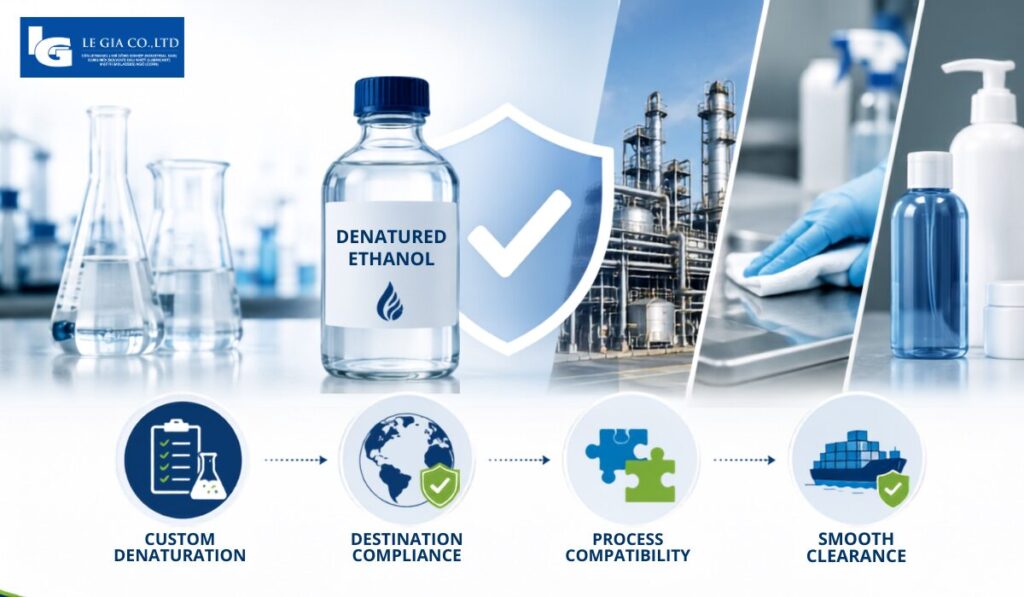
What is denatured ethanol and when should you specify it?
Denatured ethanol is ethanol deliberately made unfit for human consumption by adding a denaturant, which in most jurisdictions removes it from beverage-alcohol excise duty and can substantially reduce landed cost.
Specify denatured ethanol when all three conditions apply:
- Your application is industrial, cosmetic or cleaning – not food, beverage or ingestible pharmaceutical
- The denaturant is chemically compatible with your formulation and downstream process
- Your destination country’s customs authority recognises the specific denaturant formula you are importing
That third condition is where shipments get stopped. Denaturant recognition is national, not international. A formula accepted in one market may not clear customs in another, and the wrong denaturant can force a full duty reassessment at the port.
Le Gia positions custom denaturation as its core specialisation, formulating to each client’s exact specification. Practically, this means the denaturant is chosen to satisfy your destination regulator and your chemist at the same time – rather than you accepting a standard formula and hoping.
What are current FOB prices and MOQs for Vietnamese ethanol?
Bulk ethanol is priced against global benchmarks in USD per metric tonne, adjusted for grade, packaging and destination freight, so any quotation you receive should be checked against a published index before you negotiate.
Q1 2026 bio-ethanol benchmark prices, March 2026:
| Market | Price (USD/MT) | Approx. USD/litre* |
| China | 693 | ~0.55 |
| Germany | 718 | ~0.57 |
| South Korea | 792 | ~0.63 |
| India | 815 | ~0.64 |
| Brazil | 883 | ~0.70 |
(Source: IMARC Group bio-ethanol price index, Q1 2026)
*Converted at ethanol specific gravity 0.791, per Le Gia SDS No. 012022. Use this conversion every time. A quotation in USD/litre and a benchmark in USD/MT differ by a factor of roughly 1.26, and comparing them directly is the most common costing error in first-time ethanol procurement.
Two corrections to figures circulating on other sourcing pages. First, several guides cite a Vietnamese FOB price near USD 1.1 per litre. That is far above every published 2026 benchmark above and should not be used for budgeting. Second, headline benchmarks reflect fuel-grade and industrial-grade material; food-grade, medical-grade and custom-denatured product carry a premium reflecting certification, testing and smaller batch sizes.
Typical bulk order thresholds by packaging format:
- ISO tank: typically 21,000–26,000 litres per T11 tank, the lowest cost per litre
- 20 ft container of drums: 64 × 200 L drums palletised (12,800 L), up to 80 drums floor-loaded (16,000 L) where the carrier permits floor loading of Class 3 cargo
- IBC: 1,000 litres per unit, palletised
| [VERIFY: Le Gia to confirm current minimum order quantity by grade and packaging format, and current indicative FOB Ho Chi Minh City price ranges, before this section is published with specific figures.] |
How does Vietnam’s pricing compare to India and Thailand?
Vietnam competes on freight proximity to North and Southeast Asian buyers and on flexible small-lot certification, rather than on the lowest raw price per tonne – India and Brazil operate at larger scale and are the volume price-setters.
The March 2026 benchmarks put India at USD 815/MT and Brazil at USD 883/MT, with China at USD 693/MT (Source: IMARC Group, Q1 2026). For a buyer in Japan, South Korea or Taiwan, the relevant comparison is not the mill-gate number but the landed cost. Shorter sea legs from Ho Chi Minh City to North Asian ports reduce freight, insurance and inventory-in-transit cost against South American origins.
Three factors decide the comparison for your specific order:
- Freight distance and route stability. Regional origins reduce transit time and exposure to long-haul disruption.
- Lot size economics. Large origins price aggressively at multi-tank volumes and poorly at single-tank volumes. If you buy one or two ISO tanks per quarter, a regional specialist is usually cheaper landed.
- Certification and customisation cost. Custom denaturation and grade-specific documentation is priced into the unit rate at large plants and is often absorbed as standard service at specialist manufacturers.
What payment terms do Vietnamese exporters accept?
Vietnamese ethanol exporters most commonly work on irrevocable Letter of Credit at sight or telegraphic transfer with a deposit, with open account terms reserved for established, repeat buyers.
For a first transaction, the risk mitigation that matters more than the payment instrument is the inspection clause. Specify third-party sampling and testing at the loading port, with release of payment conditional on the independent COA matching contract specification. That single clause converts a payment-terms negotiation into a quality guarantee.
What should your RFQ include when buying bulk ethanol?
A complete bulk ethanol RFQ specifies eleven items, and omitting any one of them produces a quotation you cannot compare against another supplier’s.
Use this as a checklist. Send it as a structured document, not as a paragraph in an email.
- Grade and application – food, medical, industrial, denatured, and the end use
- Minimum alcohol strength – expressed as % v/v at 20°C, with the test method
- Maximum impurity limits -methanol, acetaldehyde, ethyl acetate, isopropanol in ppm, and water content in % vol
- Denaturant requirement – type, concentration, and destination-country regulatory basis, or explicitly “undenatured”
- Volume – per shipment and annual contracted volume
- Delivery frequency – one-off, monthly, quarterly, or call-off against a frame contract
- Packaging format – ISO tank, IBC, drum, with drum material if applicable
- Incoterms and destination port – FOB, CFR or CIF, named port
- Documentation required – COA per batch, SDS, certificate of origin form type, dangerous-goods declaration, phytosanitary or health certificate if required
- Testing protocol – who tests, at which point, against which method, and what happens on a failed result
- Target first-shipment date – so the supplier can quote against real production scheduling
Sending items 1 through 4 alone will get you a price. Sending all eleven gets you a price you can actually award a contract against.
Which certifications and documents must suppliers provide?
Every bulk ethanol shipment requires a minimum documentation set covering product quality, chemical safety, origin and dangerous-goods transport and a supplier who cannot produce samples of all four before you order will not produce them after you order.
| Document | Purpose | Issued by |
| Certificate of Analysis (COA) | Batch-specific test results against specification | Manufacturer’s QC laboratory |
| Safety Data Sheet (SDS) | Hazard classification, handling, emergency response | Manufacturer |
| Certificate of Origin | Preferential tariff treatment under trade agreements | Chamber of commerce or licensed authority |
| Commercial invoice & packing list | Customs valuation and cargo reconciliation | Exporter |
| Bill of Lading | Title and carriage contract | Carrier |
| Dangerous Goods Declaration | IMDG compliance for Class 3 cargo | Shipper |
| Quality system certificates | ISO 9001, GMP, ISO 13485, national food-alcohol conformity | Independent certification body |
Le Gia’s SDS No. 012022 classifies its ethanol as UN 1170, Proper Shipping Name ETHANOL (ETHYL ALCOHOL), Class 3 flammable liquid, Packing Group II, not a marine pollutant, with a flash point of 14°C and specific gravity 0.791–0.7915 (Source: Le Gia Safety Data Sheet No. 012022).
Note the SDS issue date when you receive one. An SDS that has not been reviewed in several years is a signal about a supplier’s compliance discipline, and some destination regulators require a document reviewed within a defined period.
How do you verify supplier quality before signing contracts?
Verify a Vietnamese ethanol supplier in five sequential steps, escalating in cost, and stop at the point where evidence contradicts the supplier’s claims.
- Certificate authentication. Take the certificate number and issuing body from the scanned certificate and verify it directly with the certification body – not through a link the supplier provides. Check the expiry date, not just the number. Le Gia’s certificates cite 764894 (ISO 9001:2015) and N711875 (GMP), both from Guardian Independent Certification Ltd, plus an ISO 13485:2016 certificate from ISSQ and a VietCert conformity certificate against QCVN 6-3:2010/BYT.
- Multi-batch COA review. Request COAs from at least three different production dates. You are testing consistency, not headline values. Widely scattered results across batches are a stronger warning than a single mediocre result.
- Independent sample testing. Have a sample shipped and tested by your own laboratory or an independent lab against the same methods listed on the COA. Match the method, not just the parameter.
- Third-party inspection at loading. Appoint an internationally recognised inspection agency to sample and seal at the loading port for the first shipment.
- Trial order before frame contract. Award a single-tank or single-container trial before committing annual volume. Treat the trial as a documentation test as much as a product test.
| Request a sample Certificate of Analysis and current pricing now: ethanol@legia.vn |
What packaging and logistics options exist for bulk shipments?
Bulk ethanol ships in three formats – ISO tank, IBC and drum and the correct choice is determined by your unloading infrastructure and consumption rate, not by unit price alone.
| Format | Volume | Cost per litre | Requires | Best for |
| ISO tank (T11) | ~21,000–26,000 L | Lowest | Bulk receiving tank, pump, grounding | Continuous high-volume consumption |
| IBC | 1,000 L | Middle | Forklift, pallet racking | Multi-site distribution, medium volume |
| Steel/HDPE drum | 200 L | Highest | Forklift or drum handler only | Small volumes, multiple grades, no bulk tank |
Because ethanol is UN 1170, Class 3, Packing Group II, flexitanks are generally not accepted for this cargo and should not be assumed as a low-cost alternative. Confirm acceptance with your carrier before building a cost model around any non-standard packaging.
Vietnam’s primary loading ports for chemical exports are Ho Chi Minh City in the south and Hai Phong in the north. Le Gia ships from Ho Chi Minh City.
When should you choose ISO tank vs IBC vs drums?
Choose ISO tank above roughly 20,000 litres per delivery when you have a receiving tank, IBC between 1,000 and 12,000 litres, and drums below 1,000 litres or when you need several grades in one shipment.
Work through it as a decision sequence:
- Do you have a bulk receiving tank with grounding and vapour management? If no, ISO tank is off the table regardless of volume economics. Discharging a flammable Class 3 liquid without proper infrastructure is a safety failure, not a cost saving.
- Is your consumption continuous or campaign-based? Continuous consumption favours ISO tank. Campaign-based production favours IBC, which lets you hold sealed inventory without tank residence time.
- Do you need multiple grades in one shipment? Drums are the only practical answer. A 20 ft container can carry different grades in segregated, individually labelled drums with separate COAs.
- What is your inventory carrying cost? ISO tank economics assume you consume the full tank within a reasonable window. If material sits, the saving disappears into working capital.
One practical note: drum material matters for long storage. Confirm with your supplier whether steel or HDPE is supplied, and whether the drum specification is UN-approved for the packing group.
What export documentation is required for ethanol shipments?
Ethanol shipments require standard commercial export documents plus a dangerous-goods documentation layer, because the cargo is classified as a Class 3 flammable liquid under the IMDG Code.
The full set:
Commercial documents
- Commercial invoice
- Packing list
- Bill of Lading or Air Waybill
- Certificate of Origin (form type depends on the applicable trade agreement)
Technical and safety documents
- Certificate of Analysis, batch specific
- Safety Data Sheet
- Dangerous Goods Declaration, citing UN 1170, Class 3, Packing Group II
- Container packing certificate
Buyer-side responsibilities
- Import permit or licence where the destination country controls ethanol imports
- Excise registration where applicable for undenatured ethanol
- Customs clearance and duty payment
Undenatured ethanol is treated as potable alcohol in many jurisdictions and can attract excise duty. Confirm your national classification before the goods sail, not after they arrive.
What risks should B2B buyers anticipate when sourcing from Vietnam?
Sourcing bulk ethanol from Vietnam carries five identifiable risks – specification variance, allocation, documentation, logistics and currency and each has a contractual mitigation that costs less than the incident it prevents.
| Risk | What it looks like | Mitigation |
| Specification variance | Batch fails incoming QC on a trace impurity | Contractual impurity ceilings with rejection rights; third-party testing at loading |
| Allocation | Volume diverted to a domestic or higher-priced buyer | Frame contract with committed quarterly volume and penalty clause |
| Documentation | Shipment held at port over a DG declaration or origin certificate error | Pre-approve all document templates before first shipment |
| Logistics | Monsoon and typhoon season disruption, roughly June to November | Buffer inventory sized to your longest historical delay; earlier booking |
| Currency and payment | FX movement between order and payment | Price in USD; define the FX reference explicitly in the contract |
The specification risk deserves emphasis. A rejection clause without a defined test method is unenforceable in practice, because both sides will produce different numbers from different methods. Name the method – ASTM D4052 for strength, GC for trace impurities – in the contract itself.
How can multi-supplier strategies mitigate supply chain disruptions?
A two-supplier structure with a roughly 70/30 volume split protects continuity without fragmenting your volume so far that you lose pricing leverage with either party.
Build it in this order:
- Qualify the secondary supplier before you need it. Qualification takes months. Doing it during a disruption means doing it badly.
- Split across origins, not just companies. Two suppliers in the same province share the same weather, the same port and often the same feedstock market. A Vietnam-plus-Thailand or Vietnam-plus-India structure diversifies real risk.
- Keep the secondary supplier live. Award the 30% continuously. A dormant qualified supplier is a phone number, not a supply chain.
- Size your buffer against your longest historical delay, not your average lead time.
- Write flexibility into both contracts. A clause permitting a defined percentage volume shift between suppliers without renegotiation lets you respond in days rather than weeks.
Why choose Le Gia as your Vietnamese ethanol partner?
Le Gia combines 12,000,000 litres per year of certified production capacity with custom denaturation as a core specialisation – a combination that suits buyers who need a specific formulation rather than a commodity grade.
The verifiable case rests on four points.
Certification depth across applications. ISO 9001:2015 (No. 764894, Guardian Independent Certification Ltd), ISO 13485:2016 (ISSQ, valid to 25 Apr 2027), GMP (No. N711875, Guardian) and VietCert conformity to QCVN 6-3:2010/BYT together cover industrial, medical and food-contact applications under one supplier relationship. For a buyer sourcing multiple grades, that removes the cost of qualifying separate vendors per application.
Transparent impurity data. Le Gia publishes batch COAs with full GC impurity results – methanol 32.0 ppm, acetaldehyde 10.0 ppm, ethyl acetate 15.0 ppm, isopropanol 130.0 ppm on the LGCS cassava batch dated 3 February 2026. Suppliers that publish real numbers rather than purity headlines are easier to audit and easier to contract with.
Demonstrated multi-sector acceptance. Acecook, Ajinomoto, Nutifood, CP Group, Lotteria, Nippon Paint and Siegwerk span food, dairy, quick-service restaurant, coatings and printing ink applications. Each of those industries runs a different incoming QC regime.
Export reach across ten-plus markets. Taiwan, South Korea, Australia, Canada, Thailand, Laos, Cambodia, Indonesia, India and Singapore – meaning the export documentation workflows for several regulatory regimes already exist rather than being built for your first order.
What custom denaturation services does Le Gia offer?
Le Gia formulates denatured ethanol to each client’s exact specification rather than supplying a fixed catalogue of standard formulas, which is the company’s stated core specialisation
What that means in a procurement context:
- The denaturant is selected to satisfy your destination country’s customs classification and your formulation chemistry simultaneously
- Concentration is set to your requirement rather than to a default
- Documentation is issued to match the denaturant actually used, which is what customs authorities check against
The commercial benefit is duty treatment. Correctly denatured ethanol is generally exempt from beverage-alcohol excise in most jurisdictions, and on a full ISO tank that exemption is usually a larger number than any per-litre price negotiation you will win.
How do 20+ years of export experience benefit your procurement?
Le Gia has operated since 2001, and the practical value of that history to a buyer is documentation fluency and problem-response speed rather than the number itself.
Three concrete benefits:
Documentation that clears first time. A supplier that has shipped repeatedly into Taiwan, South Korea, Singapore, India, Australia and Canada has already encountered each regime’s document quirks. Your first shipment is not their first shipment into that market.
Process maturity behind specification consistency. Consistency across batches is a function of process control developed over time. The COA margins shown earlier – impurities well inside limits rather than near them – are what mature process control produces.
Faster problem resolution. When something goes wrong, the difference between a two-day and a two-week resolution is whether the supplier has handled that class of problem before.
Ready to request a quote for Vietnamese bulk ethanol?
Send an RFQ with grade, volume, packaging and destination port, and Le Gia will respond with pricing, a sample Certificate of Analysis and available shipping windows.
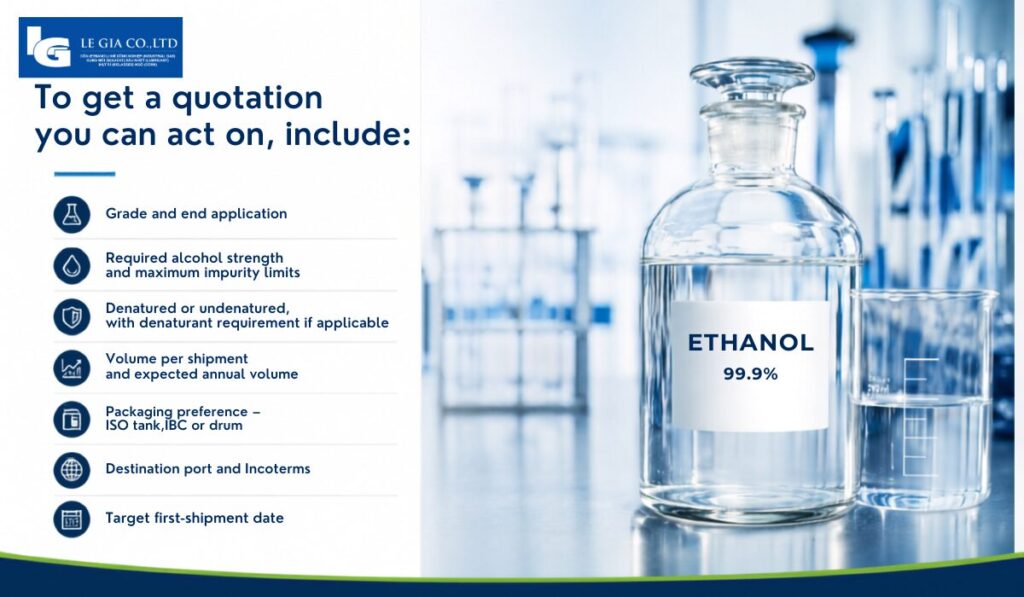
To get a quotation you can act on, include:
- Grade and end application
- Required alcohol strength and maximum impurity limits
- Denatured or undenatured, with denaturant requirement if applicable
- Volume per shipment and expected annual volume
- Packaging preference – ISO tank, IBC or drum
- Destination port and Incoterms
- Target first-shipment date
Contact
- Email: ethanol@legia.vn
- Phone / WhatsApp: (+84) 0908 769 151 (Mrs. Thắm)
- Office: (+84) 028 3865 2804
- Address: 108 Khuông Việt, Tân Phú Ward, Ho Chi Minh City
- Web: https://legia.vn
Two timing considerations for Q4 2026 and Q1 2027 planning. Vietnam’s E10 mandate has tightened the domestic ethanol market since June 2026, which makes contracted volume more secure than spot volume. And production lead time runs from 10 working days before transit — so a shipment needed in your plant in November is an RFQ you send in September, not October.
| Request your batch-specific COA and current pricing at ethanol@legia.vn. |
FAQ
Can small businesses import Vietnamese ethanol legally?
Yes. Small businesses can import Vietnamese ethanol legally provided they hold any import permit their country requires for flammable liquids and, for undenatured ethanol, any applicable excise registration. The practical constraint is not legality but minimum order size – the smallest economic bulk shipment is generally a 20 ft container of 200 L drums – 12,800 litres palletised, up to 16,000 litres floor-loaded. Below that, air or LCL freight of a Class 3 dangerous good becomes disproportionately expensive. Engage a licensed customs broker experienced in dangerous goods before placing your first order, and confirm whether your national authority classifies undenatured ethanol as potable alcohol, which changes the duty treatment substantially.
How do Vietnamese ethanol specs meet international food-grade standards?
Vietnamese food-grade ethanol is certified against QCVN 6-3:2010/BYT, Vietnam’s national technical regulation for alcoholic beverage products, with conformity assessed by an accredited body such as VietCert. Manufacturers serving international food and pharmaceutical buyers typically hold GMP and ISO 9001 certification alongside it, and issue batch COAs with gas chromatography results for methanol, acetaldehyde, ethyl acetate and isopropanol. Le Gia’s February 2026 cassava batch reported methanol at 32.0 ppm and acetaldehyde at 10.0 ppm, both well inside specification limits. For USP, BP or EP compliance specifically, confirm the pharmacopoeial monograph with the supplier in writing before contracting.