The global energy landscape is undergoing a tectonic shift, placing ethanol exports by country at the center of 2026 procurement strategies. In 2024, the United States shattered records by exporting 1.9 billion gallons of ethanol worth $4.311 billion. As we move through 2025, the U.S. is on track for a second consecutive record year, with year-to-date exports through July already up 9% over 2024.
While traditional giants like the U.S. and Brazil dominate, 2025 has seen India and Vietnam pivot into major trade and production drivers. For partners like Le Gia, with 20 years of expertise, this market transition demands a focus on supply chain security and verified quality. This report dissects 2025 statistics and provides a definitive 2026 market forecast to protect your budget and brand reputation.
I. Who are the leading ethanol exporters by country in 2025?
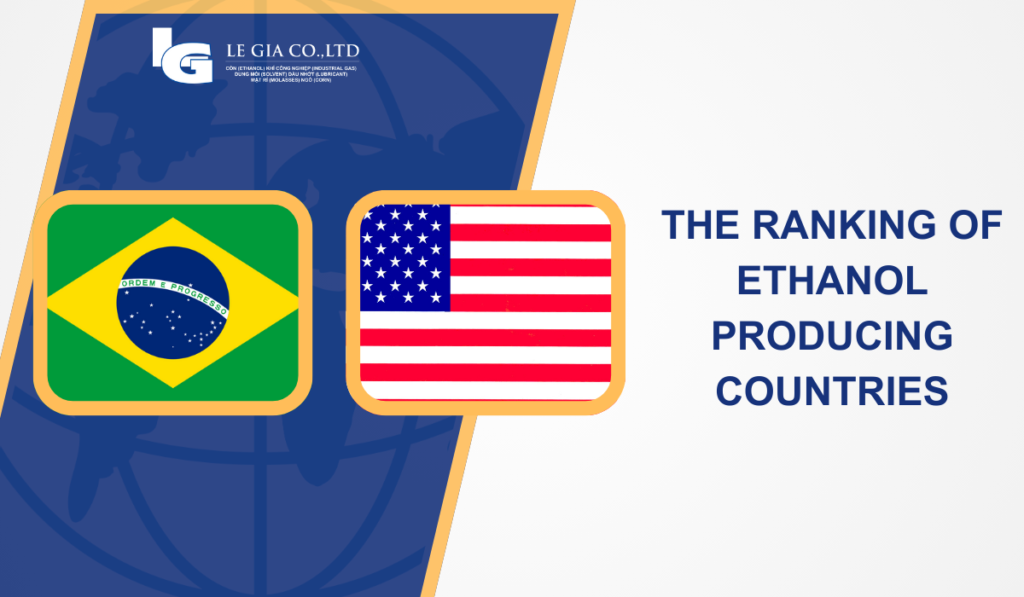
The ranking of ethanol producing countries is currently led by the U.S.-Brazil duopoly, which accounts for approximately 80% of global production. However, 2025 has seen a significant diversification of trade routes driven by international blending mandates.
The U.S. Energy Information Administration (EIA) recently increased its 2026 production forecast to 1.08 million barrels per day (b/d), signaling that American producers are scaling up to meet record global demand.
1.1. Why did U.S. ethanol exports hit record levels in 2025?
- U.S. fuel ethanol exports averaged 138,000 b/d through the first seven months of 2025, the highest in recorded history.
- Roughly 13% of total domestic U.S. production was exported in early 2025, up from 12% in 2024.
- Most growth from 2024 to 2025 was driven by increased shipments to the Netherlands, acting as a hub for the United Kingdom, France, and Ireland.
- Exports are filling a critical gap as domestic U.S. gasoline consumption remains flat due to vehicle efficiency and EV adoption.
1.2. How will Brazil’s 2026 sugarcane harvest impact global supply?
- Brazil remains a formidable second-largest producer, primarily utilizing sugarcane to offer lower carbon intensity scores compared to corn-based ethanol.
- For the 2025-2026 period, La Niña conditions are expected to boost rainfall and sugarcane yields, potentially depressing feedstock costs and increasing availability.
- However, Brazil continues to face punitive trade barriers in some markets, which may influence its 2026 export volume toward more open regions.
1.3. Which emerging ethanol producing countries will lead 2026 growth?
- Vietnam is scaling rapidly, with the government mandating nationwide E10 blending starting June 1, 2026.
- Thailand maintains a production capacity of 7.0 million liters per day as of September 2025, with a forecast of 1.0–2.0% annual growth in gasohol-powered vehicles.
- Manufacturers with integrated supply chains, such as those owning sugar mills or having long-term molasses partnerships, are projected to face lower production costs in 2026.
II. What defines the largest ethanol imports by country right now?
The demand side of ethanol trade is dictated almost entirely by government blending mandates aimed at decarbonization.
- Canada: Remains the top global destination for ethanol, accounting for over one-third of total U.S. shipments in early 2025.
- The United Kingdom: Experienced a 52% year-over-year jump in imports in 2024 following its E10 transition, a trend continuing into 2025.
- European Union: Strong demand in the Netherlands, France, and Ireland is pulling record volumes from the U.S. to meet ambitious GHG reduction targets.
III. How is ethanol production by country shifting toward the Asia-Pacific?
3.1. Can India meet its 2026 E20 mandate without imports?
- India hit its 20% ethanol blending target (E20) by March 2025, five years ahead of the original 2030 schedule.
- The program has saved India roughly Rs 1.5 lakh crore ($18B+) in foreign exchange by cutting oil import bills.
- Despite this success, India’s rapid scale-up has relied on a diverse feedstock mix including sugarcane, molasses, corn, and damaged food grains.
3.2. How will Vietnam’s June 2026 mandate reshape regional trade?
- Starting June 1, 2026, all unleaded gasoline in Vietnam must be blended into E10 fuel.
- This mandate, signed under Decision No. 46/2025/QD-TTg, repeals older regulations to pave the way for a deeper phase of biofuel development.
- The government is currently evaluating domestic and import capacity to ensure price stability for consumers during this transition.

3.3. Why is Vietnam a strategic hub for South East Asia?
- Vietnam serves as a premier manufacturer and exporter of high-purity ethanol (up to 99.5% purity).
- Local experts like Le Gia specialize in Ethanol Denaturation, creating tailored solvent formulations for global industrial demands.
- With a supply capacity of 12,000,000 liters per year, Le Gia currently exports to key markets including Japan, South Korea, Taiwan, and India.
IV. What are the primary drivers for the 2026 ethanol market?
4.1. Will Sustainable Aviation Fuel (SAF) create an ethanol shortage?
- IATA projects Sustainable Aviation Fuel (SAF) output to reach 1.9 million metric tons (Mt) in 2025, nearly double the 2024 amount.
- By 2026, SAF production is projected to slow slightly to 2.4 Mt, representing only 0.8% of total jet fuel consumption.
- This rising demand for “alcohol-to-jet” technology will increasingly compete for ethanol feedstock originally destined for the road-fuel market.
4.2. How do Carbon Intensity (CI) scores influence 2026 prices?
- Policies like California’s Low-Carbon Fuel Standard (LCFS) prioritize ethanol based on its carbon intensity reference values.
- Corn-based ethanol often faces higher scrutiny regarding indirect land-use changes, whereas sugarcane ethanol typically maintains a competitive edge in mandated markets.
4.3. Why is full supply chain control essential for 2026?
- Controlling the full supply chain (Production → Trading → Blending) allows for delivery as fast as 10 working days.
- Specialized providers like Le Gia offer flexible supply solutions and international-standard quality, which are critical for F&B, pharmaceutical, and cosmetic industries.
V. What logistics and price stability criteria must exporters meet?
5.1. How does “Price Locking” protect your 2026 procurement budget?
- With overall worldwide demand rising and regional feedstock sensitivity (like the return of El Niño potentially in 2027), price stability is key.
- A transparent business model and competitive, stable pricing are listed as core advantages for established regional manufacturers.
5.2. What are the safest methods for large volume ethanol export?
- The ISO Tank (e.g., 22K2 L4BN) is the standard for high-purity ethanol transport, ensuring product integrity during international shipping.
- Professional packaging following strict industry standards is mandatory to minimize environmental impact and ensure safe delivery.
VI. Frequently Asked Questions
- Which country produces the most ethanol from sugarcane? Brazil is the global leader in sugarcane-based ethanol.
- Is the U.S. a net exporter or importer? The United States is the largest global exporter of fuel ethanol, on track for a record-breaking surplus in 2025.
- What is the lead time for shipments? Top-tier regional suppliers can deliver within 10 working days due to established supply chains.
Conclusion
As we head into 2026, the ethanol market is transitioning from a “fuel additive” to a strategic pillar of the bio-based economy. Success requires watching the Triad of Growth: U.S. volume records, India’s E20 expansion, and Vietnam’s new 2026 mandate.
LE GIA CO.,LTD – Your Trusted Authority in Global Ethanol Sourcing