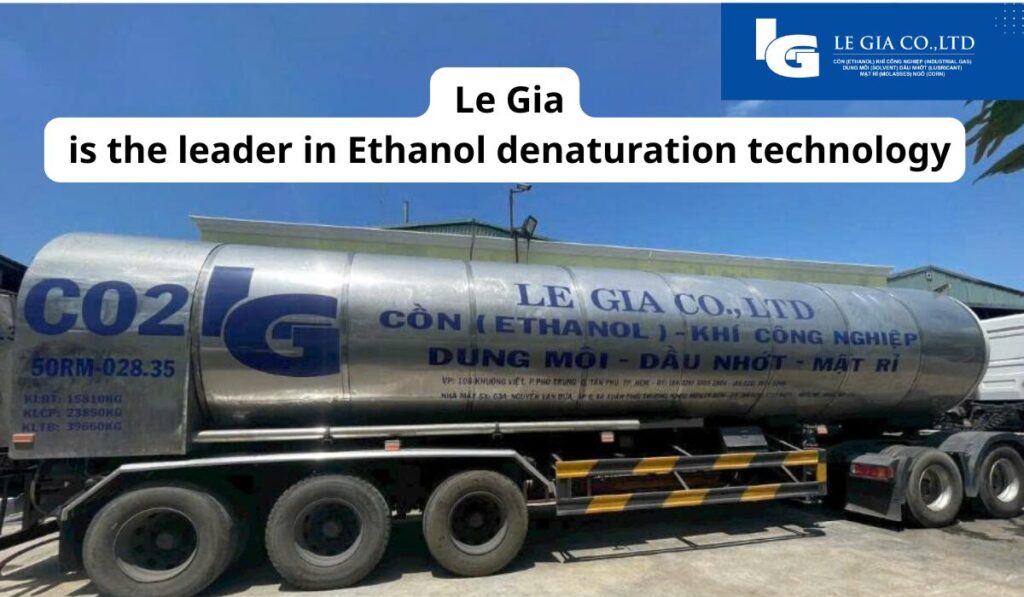
Denatured ethanol is high-purity ethyl alcohol rendered unfit for human consumption by adding specific chemical additives known as denaturants. This process allows industries to utilize powerful solvents for cosmetics, pharmaceuticals, and manufacturing while remaining exempt from heavy beverage excise taxes. At Le Gia, we provide flexible denaturation solutions with purity levels up to 99.5%, helping partners optimize raw material costs by 30-50%.
In the context of Vietnam’s rapidly growing chemical industry and its deep integration into the global supply chain, understanding denatured ethanol is essential for cost optimization and regulatory compliance. Discover everything you need to know about this process and how to choose the most reliable supply partner.
What is denatured ethanol and why do businesses need it?
What does the concept of denatured ethanol mean?
Denatured ethanol is ethyl alcohol with added denaturants that make it completely unusable for alcoholic beverages. Common denaturants include methanol, isopropanol (IPA), or denatonium benzoate—an extremely bitter compound that ensures immediate recognition if accidentally ingested.
Unlike food-grade ethanol used for spirits, denatured ethanol is specifically designed for industrial purposes such as cosmetic solvents, pharmaceutical raw materials, and ingredients for inks, paints, and detergents. This process does not reduce the critical chemical properties of ethanol—such as high solubility, rapid evaporation, or antimicrobial activity—but simply renders it unsuitable for consumption.
There are two main types of denatured ethanol: SDA (Specially Denatured Alcohol) and CDA (Completely Denatured Alcohol). Each has different formulations suited for specific industries and applications.
Why denature alcohol instead of using pure ethanol?
The answer lies in two main reasons: legal and economic.
Legally, pure non-denatured ethanol is strictly regulated by alcohol and tax authorities in most countries. In Vietnam, food-grade ethanol is subject to high excise taxes and numerous production and distribution regulations. Even if your business only requires ethanol as an industrial solvent, you would still be liable for these taxes if using pure ethanol.
When ethanol is properly denatured according to government-approved formulas, it becomes exempt from excise taxes. This provides a massive economic advantage, potentially reducing raw material costs by 30-50% compared to food-grade ethanol. For large-scale manufacturers such as cosmetic or pharmaceutical plants, these savings can amount to significant sums annually.
Furthermore, denaturing alcohol prevents the abuse of industrial ethanol in the production of counterfeit liquor—a serious public health risk. Therefore, regulatory authorities encourage and facilitate the use of denatured alcohol in manufacturing.
What are the tax benefits of using denatured alcohol?
This is the most attractive feature for businesses. In Vietnam, pure food-grade ethanol is subject to high excise tax rates, often ranging from 35% to 65% depending on concentration and final use.
In contrast, denatured ethanol is completely exempt from excise tax, provided you comply with approved denaturing formulas and prove a legitimate industrial purpose. This means the price of denatured ethanol can be 40-60% lower than food-grade ethanol of the same purity. However, it is vital to work with a reputable supplier who holds full licensing and legal documentation.
Distinguishing between SDA and CDA: Which fits your industry?
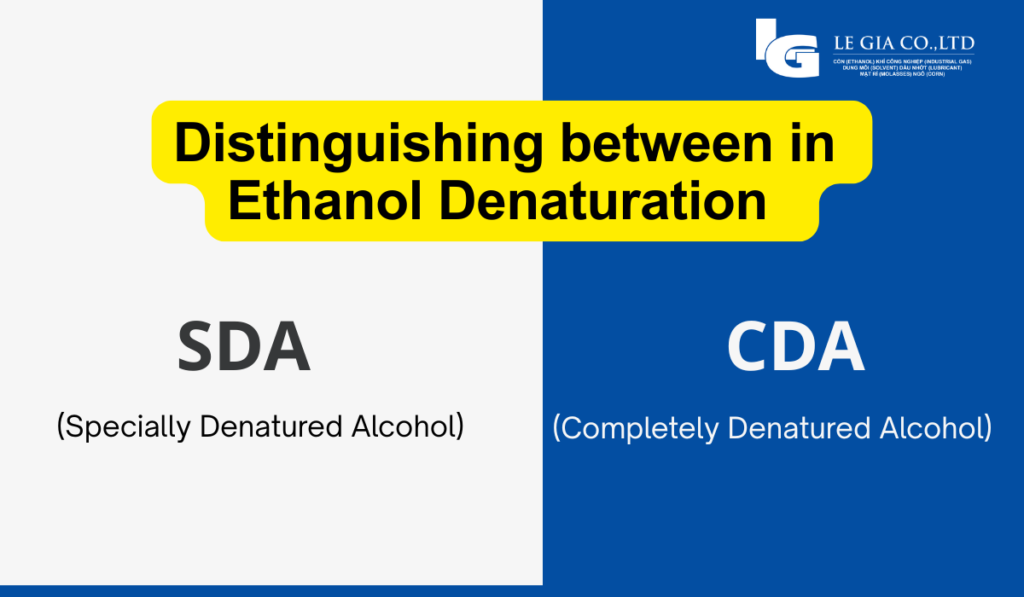
Comparison of SDA and CDA in Ethanol Denaturation
| Feature | SDA (Specially Denatured Alcohol) | CDA (Completely Denatured Alcohol) |
| Properties | Lightly denatured, skin-safe | Fully denatured, highly toxic |
| Applications | Cosmetics, Pharmaceuticals, Fragrance | Inks, Paint, Industrial Cleaning |
| Licensing | Requires strict regulatory control | Simpler procedures |
When is SDA (Specially Denatured Alcohol) used?
SDA is ethanol specially denatured with specific formulas approved by regulatory agencies. The denaturants are carefully selected to ensure the final product remains safe for skin contact, even though it remains completely undrinkable.
SDA is typically used in industries involving direct consumer contact, such as cosmetics, pharmaceuticals, and personal care products. Common SDA formulas include SDA 40B, SDA 3C, and SDA 29.
How does CDA (Completely Denatured Alcohol) differ from SDA?
CDA is ethanol that has been completely denatured, meaning the additives used render the product extremely toxic and nearly impossible to separate through standard methods.
The biggest difference is that CDA often does not require special permits for purchase and use due to its radical denaturation—the risk of someone converting CDA back into a potable beverage is nearly zero. Common formulas include CDA 12-A, CDA 19, and CDA 20.
CDA is generally used in industries without direct consumer contact: ink production, biofuels, industrial detergents, solvents for paints and varnishes, laboratory specimen preservation, and cleaning electronic components. Due to its high toxicity and unpleasant odor, CDA requires strict labor safety measures, though it offers lower costs and simpler legal procedures than SDA.
Which denaturation formula should the cosmetic industry choose?
For the cosmetic industry, SDA 40B is the optimal choice and is widely used worldwide. This formula is specifically designed to meet strict skin safety requirements and compatibility with other cosmetic ingredients.
SDA 40B ensures legal compliance while maintaining critical properties for cosmetics: rapid evaporation for a non-greasy feel, excellent solubility for essential oils and active ingredients, and natural antimicrobial properties that help preserve the product. Most importantly, it is safe for human skin.
Common cosmetic products using SDA 40B include:
- Perfumes and body mists (60-90% ethanol)
- Hairsprays and hair gels (40-70% ethanol)
- Makeup removers and toners (10-40% ethanol)
- Spray sunscreens (30-50% ethanol)
- Deodorants (30-60% ethanol)
However, some specialty products like antibacterial hand gels may use SDA 3C because the higher ethanol concentration (typically 60-70%) required for effective germ-killing is enhanced by isopropanol’s antimicrobial properties.
What standards must pharmaceutical denaturation formulas meet?
The pharmaceutical industry has the most stringent requirements for denatured ethanol as it directly impacts human health. The ethanol must ensure the highest purity and absolute safety for use in topical medicines, hygiene solutions, or other medical products.
Mandatory standards for pharmaceutical-grade denatured ethanol include:
- Purity: The base ethanol must reach a minimum of 99.5% purity before denaturation, produced via fermentation from food-grade raw materials. Impurities like natural methanol, aldehydes, and esters must be at trace levels per USP or EP regulations.
- Approved Denaturants: The industry only accepts specific SDA formulas such as SDA 3C, SDA 23A, or SDA 40B. Denaturants must be FDA-approved (or equivalent) and of pharmaceutical origin.
- GMP Certification: Facilities must comply with Good Manufacturing Practice (GMP) principles to ensure strict quality control, including testing for microbes, heavy metals, and contaminants.
- ISO 13485 Certification: For ethanol used in medical device manufacturing (such as medical sanitizers), ISO 13485:2016 certification is mandatory.
- Traceability: Each batch must have a detailed Certificate of Analysis (CoA) specifying the raw material source, test results, and batch number.
Common pharmaceutical applications include:
- Pre-injection skin antiseptics (70% ethanol)
- Solvents in cough syrups or nasal sprays
- Herbal extraction in traditional medicine production
- Preservatives in certain syrups and oral medicines
- Medical equipment disinfection
What are the common denaturants in industrial ethanol?
What is the purpose of adding Methanol?
Methanol is the most common and effective denaturant used in industrial alcohol production, particularly in CDA formulas. A typical ratio is 5% methanol by volume.
Methanol is widely chosen for several reasons:
- High Toxicity: Methanol is extremely toxic to humans; as little as 10ml can cause permanent blindness and 30ml can be fatal. This ensures the alcohol cannot be diverted for drinking.
- Difficult Separation: Methanol and ethanol have close boiling points, making separation via simple distillation very difficult and expensive.
- Solvent Properties: Methanol is chemically compatible with ethanol and does not significantly alter critical properties like solubility or evaporation rate.
- Low Cost: Methanol is much cheaper than ethanol, helping to reduce production costs.
Due to its high toxicity, storage and use require strict labor safety. Workers must wear full protective gear, and storage areas must be well-ventilated and labeled clearly: “INDUSTRIAL ALCOHOL – NOT FOR CONSUMPTION – CONTAINS TOXIC METHANOL.”
What roles do Isopropanol and Denatonium Benzoate play?
Isopropanol and Denatonium Benzoate represent a “friendlier” denaturation approach, commonly used in SDA formulas for cosmetics and pharmaceuticals.
Isopropanol (IPA): Also known as rubbing alcohol, IPA is the second most common denaturant. It is less toxic than methanol and safer for skin contact, though still undrinkable. IPA is used in SDA 3C formulas (typically 5%). It is particularly suitable for:
- Hand sanitizers (typically 60-70% ethanol with IPA)
- Pre-surgical skin cleaning solutions
- Hospital-grade glass and surface cleaners
- Deep-cleansing cosmetics for oily skin
Denatonium Benzoate: This is the bitterest substance known to man. Even at extremely low concentrations (approx. 10 ppm), it makes any liquid impossible to swallow. It is typically added to SDA 40B formulas along with tert-butyl alcohol. Its advantages include being non-toxic to skin, immediately effective upon tasting, and having no impact on the scent, color, or chemical properties of the final product. This makes it the preferred choice for perfumes, hairsprays, and toners.
How to ensure safety when handling denatured alcohol?
Using denatured ethanol in industrial production requires strict adherence to labor safety principles, including:
- Personal Protective Equipment (PPE): Chemical-resistant gloves (nitrile), safety goggles, and organic vapor respirators in confined spaces.
- Workspace Design: Forced ventilation systems to prevent vapor accumulation, storage below $25^\circ C$ away from direct sunlight, and maintaining a minimum 10-meter distance from ignition sources.
- Labeling: All containers must be clearly labeled: “DENATURED ALCOHOL – DO NOT DRINK – FLAMMABLE”.
Why is Le Gia the leader in ethanol denaturation technology?
With a 20-year journey of continuous investment in technology and people, Le Gia has established its position as a leading expert in ethanol denaturation in the region. We are not just a supplier, but a strategic partner accompanying your business success.
- Massive Supply Capacity: Possessing a supply capacity of up to 12,000,000 liters of ethanol per year, meeting all demands from pharmaceuticals and cosmetics to heavy industry.
- Master of Custom Blending: Le Gia takes pride in its ability to provide flexible blending (Tailored Formulations) according to the exact technical requirements of each customer, saving partners time and cost.
- International Quality Standards: Entire operation certified under ISO 9001:2015, ISO 13485:2016 (medical devices), and GMP.
- Rapid Logistics: Total control of the supply chain allows Le Gia to commit to flexible delivery times starting from just 10 working days.
- Export Experience: Our products have reached over 10 countries and territories, including demanding markets like Japan, South Korea, Taiwan, and Australia.
CONTACT THE ETHANOL DENATURATION EXPERTS!
Elevate your product quality with solutions from Vietnam’s leading manufacturer.
- Hotline: (+84) 0908 769 151 (Mrs. Thắm)
- Email: ethanol@legia.vn
- Address: 108 Khuong Viet, Tan Phu Ward, Tan Phu District, Ho Chi Minh City