
Absolute alcohol is ethanol dehydrated to at least 99.5% by volume (about 99.2% by weight), the threshold the European Pharmacopoeia sets for anhydrous ethanol and the USP sets for dehydrated alcohol. It is used wherever water would compromise a process, as a solvent and reagent in pharmaceutical and laboratory work, a carrier in cosmetics, a cleaning agent in electronics and a blending component in coatings and fuel. Choosing the right grade depends on four checks: assay and water content, impurity limits such as methanol and benzene, whether the product is denatured, and the documentation behind each batch.
This guide is written for the procurement managers, formulation scientists and quality teams who need to buy the right grade the first time. It explains what “absolute” really guarantees and what it does not, how to match a grade to an application, which documents to demand, and how to evaluate an international supplier, including what to ask a Vietnamese ethanol manufacturer before you request a quotation.
What is absolute alcohol and how does it differ from other ethanol grades?
Absolute alcohol is ethyl alcohol (CAS 64-17-5, C2H5OH) from which almost all water has been removed, leaving a clear, colourless, hygroscopic liquid with at least 99.5% ethanol by volume. The name describes a purity level rather than a separate chemical, so absolute alcohol, absolute ethanol, anhydrous ethanol, dehydrated alcohol and 200 proof ethanol all point to the same substance at slightly different specifications.
The reason this grade exists is physics. Ordinary distillation cannot push ethanol past roughly 95.6% by mass, because ethanol and water form an azeotrope that boils as a single mixture, so every grade above that point needs an extra dehydration step. Modern plants use molecular sieves, porous zeolite beads that trap water molecules while letting ethanol pass, whereas older plants used azeotropic distillation with an entrainer such as benzene, which is why pharmacopoeias still test absolute alcohol for benzene traces.
In practice, buyers compare 4 grade families, and the differences matter more than the shared name:
| Grade | Typical ethanol content | Water | Additives | Typical uses |
| Absolute / anhydrous (non-denatured) | ≥ 99.5% v/v | Very low, ~0.1–0.5% | None | Pharmaceuticals, laboratories, cosmetics, electronics |
| Denatured absolute | ≥ 99% v/v before denaturing | Very low | Denaturant (e.g. IPA, MEK, methanol, bitterant) | Industrial solvent, cleaning, coatings, fuel |
| Rectified spirit / Ethanol 96% | 95.1-96.9% v/v | ~3-5% | None | Food and beverage, extraction, disinfectant base |
| Industrial (technical) ethanol | Varies by supplier | Varies | May be denatured | General solvent, inks, manufacturing |
The 3 questions below are the ones that decide whether a given drum fits your process.
What purity level defines absolute alcohol versus anhydrous ethanol?
The 2 terms describe the same specification, and the confusion comes from different naming systems rather than different products. The European Pharmacopoeia lists the material as “Ethanol, anhydrous” with not less than 99.5% v/v at 20°C, equivalent to about 99.2% m/m, while the USP calls it “Dehydrated Alcohol” with not less than 99.2% by weight, corresponding to not less than 99.5% by volume at 15.56°C. The British Pharmacopoeia explicitly lists “absolute alcohol” as a synonym for anhydrous ethanol.
What this means for a buyer is simple: “absolute” on a label is a marketing word, whereas “Ph. Eur.” or “USP” on a COA is a testable commitment. A drum sold as “99% absolute ethanol” with no reference standard may sit below both pharmacopoeia limits, and a weight-based figure looks lower than the same product expressed by volume.
Always ask 3 things before comparing offers: whether the assay is stated in v/v or m/m, the reference temperature used, and which pharmacopoeia or internal method applies. Two offers that both say “99.5%” are only comparable when those three answers match.
How does water content impact pharmaceutical and laboratory applications?
Water is the main reason anyone pays for absolute alcohol, because even a fraction of a percent can change how a process behaves. In moisture-sensitive chemistry, for example Grignard reactions, esterifications or the preparation of anhydrous reagents, residual water consumes reagents, lowers yield and creates side products that must be removed later.
In pharmaceutical manufacturing, ethanol is often used to crystallise or wash active ingredients, and extra water can shift solubility so that crystals form differently or residual solvent levels drift out of specification. In analytical labs, variable water content changes a solvent’s polarity, which can shift extraction recoveries and chromatographic retention times, turning a supplier problem into a method validation problem.
There is also a counterintuitive point that many suppliers leave out: lower water is not always better. For skin and surface disinfection, 60-90% ethanol generally works better than absolute alcohol, because water helps denature microbial proteins, and ethanol is less effective against non-enveloped viruses such as norovirus. Specifying absolute alcohol for a disinfection step can therefore raise cost without improving performance.
What is the difference between absolute, denatured, and rectified alcohol?
These three grades differ along two independent axes: how much water remains, and whether something has been added to make the ethanol undrinkable. Mixing up those axes is one of the most common procurement errors.
| Type | Purity | Additives | Tax status (general) | Main applications |
| Absolute alcohol | ≥ 99.5% v/v | None | Usually subject to alcohol excise or licensing | Pharma, lab, cosmetics, electronics |
| Denatured alcohol | Can be 96% or ≥ 99% base | Approved denaturants | Often eligible for excise relief, depending on jurisdiction | Industrial solvent, cleaning, fuel, coatings |
| Rectified spirit | 95.1-96.9% v/v | None | Subject to alcohol excise | Food, beverage, extraction |
A denatured product can be anhydrous, and a non-denatured product can be 96%, so “denatured” says nothing about water content. In the United States, permitted denaturant formulas are listed in 27 CFR Part 21, while EU member states grant excise exemptions for denatured alcohol under Council Directive 92/83/EEC, so the right denaturant depends on the destination country as much as on the application.
Which industries require absolute alcohol and why?
Absolute alcohol earns its premium in industries where water, residue or trace impurities translate directly into rejected batches, failed audits or product defects. The same molecule serves very different buyers, and each one cares about a different line on the certificate of analysis.
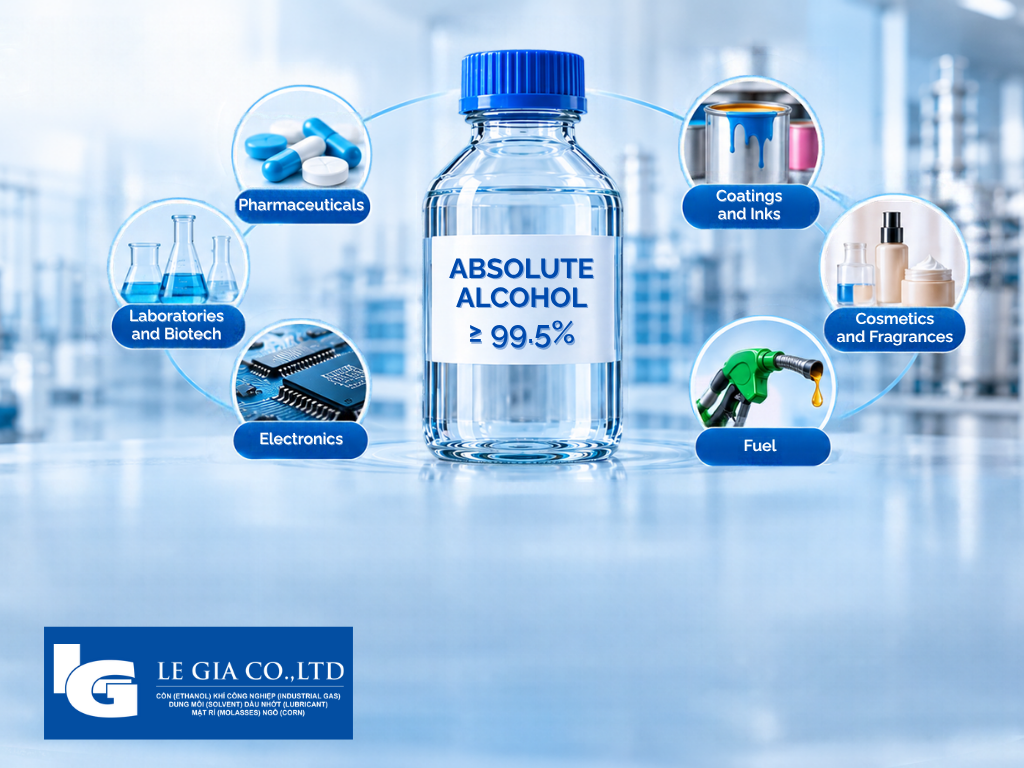
A pharmaceutical buyer reads the methanol and benzene limits first, an electronics engineer looks at residue on evaporation, a coatings formulator checks water and acidity, and a fuel blender focuses on water tolerance and denaturant content. Understanding which parameter drives your industry is the fastest way to stop overpaying for specifications you do not need, or underbuying on the one that matters.
The table below maps the main buyer groups to the parameter they should prioritise:
| Industry | Why absolute grade is used | Parameter to prioritise |
| Pharmaceuticals | Solvent, excipient, crystallisation and washing medium | Assay, methanol, benzene, aldehydes, UV absorbance |
| Laboratories and biotech | Reagent, extraction, sample preparation | Water, residue, UV absorbance, lot consistency |
| Electronics | Flux removal, precision cleaning | Residue on evaporation, water, ionic contamination |
| Coatings and inks | Resin solvent, viscosity control | Water, acidity, denaturant compatibility |
| Cosmetics and fragrances | Carrier, solvent for actives and perfume oils | Odour, denaturant type, regulatory status |
| Fuel | Gasoline blending component | Water, denaturant, fuel-grade specification |
Why do pharmaceutical manufacturers need 99.5% purity ethanol?
Pharmaceutical manufacturers buy absolute alcohol because pharmacopoeia compliance is not optional, and the anhydrous ethanol monographs in Ph. Eur. and USP set an assay that only a dehydrated product can reach, plus impurity limits that demand a tightly controlled process. Those limits include not more than 200 ppm v/v methanol, 10 ppm acetaldehyde plus acetal, 2 ppm benzene, 300 ppm total other impurities and 25 ppm residue on evaporation, plus UV absorbance limits that reveal aromatic contamination.
In day-to-day manufacturing, absolute alcohol plays four common roles:
- Solvent for synthesising, extracting or recrystallising active pharmaceutical ingredients.
- Excipient and co-solvent in oral solutions, tinctures and some parenteral formulations.
- Wash solvent for removing impurities from filter cakes and equipment.
- Diluent for preparing analytical standards in QC laboratories.
Because ethanol is usually an excipient rather than an API, the relevant quality framework is excipient GMP, such as the IPEC-PQG guidelines or EXCiPACT certification, rather than ICH Q7, which applies to active ingredients. Ask your supplier which framework their GMP certificate covers, since a GMP logo alone does not answer that question.
How is absolute ethanol used in electronics and precision cleaning?
In electronics, the value of absolute ethanol lies in how cleanly it leaves the surface. Technicians use it to dissolve rosin flux residue after soldering, wipe optical components and clean connectors, and the critical requirement is that the solvent evaporates completely without leaving water spots, salts or film.
Water content matters because a wetter solvent evaporates more slowly and can carry dissolved ionic contamination onto the board, which raises the risk of corrosion or leakage currents later in the product’s life. Residue on evaporation matters for the same reason, and the Ph. Eur. limit of 25 ppm gives buyers a measurable benchmark rather than a vague “electronics grade” label.
Isopropyl alcohol remains more common in many electronics plants, so absolute ethanol competes mainly where its solvency for specific fluxes, its lower odour or its regulatory profile gives it an advantage. For sensitive assemblies, buyers should qualify the solvent against their own cleanliness testing, typically ionic contamination or surface insulation resistance tests, before switching supplier.
What role does anhydrous ethanol play in coatings, cosmetics, and fuel?
These 3 sectors use anhydrous ethanol for different physical reasons, which is why one generic “industrial grade” rarely suits all of them.
- Coatings and inks: ethanol dissolves resins such as nitrocellulose, shellac and polyvinyl butyral, and low water content prevents blushing, haze and poor film formation in fast-drying lacquers and flexographic inks.
- Cosmetics and fragrances: ethanol carries perfume oils and active ingredients and evaporates quickly on skin; it is labelled with its INCI name “Alcohol” or, when denatured, “Alcohol Denat.”, as EU Regulation 1223/2009 requires, so the denaturant must be acceptable for cosmetic use.
- Fuel: anhydrous ethanol is blended into gasoline, and water must stay low because excess water can cause phase separation in the tank; denatured fuel ethanol for blending is specified in ASTM D4806.
The fuel segment is also a policy story in Vietnam, where Circular 50/2025/TT-BCT requires unleaded gasoline to be blended into E10 nationwide from 1 June 2026, while E5 RON92 remains on sale until the end of 2030. That shift raises domestic attention on fuel-grade ethanol, and it is a useful reminder for international buyers to confirm early which grade and quantity a Vietnamese supplier can reserve for export.
How do you select the correct absolute alcohol grade for your application?
The right grade is the cheapest one that passes every test your process and your regulator will apply, not the purest one on the price list. Buyers who start from “the highest purity available” often pay for pharmacopoeia testing they never use, while buyers who start from price alone discover the gap only when an incoming QC test fails.
A practical selection sequence works through five questions in order, each one narrowing the field:
- Will the ethanol end up in or on a human or animal? If yes, it must be non-denatured or use an approved denaturant, and a pharmacopoeia or food-grade specification applies.
- Which reference standard does your QC or regulator recognise? Ph. Eur., USP, JP, ACS reagent, ASTM or an internal specification each define different tests.
- What is your maximum tolerable water content? This decides between 96% rectified, ≥ 99% technical and ≥ 99.5% anhydrous grades.
- Which impurities would damage your product? Methanol, benzene, aldehydes, residue and UV absorbance matter to different users.
- Does the destination country tax non-denatured ethanol? If yes, a denatured grade with a locally approved formula may cut landed cost significantly.
Once those 5 answers are written down, they form the core of your purchase specification, and every supplier quotation can be checked against the same list.
What specifications matter most for pharmaceutical-grade ethanol?
For pharmaceutical use, the specification is defined by the monograph your product is registered against, and Ph. Eur. and USP anhydrous ethanol monographs are now closely harmonised. The table below summarises the parameters a buyer should see on every batch COA:
| Parameter | Ph. Eur. / USP anhydrous ethanol limit |
| Assay | ≥ 99.5% v/v (≥ 99.2% m/m) |
| Relative density (20°C, Ph. Eur.) | 0.790–0.793 |
| Acidity or alkalinity | Passes test (≤ 30 ppm as acetic acid) |
| Methanol | ≤ 200 ppm v/v |
| Acetaldehyde + acetal | ≤ 10 ppm v/v (as acetaldehyde) |
| Benzene | ≤ 2 ppm v/v |
| Total other volatile impurities | ≤ 300 ppm |
| Residue on evaporation | ≤ 25 ppm |
| UV absorbance | ≤ 0.40 at 240 nm; ≤ 0.30 at 250–260 nm; ≤ 0.10 at 270–340 nm |
Two details separate a credible pharmaceutical COA from a weak one. First, the impurities should be measured by gas chromatography using the pharmacopoeia method, not estimated. Second, the COA should state the actual result for each parameter, because “conforms” without numbers gives your QA team nothing to trend over time. Residual-solvent assessment under ICH Q3C and USP <467> covers drug substances, excipients and finished products, so your regulatory team may also ask the supplier for a statement on solvents used in manufacture.
How do laboratory-grade and industrial-grade absolute alcohol compare?
Laboratory and industrial grades can share the same assay yet behave very differently in use, because laboratory grades control the trace impurities that interfere with analysis. The comparison below shows where the two typically diverge:
| Attribute | Laboratory / reagent grade | Industrial / technical grade |
| Reference standard | ACS reagent, Ph. Eur., USP or supplier analytical spec | Supplier specification or ASTM-type commercial spec |
| Assay | Typically ≥ 99.5% v/v, some grades ≥ 99.8% | Typically ≥ 99% v/v |
| Water | Tightly specified, often ≤ 0.1–0.2% | Specified, wider tolerance |
| Trace impurities | Metals, UV absorbance, residue controlled | Methanol and acidity commonly listed; others optional |
| Packaging | Bottles and small drums, sealed | Drums, IBCs, ISO tanks |
| Suitable applications | Analysis, HPLC, molecular biology, standards | Solvent, cleaning, coatings, chemical synthesis |
The decision usually comes down to scale. A QC laboratory using a few litres a month gains little from bulk industrial pricing and needs certified small packs, whereas a coatings plant using tonnes a month rarely needs UV absorbance or trace-metal certification. Where the same site has both needs, splitting the purchase into two grades is often cheaper than buying everything at reagent quality.
When should you choose denatured versus non-denatured absolute ethanol?
The choice depends on end use, destination tax rules and whether any denaturant could reach the final product. Non-denatured absolute ethanol is the default for pharmaceuticals, food contact, most cosmetics and analytical work, because any additive would contaminate the product or invalidate the test method.
Denatured absolute ethanol suits processes where the ethanol is a working solvent that leaves the product, such as industrial cleaning, coatings, printing inks, extraction and fuel blending. In those cases, choosing a denaturant that your process tolerates is the technical question, while choosing a formula your destination country recognises is the commercial question.
Typical denaturant options include isopropyl alcohol, methyl ethyl ketone, methanol, tert-butyl alcohol and bittering agents such as denatonium benzoate, and each country approves its own combinations and concentrations. In the United States those formulas are published in 27 CFR Part 21, and in the EU denatured alcohol exemptions are implemented nationally under Council Directive 92/83/EEC, so the formula must be agreed before production rather than corrected after arrival.
How should you evaluate bulk absolute alcohol suppliers globally?
Evaluating a bulk supplier means scoring three things at once: whether they can make the grade, whether they can document it, and whether they can move it safely across borders on your schedule. Price matters, yet in ethanol a low quote that fails on any of those three usually costs more once demurrage, re-testing or a rejected shipment is counted.
A weighted scorecard keeps the comparison objective when several offers arrive, and the weights below are a starting point you can adapt to your own risk profile:
| Criterion | Example weight | What to check |
| Product quality and specification fit | 30% | Consecutive COAs, reference standard, water and impurity results |
| Documentation and certification | 20% | Certificate scope and validity, SDS date, traceability |
| Supply reliability | 20% | Own production versus trading, raw material source, allocation for export |
| Logistics and packaging | 15% | Dangerous-goods experience, packaging options, export documents |
| Commercial terms | 15% | Price structure, Incoterms, payment terms, responsiveness |
Score each supplier from 1 to 5 per criterion, multiply by the weight and compare totals, then use the lowest-scoring criterion of your preferred supplier as the focus of contract negotiations.
What production capacity and export experience indicate reliability?
Headline annual capacity tells you less than most buyers assume, because what matters is how much of the right grade a supplier can commit to you, month after month, after serving existing customers. The more useful questions are about control of the supply chain and proven export behaviour.
First, establish whether the company manufactures or only trades. A producer that ferments, distils and dehydrates its own ethanol controls raw material, process and testing, whereas a pure trader depends on someone else’s plant and may change source without telling you. Ask which raw materials are used, such as cassava, molasses or corn, since feedstock affects impurity profile and origin documentation.
Second, look for evidence of dangerous-goods exports to markets similar to yours, including references, typical destinations and the export documents the supplier prepares routinely. Lê Gia, for instance, produces bio-ethanol from cassava and molasses at its own factory, specialises in ethanol denaturation, and ships to more than 10 countries and territories, including Taiwan, South Korea, Australia, Canada, Thailand, Laos, Cambodia, Indonesia, India and Singapore.
Third, ask how the supplier protects export customers during domestic demand peaks, because a written allocation commitment is worth more than a large capacity figure.
Which packaging options suit international bulk shipments?
Packaging decides your freight cost, your handling risk and how much moisture the ethanol can pick up before use, so it deserves as much attention as the specification. The main options for absolute alcohol compare as follows:
| Packaging | Typical volume | Best for | Watch-outs |
| Steel or HDPE drums | ~200–220 L | Mixed loads, smaller sites, LCL | More handling; partial drums absorb moisture once opened |
| UN-approved IBC totes | ~1,000 L | Medium volumes, easier dispensing | Must be approved for Class 3 flammable liquids; check reuse rules |
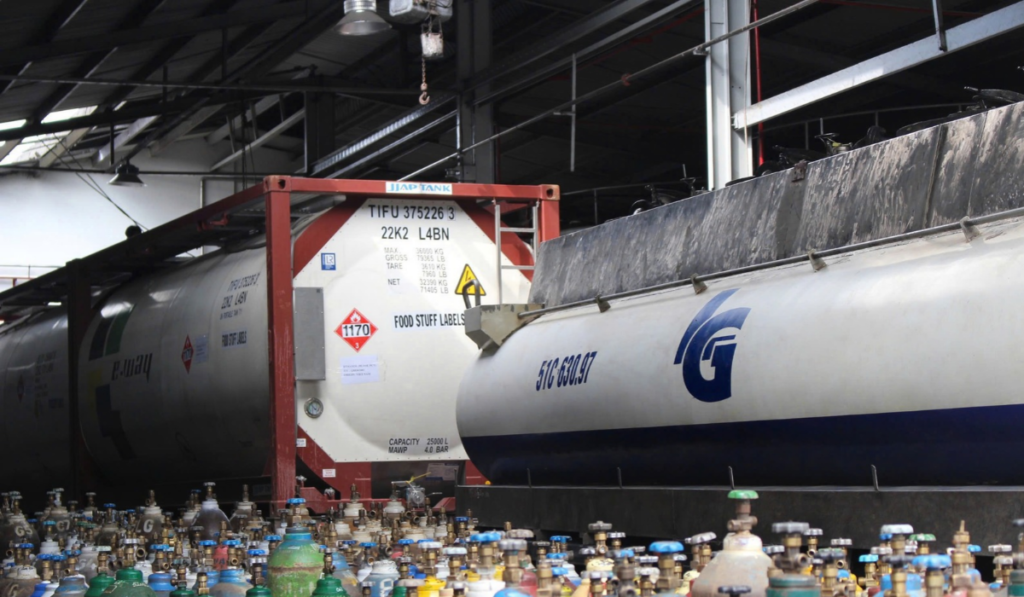
| ISO tank containers | ~20,000–26,000 L | Full-container bulk, repeat contracts | Needs receiving tank and earthing; cleaning certificate required |
| Flexitanks | Not applicable | Not suitable | Not an approved packaging under the IMDG Code, so never used for Class 3 ethanol |
What are common mistakes when sourcing absolute alcohol internationally?
Most sourcing failures with absolute alcohol are predictable, and five mistakes account for a large share of rejected or delayed shipments:
- Treating “absolute” as a specification. Without a named standard, unit and temperature, two “99.5%” offers cannot be compared fairly.
- Ignoring moisture pickup after delivery. Absolute alcohol is hygroscopic, so a partly used drum left loosely closed can drift out of its water specification well before the batch is used up.
- Choosing a denaturant for the process but not the country. A technically perfect blend can still be refused tax relief if its formula is not approved at destination.
- Booking the wrong packaging or carrier. Quoting flexitanks or using a forwarder without dangerous-goods experience can stop a Class 3 shipment at the port.
- Skipping independent verification. Accepting a single COA without pre-shipment sampling, or without checking certificate scope and validity, shifts all quality risk to the buyer.
Each of these mistakes is cheap to prevent at the enquiry stage and expensive to fix after the vessel sails, which is why a written specification and a document checklist should accompany every first order.
How can you request samples or bulk quotations from Vietnam?
The fastest way to receive an accurate quotation is to send a complete enquiry the first time, because every missing detail adds another round of emails before a price can be confirmed. When contacting Lê Gia or any other Vietnamese manufacturer, include the following details:
- Grade and standard: assay, maximum water, and the reference such as Ph. Eur., USP or your internal specification.
- Denatured or non-denatured: if denatured, the formula or the destination country’s approved formula.
- Volume and frequency: a single trial order, a monthly schedule or an annual contract.
- Packaging and destination: drums, IBCs or ISO tanks, plus the destination port and preferred Incoterm.
- Documents required: COA, SDS, certificates of origin, and any questionnaire your QA team uses.
Send your specification to ethanol@legia.vn, call (+84) 28 3865 2804, or message (+84) 908 769 151 on WhatsApp to discuss samples and pricing with Lê Gia’s team. Buyers who share their full specification before their next tender or budget cycle give themselves time for sample testing and supplier approval, instead of qualifying a new source under deadline pressure.
Request a technical consultation or bulk quotation: email your grade, volume and destination to ethanol@legia.vn and receive a quotation built around your specification rather than a catalogue price.
Frequently asked questions about absolute alcohol
Is 200 proof ethanol always the same as absolute alcohol?
Not always, because US proof is simply twice the alcohol percentage by volume, so “200 proof” is a nominal label rather than a guarantee of zero water. Commercial 200 proof products sold as USP dehydrated alcohol meet at least 99.5% v/v, which matches the absolute alcohol threshold only when the COA confirms that standard.
How should absolute ethanol be stored to prevent moisture absorption?
Keep it in tightly closed, compatible containers such as stainless steel or the original sealed drum, in a cool, dry, well-ventilated area away from ignition sources, and protect large tanks with a nitrogen blanket or desiccant breather. Use opened containers quickly and reseal them immediately, because absolute alcohol absorbs moisture from humid air.
What transport classifications apply to bulk absolute alcohol shipments?
Absolute alcohol ships as UN 1170, Ethanol, Class 3 flammable liquid, normally in Packing Group II, under the IMDG Code by sea and ADR by road in Europe. It requires dangerous-goods declarations, GHS labelling and a carrier experienced with flammable liquids.
Can absolute alcohol be customized with specific denaturant profiles?
Yes, manufacturers with denaturation capability can blend approved denaturants such as isopropyl alcohol, MEK or bittering agents to match a destination country’s formula and your process. Agree the formula in writing before production, and request a quotation because order size for custom blends is set per enquiry.