
An ethanol COA (Certificate of Analysis) is a lot-specific quality document that reports the measured results of one batch against agreed specification limits, together with the test method, unit, test date and an authorized signature. To read and verify one, confirm the lot number matches your shipment, check every result sits inside its limit on the same unit and temperature basis, confirm the parameter panel fits your grade (Ph. Eur. ethanol 96% caps methanol at 200 ppm V/V and benzene at 2 ppm V/V), and reject any certificate that lacks traceability or sign-off.
This guide walks through the ethanol COA the way an experienced QA reviewer reads it, parameter by parameter and grade by grade, using a real certificate from a Vietnamese ethanol manufacturer as the worked example. By the end, you will know which numbers matter for your use, which gaps should stop a release, and exactly what to ask a supplier before the next order ships.
What is a certificate of analysis for ethanol and why does it matter
A certificate of analysis for ethanol is the manufacturer’s signed record of what was actually measured in one specific lot, not a description of what the product is supposed to be. That distinction sounds small, but it decides whether the document can support a batch release, a customs filing or a customer audit.
In B2B trade, the ethanol COA does three jobs at once. It is quality evidence for the receiving QA team, a traceability link between the drum and the production record, and a commercial reference if a dispute arises over quality. When any of those three jobs fails, the cost lands on the buyer, usually as a delayed release, a rejected lot or an audit finding.
The document matters more for ethanol than for many commodity chemicals, because the same CAS number (64-17-5) covers products sold into pharmaceutical excipients, food processing, cosmetics, printing inks and industrial cleaning. Each of those uses tolerates a very different impurity profile, so a COA that is complete for a paint maker may be inadequate for a cough-syrup formulator.
What information does an ethanol COA document for each batch
A usable ethanol COA answers four questions on one page: which product, which batch, what was measured, and who is accountable for the result. Reviewers who check these four blocks in order catch most document problems before they reach the analytical data.
A complete certificate typically records the following fields:
- Identity: product name, grade, feedstock where relevant, CAS number 64-17-5, and the manufacturer’s product code
- Traceability: a unique lot or batch number, certificate number, manufacturing date, analysis date, and expiry or retest date
- Analytical data: each parameter with its unit, specification limit, measured result and test method reference
- Accountability: issuing company and site address, laboratory name, and an authorized signature with name and title
The analytical block is where most attention goes, yet the traceability block is where gaps cost the most. A certificate with perfect results but no lot number cannot be tied to any physical container, so it proves nothing about the material you received.
How does a COA differ from an SDS, specification sheet and certificate of conformance
Buyers often receive four quality documents with an ethanol shipment, and each answers a different question. Treating them as interchangeable leaves gaps in the supplier file.
| Document | Question it answers | Batch-specific | What it contains |
| Certificate of analysis (COA) | What did this lot actually measure | Yes | Parameters, limits, results, methods, signature |
| Certificate of conformance (CoC) | Does this lot meet the agreed specification | Usually yes | A pass statement, often without numerical results |
| Specification sheet | What does the supplier promise for this grade | No | Target limits and test methods for every lot |
| Safety data sheet (SDS) | How is the product handled safely | No | Hazards, first aid, storage, transport (UN 1170, Class 3) |
The practical rule is simple: the specification sheet sets the promise, the COA proves the promise was kept for one lot, and the SDS governs handling regardless of the lot. A CoC can support a release only when your quality agreement explicitly accepts it, because it removes the numbers your QA team would otherwise verify.
Why do procurement and QA teams require lot-specific COAs
Ethanol is a natural product of fermentation and distillation, so its trace composition moves from batch to batch with feedstock, fermentation conditions and the cut points chosen during rectification. A generic certificate cannot capture that variation, which is exactly why regulated buyers insist on a COA tied to the shipped lot.
5 operational reasons drive that requirement:
- Batch variability: methanol, acetaldehyde and higher alcohols shift with each distillation run, even within one plant
- Audit trail: GMP and ISO-based quality systems expect every incoming raw material to be traceable to its own release evidence
- Investigation readiness: when a finished product fails, the lot-specific COA is the first record investigators pull
- Liability allocation: a signed lot-specific result shifts accountability for that measurement onto the issuer
- Downstream obligations: your own customers increasingly ask you to pass supplier COA data up the chain
A lot-specific COA does not replace incoming testing in regulated sectors, but it determines how much testing you need. In many GMP-based supplier programmes, a consistent record of complete certificates can qualify a supplier for reduced incoming checks, which shortens release time.
Which parameters should an ethanol COA contain for quality assurance
The parameters on an ethanol COA fall into four groups: strength, volatile impurities, physical properties and non-volatile contaminants. Which groups appear, and how tightly they are limited, depends on the grade and the standard the supplier is certifying against.
The most useful benchmark for buyers is the European Pharmacopoeia monograph for ethanol 96%, because it is widely published and many suppliers certify against it. Supplier specification sheets built on that monograph list an assay of 95.1–96.9% V/V, relative density of 0.805–0.812, methanol at a maximum of 200 ppm V/V, acetaldehyde plus acetal at a maximum of 10 ppm V/V, benzene at a maximum of 2 ppm V/V, and residue on evaporation at a maximum of 25 ppm.
Industrial and general-grade certificates usually carry a shorter panel, which is acceptable when the application does not need the missing tests. The reviewer’s job is to decide whether the panel on the page matches the risk of the use, not simply whether every listed result passes.
What do assay, purity and ethanol percentage values actually mean
Assay is the measured ethanol content, but the number only means something once you know its basis: percent by volume (V/V), percent by mass (m/m) and the reference temperature. The same liquid can legitimately read about 95.4% V/V and about 93% m/m, because ethanol is lighter than water.
Temperature changes the reading too, since ethanol expands faster than water when warmed. Ph. Eur. reports at 20 °C, while USP expresses its Alcohol assay at 15.56 °C, which is why a pharmacopoeial excipient datasheet can list an assay of 94.9–96.0% V/V on the USP basis and 95.1–96.9% V/V on the Ph. Eur. basis for one product.
Here is the counter-intuitive point many guides skip: volume-based results on a COA do not have to add up to 100%. When ethanol and water mix, the combined volume shrinks, so a certificate showing 96.0% V/V ethanol and 4.6% vol water is not wrong simply because the two figures total 100.6%. What deserves a question is the basis of the water result, because Karl Fischer titration measures water by mass and a volume figure needs a stated conversion.
The practical difference between grades sits at both ends of the scale. Hydrous or rectified ethanol is around 95–96% V/V because ordinary distillation cannot pass the ethanol–water azeotrope at about 95.6% by mass (roughly 97% V/V), while anhydrous ethanol (Ph. Eur. minimum 99.5% V/V, equivalent to 99.2% m/m) requires an additional dehydration step, typically molecular sieves.
Why are methanol, acetaldehyde and benzene impurity limits critical
Three volatile impurities carry most of the safety and regulatory weight on an ethanol COA, and each enters the product by a different route. Understanding the route tells you which supplier controls matter.
Methanol forms from pectin in the feedstock during fermentation, so its level depends heavily on the raw material and on how the methanol-rich fraction is removed during rectification. Ph. Eur. ethanol 96% caps it at 200 ppm V/V, and EU rules for ethyl alcohol of agricultural origin, as amended by Delegated Regulation (EU) 2022/1303, set a limit of 30 g per hectolitre of 100% vol alcohol. ICH Q3C classes methanol as a Class 2 residual solvent with a 3,000 ppm concentration limit, a figure that applies to solvent residues in drug products rather than to ethanol as a raw material.
Acetaldehyde is an oxidation by-product that rises with poor storage and incomplete rectification. It drives sharp odours that matter in food, beverages and fragrance, which is why Ph. Eur. limits acetaldehyde plus acetal to 10 ppm V/V.
Benzene should not come from fermentation at all, so its presence points to contamination, shared equipment or azeotropic dehydration that uses benzene as an entrainer. It is an ICH Q3C Class 1 solvent with a 2 ppm limit, matching the Ph. Eur. monograph limit for ethanol 96%.
Beyond these three, a full pharmacopoeial certificate also reports total other volatile impurities (maximum 300 ppm V/V in Ph. Eur.), while commercial COAs often list ethyl acetate and isopropanol individually.
How should water content, density and residue results be interpreted
These three physical results cross-check each other, so read them together rather than one by one. A density that disagrees with the reported strength is one of the fastest signals that a certificate needs questioning.
Water content is normally measured by Karl Fischer titration, either volumetric (ASTM E203) or coulometric (ASTM E1064) for very dry samples. For hydrous ethanol it confirms the strength reading, while for anhydrous ethanol it is the decisive release parameter, because moisture-sensitive syntheses fail when it drifts.
Density or relative density tracks strength closely at a fixed temperature, and for Ph. Eur. ethanol 96% the accepted range is 0.805-0.812. Density measured at a temperature other than the reference must be corrected before comparison, otherwise a compliant lot can appear out of range.
Residue on evaporation measures what is left after the ethanol boils off, such as metal salts, plasticisers from containers or rust. Ph. Eur. limits it to 25 ppm m/V, and buyers in electronics cleaning and fine coatings should treat any unexpectedly high result as a packaging or transfer-line problem.
Which analytical methods validate ethanol test results
A result is only as credible as the method behind it, so every parameter on a COA should carry a recognised method reference. Without one, two suppliers can report the same number from incomparable tests.
The methods buyers most often see on ethanol certificates include:
- Gas chromatography with flame ionisation detection (GC-FID): volatile impurities such as methanol, acetaldehyde, benzene, ethyl acetate and higher alcohols, as in the Ph. Eur. ethanol monograph
- ASTM D4052: density and relative density by digital density meter, which also supports alcohol strength
- ASTM E203 and ASTM E1064: water by volumetric or coulometric Karl Fischer titration
- ASTM D1209: colour on the platinum-cobalt (Pt-Co) scale
- ASTM D1613: acidity expressed as acetic acid in volatile solvents
- USP <467> and Ph. Eur. 2.4.24: residual solvent methods aligned with ICH Q3C
Fuel ethanol follows its own framework, such as ASTM D4806 for denatured fuel ethanol for blending with gasoline. Whatever the method, the laboratory running it should be able to show competence, ideally through ISO/IEC 17025 accreditation or a documented in-house method validation.
How do you read and interpret an ethanol COA step by step
Reading a COA well means checking it against three references in sequence: your own purchase specification, the method and unit basis, and the physical shipment. Skipping any one of the three is how compliant-looking paperwork lets a non-compliant lot through.
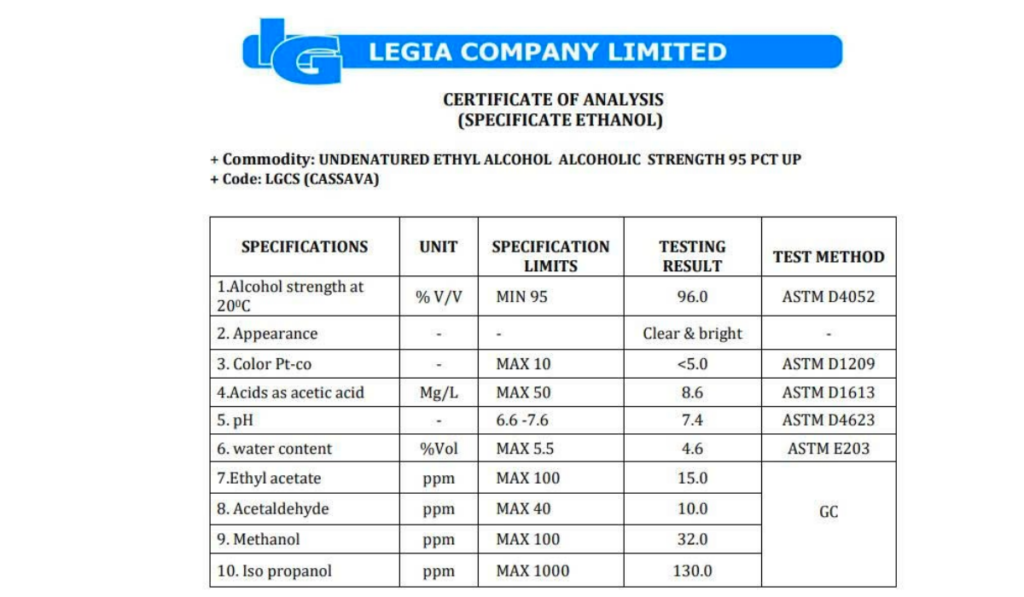
The worked example below uses a real certificate issued by Le Gia Co., Ltd for undenatured ethyl alcohol, alcoholic strength 95% and above, produced from cassava (product code LGCS, issued in Ho Chi Minh City on 3 February 2026). It is a general-grade certificate, which makes it a useful teaching case, because it shows both what a sound commercial COA contains and what a pharmaceutical buyer would still need to request.
How to match specification limits against actual analytical results
Start with your purchase specification, not the supplier’s limit column, because the supplier’s limits only tell you what they promise, while your limits define what you can accept. Then work through the certificate line by line.
The four-step comparison runs as follows:
- Map each parameter on the COA to the matching line in your specification, and list any parameter you require that the COA does not report
- Check the basis of each result, confirming the unit and reference temperature match your specification
- Compare the result with both the supplier limit and your limit, applying the tighter of the two
- Record the margin to the limit, so you can track drift across lots rather than only pass or fail
Applied to the Le Gia certificate, with Ph. Eur. ethanol 96% shown as an external reference, the comparison looks like this:
| Parameter | Supplier limit | Lot result | Ph. Eur. 96% reference | Reviewer note |
| Alcohol strength at 20 °C (% V/V) | Min 95 | 96.0 | 95.1–96.9 | Inside both ranges |
| Methanol (ppm) | Max 100 | 32.0 | Max 200 V/V | Wide margin |
| Acetaldehyde (ppm) | Max 40 | 10.0 | Max 10, as acetaldehyde + acetal | At the Ph. Eur. ceiling; not directly comparable because acetal is not reported |
| Ethyl acetate (ppm) | Max 100 | 15.0 | Counts toward total other impurities | Within limit |
| Isopropanol (ppm) | Max 1,000 | 130.0 | Counts toward total other impurities (max 300) | Acceptable for general use; check if a pharmacopoeial grade is required |
| Water (% vol) | Max 5.5 | 4.6 | Not a separate Ph. Eur. 96% test | Plausible; confirm the water basis, as Karl Fischer measures by mass |
| Acids as acetic acid (mg/L) | Max 50 | 8.6 | Acidity test, about 30 ppm as acetic acid | Low acidity |
| Colour (Pt-Co) | Max 10 | Below 5.0 | Clarity and colour tests | Clear and bright |
The certificate passes every limit it states, which makes it a sound document for general industrial and solvent use. A pharmaceutical buyer would still need identity, benzene, total other volatile impurities, residue on evaporation and UV absorbance results before release, because those tests are not on this panel.
What do units, methods and temperature conditions indicate
Units and conditions are where two honest certificates can disagree without either being wrong. Reviewers who normalise everything to one basis before comparing avoid most false rejections and most false acceptances.
Three checks cover the majority of cases. First, confirm whether ppm means ppm by volume or by mass, because Ph. Eur. impurity limits are expressed V/V while a GC report may use either basis, and mg/L is a mass-per-volume figure that is not identical to either. Second, confirm the reference temperature for strength and density, typically 20 °C for Ph. Eur. and the Le Gia certificate, or 15.56 °C (60 °F) for USP and US trade. Third, confirm each method is suitable for the parameter it reports, for example Karl Fischer for water and GC for volatile impurities.
The Le Gia certificate states strength at 20 °C and lists ASTM methods for strength, colour, acidity and water, with GC for the volatile impurities. That method disclosure lets a buyer’s laboratory repeat the tests on the same basis.
How to verify lot number, date and authorization traceability
The final step ties the paper to the product. A certificate passes this step only when every identifier on it can be matched to the drums, IBCs or ISO tank you actually received.
Use this verification checklist at goods receipt:
- The lot or batch number on the COA matches the container labels and the packing list
- The analysis date falls after the production date and before the shipment date
- The certificate age sits within the maximum you set in your quality agreement
- An expiry or retest date, if applicable, leaves enough shelf life for your usage plan
- The issuer’s legal name, address and an authorized signatory with title are shown
- A company stamp, certificate number or electronic signature allows the document to be verified
The Le Gia certificate carries the company seal, the director’s signature, the issue date and the product code. Buyers should still request that a distinct lot or batch number appear on both the certificate and the container labels, because a product code identifies a grade rather than a single production lot.
How do COA requirements differ by ethanol grade and application
The right COA panel follows the end use, not the price tier. A food-grade label or a high-purity claim says little until you know which standard the certificate tests against and which parameters it actually reports.
The table below summarises the reference framework and the parameters a buyer should expect to see for each application family:
| Application | Typical reference | Parameters to expect beyond strength | Gap to check for |
| Pharmaceutical excipient | Ph. Eur., USP-NF, JP monographs; ICH Q3C and Q3D | Methanol, acetaldehyde + acetal, benzene, other volatile impurities, residue, UV absorbance, identity | Benzene and UV tests missing |
| Food and beverage | 21 CFR 184.1293 (FCC specifications); EU 2019/787 as amended; national rules | Methanol, esters, aldehydes, higher alcohols, acidity, sensory | Results not expressed per 100% vol alcohol |
| Cosmetics and personal care | EU Regulation 1223/2009 and market rules | Methanol, odour, denaturant identity where used | Denaturant not declared |
| Industrial and solvent use | Buyer purchase specification | Strength, water, colour, acidity, key impurities | Methods not referenced |
| Denatured ethanol | Government denaturation formulas, e.g. US 27 CFR Part 21 | Denaturant type and concentration | Formula reference missing |
What parameters matter for pharmaceutical and medical-grade ethanol
Pharmaceutical buyers should expect a certificate that mirrors the full pharmacopoeial monograph, because their own release depends on demonstrating compliance with it. A partial panel, however clean, cannot support that claim.
For ethanol 96%, the Ph. Eur. reference includes an assay of 95.1–96.9% V/V, identity by infrared, acidity or alkalinity, relative density, UV absorbance limits across 240–340 nm, methanol at 200 ppm V/V maximum, acetaldehyde plus acetal at 10 ppm V/V, benzene at 2 ppm V/V, total other impurities at 300 ppm V/V and residue on evaporation at 25 ppm. Excipient-grade products sold for multi-compendial use also state the USP assay basis, 94.9–96.0% V/V at 15.56 °C, alongside the Ph. Eur. figures.
Anhydrous ethanol for pharmaceutical use needs a separate monograph certificate with a minimum strength of 99.5% V/V and a water result that supports it. Products intended for parenteral or sensitive applications may also carry bacterial endotoxin results, and an ICH Q3D elemental impurities statement is increasingly expected for any excipient entering a regulated dossier.
The central rule for medical buyers is that the certificate must name the monograph it claims compliance with. A COA stating 96% strength without a pharmacopoeia reference is a general-grade document, regardless of how the product is marketed.
Which specifications apply to food-grade and cosmetic ethanol
Food-grade ethanol is judged against food law rather than pharmacopoeias, and the main reference points differ by market. In the United States, 21 CFR 184.1293 affirms ethyl alcohol as GRAS for a specified use and ties the ingredient to Food Chemicals Codex specifications, while the European Union defines ethyl alcohol of agricultural origin in Regulation (EU) 2019/787, updated by Delegated Regulation (EU) 2022/1303.
The EU framework expresses impurity limits per hectolitre of 100% vol alcohol, setting methanol at 30 g and ethyl acetate at 1.3 g, which means a buyer must convert a COA reporting ppm in the product before comparing. In Vietnam, Appendix I of QCVN 6-3:2010/BYT sets requirements for food alcohol used to make alcoholic beverages, and the Ministry of Industry and Trade is drafting an updated regulation aligned with EU rules, so certificates for this market should state which national and destination-market rules they cover.
Cosmetic-grade ethanol sits between food and industrial use. EU Regulation 1223/2009 governs the finished cosmetic, and much cosmetic ethanol is supplied denatured, labelled as alcohol denat. in ingredient lists. For these products, odour, methanol level and the identity of any denaturant matter more than pharmacopoeial UV tests, because they decide fragrance stability and labelling.
How do industrial and denatured ethanol COAs differ
Industrial ethanol certificates are shorter by design, because coatings, printing inks, cleaning agents and electronics solvents are judged on performance rather than ingestion safety. Strength, water, colour, acidity and evaporation behaviour usually decide suitability, with selected impurities added where they affect the process.
Denatured ethanol adds one mandatory element: the certificate must declare what was added, how much, and under which formula. Common denaturants include methanol, isopropanol, methyl ethyl ketone, ethyl acetate and denatonium benzoate, and each changes both the regulatory status and the technical behaviour of the solvent. In the United States, specially denatured alcohol formulas are defined under 27 CFR Part 21, and other markets apply their own approved formulations.
This is where buyers gain the most from a supplier that blends to specification. A denatured ethanol COA should report the base ethanol quality and the denaturant concentration as separate results, so the buyer can confirm both the tax-relevant formula and the performance-relevant purity in one document.
How can B2B buyers verify supplier COA authenticity and completeness
Verification moves the review from reading one certificate to judging a supplier’s whole documentation system. The question shifts from whether this page passes to whether you can trust the next fifty pages without retesting each lot.
Experienced buyers verify on three levels. They screen each certificate for warning signs, they question the supplier about how certificates are produced, and they physically link certificates to shipments through receiving controls and periodic independent testing.
What red flags indicate an incomplete or unreliable ethanol COA
Many unreliable certificates are not forged, they are generic, recycled or produced by a process with no real link to the batch. The warning signs are therefore usually patterns rather than single errors.
Watch for these signals when reviewing ethanol certificates:
- Identical results across several lots, which suggests a template rather than fresh analysis for each batch
- No method references, so results cannot be compared with your laboratory or another supplier’s data
- Pass or conforms in place of numbers for parameters your specification limits numerically
- No unit basis, such as ppm without V/V or m/m, or strength without a reference temperature
- Missing identifiers, including no lot number, no certificate number or an analysis date later than the shipping date
- Limits that change between documents, where the COA limit differs from the agreed specification sheet without notice
- Purity claims without data, such as high purity or pharma quality with no impurity results to support them
A result sitting at or near a limit is not a red flag by itself, because real lots vary and honest suppliers report what they measure. What deserves attention is a sustained trend toward the limit across successive lots, which signals a process drifting out of control.
Which questions should procurement ask ethanol suppliers
The right questions reveal how a certificate is produced, which matters more than any single result on it. Ask them during supplier qualification rather than after a problem appears.
Useful questions to put to an ethanol supplier include:
- Which laboratory performs each test, and is it in-house, third-party or ISO/IEC 17025 accredited
- Is every COA generated from analysis of the shipped lot, or from a production run that is split across several shipments
- Which standard or monograph does the certificate claim compliance with, and which tests from that standard are not performed
- How are retained samples kept, for how long, and can they be retested if a dispute arises
- How will you notify us of changes to feedstock, process, limits or methods
- Can you add buyer-specific parameters, such as benzene or residue on evaporation, to the COA for our orders
- What is your feedstock, and does it change seasonally, for example between cassava and molasses
Written answers to these questions belong in the supplier qualification file. They also form the basis of the quality agreement, which is where certificate content, maximum certificate age and change notification should be made contractual.
How to link COA documentation to actual shipped batches
A certificate proves nothing about your material until it is physically tied to the containers you received. That link is built at goods receipt and maintained through sampling.
The receiving team should match the lot number on the COA to every drum, IBC or ISO tank label and to the packing list, then record seal numbers for tank shipments. Any mismatch, such as one COA covering containers labelled with two lot numbers, should trigger quarantine until the supplier explains it.
Sampling closes the loop. Many buyers run a reduced identity check on every delivery, for example density and water, and send a full-panel sample to an independent laboratory on a periodic basis or at every new supplier, feedstock or process change. Comparing the independent results with the supplier’s COA over time shows whether the supplier’s laboratory and yours agree, which is the most reliable evidence that future certificates can be trusted.
What do most supplier COAs fail to explain for buyers
The biggest gap in ethanol certificates is not a missing number, it is missing context about what the numbers cover. Three omissions recur across supplier documents, and each one can mislead a careful reviewer.
First, a COA describes the lot at the moment of analysis, not at the moment of delivery. Anhydrous ethanol absorbs moisture from air during transfers, and acetaldehyde can rise during long, warm storage, so a certificate issued weeks before a sea shipment may no longer describe what arrives. Few certificates state storage conditions or recommend a retest interval.
Second, most certificates report results without measurement uncertainty. A methanol result of 195 ppm against a 200 ppm limit passes on paper, yet if the method’s uncertainty is plus or minus 10 ppm, the true value could exceed the limit. Certified reference materials state uncertainty as a requirement, while commercial COAs rarely do.
Third, certificates almost never list the tests that were not performed. A buyer seeing a clean page assumes the panel is complete, when it may omit benzene, residue or UV absorbance entirely. The safest habit is to compare every certificate with your specification and write down what is absent, because absence is invisible on the page.
Why two decades of ethanol manufacturing shapes reliable COA documentation
Certificate quality is a by-product of process control, and process control is built over years of running the same plant on the same feedstocks. A manufacturer that controls fermentation, distillation, blending and quality testing under one roof can tie each certificate to its own production record, rather than relaying a document from a third party.
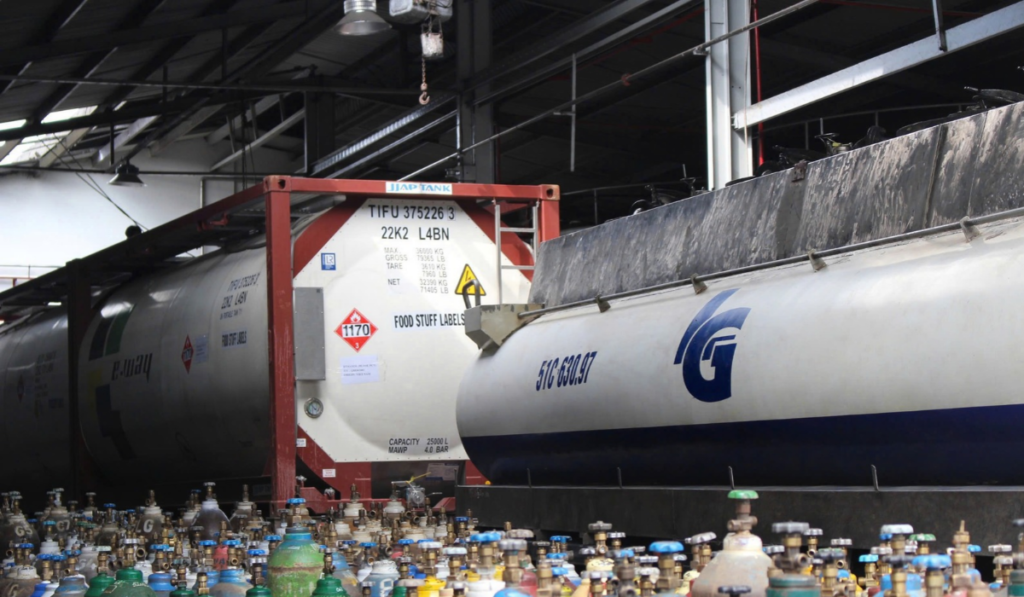
Le Gia Co., Ltd has produced ethanol in Ho Chi Minh City since 2001, fermenting agricultural feedstock such as cassava into bio-ethanol at its own factory and specialising in ethanol denaturation and blending to customer specification. Its medical alcohol production is covered by ISO 13485:2016, and its ethanol supplies manufacturers including Ajinomoto, Acecook, Nutifood, Nippon Paint and Siegwerk.
That experience shows up in the details of the certificate discussed above: strength reported at a stated temperature, a method reference for most parameters, GC analysis of named volatile impurities, and a signed and sealed document. Exporting to more than 10 countries and territories, including Taiwan, South Korea, Australia, Canada, Thailand and Singapore, also means meeting different buyers’ documentation expectations, from local regulators to multinational QA departments, and adapting the panel to each grade and market.
What compliance risks arise from accepting generic or incomplete COAs
Accepting a weak certificate rarely causes an immediate problem, which is precisely why the risk accumulates unnoticed. The cost appears later, at an audit, a customs inspection or a product complaint, when the original lot is already consumed.
The main exposures fall into four groups:
- Regulatory: inspectors can cite a manufacturer whose raw material release relies on certificates that do not support the claimed grade, and import authorities can hold shipments whose documents do not match the goods
- Product safety: methanol and benzene contamination are not theoretical, as shown by the US FDA’s 2020 warnings and recalls of hand sanitizers labelled as ethanol that tested positive for methanol, and by later FDA guidance on benzene contamination risk in drug products
- Operational: a lot released on an incomplete COA and later questioned forces quarantine of finished goods, rework or recall, often across several production batches
- Commercial: your own customers audit your supplier controls, and a weak file can cost certifications, approved-supplier status or contracts
The common thread is that the buyer, not the supplier, carries most of these consequences. A strong certificate requirement in the quality agreement is therefore cheap insurance, because it shifts verification upstream, before the ethanol enters your process.
How can you request a lot-specific ethanol COA or sample today
The best time to settle COA content is before the purchase order, not after the drums arrive. A supplier who knows your specification in advance can test the right panel on the right lot, which removes most of the review problems described in this guide.
To get a certificate that fits your application on the first exchange, include these details in your request:
- Grade and end use, for example pharmaceutical excipient, food processing, cosmetics, printing ink or industrial cleaning
- Standard or specification, such as Ph. Eur., USP, a destination-market food rule or your own internal specification
- Additional parameters beyond the standard panel, such as benzene, residue on evaporation or a named denaturant
- Volume, packaging and timeline, including drums, IBCs or ISO tanks and the Incoterms you work with
- Destination market, so the documents can support customs clearance and local regulation
Le Gia’s team can share a current COA, prepare a sample with its accompanying certificate, and discuss blended or denatured formulations built to your specification, with delivery from 10 working days for confirmed orders. Manufacturers such as Ajinomoto, Acecook and Nippon Paint already source Le Gia ethanol, and aligning COA requirements at the quotation stage avoids document back-and-forth that can delay a first delivery.
Request your lot-specific ethanol COA or sample: email ethanol@legia.vn or message WhatsApp +84 908 769 151 (Mrs. Thắm) with your grade, specification and volume. Send it before your next purchase order is issued, so the certificate arrives built for your release checklist rather than adapted to it.
FAQ: ethanol COA edge cases and long-tail questions
Does an ethanol COA guarantee all future batches meet the same specification
No, a COA covers only the lot that was tested, so every new lot needs its own certificate. Consistency across lots is supported by the specification sheet, the quality agreement and the supplier’s process controls, which buyers confirm through trend review and periodic independent testing.
Can a COA without a signature or laboratory reference be legally valid
It may be accepted commercially in some markets, but most regulated buyers and GMP-based systems require an identifiable issuer and an authorized signature, handwritten or compliant electronic. Without them, the certificate cannot be traced to an accountable party and carries little weight in an audit or dispute.
How do international buyers handle unit conversions between COA formats
The safest approach is to fix units, bases and reference temperatures in the purchase specification, so the supplier reports directly on your basis. Where conversion is unavoidable, such as ppm in product versus grams per hectolitre of 100% vol alcohol, document the calculation in the receiving record for audit.
What should buyers do if COA results contradict product performance
Quarantine the affected material, test a retained sample at an independent laboratory, and notify the supplier’s quality team in writing with the evidence. The outcome should decide whether the lot is rejected and whether the supplier’s qualification status changes.
Is a COA the same as a food-grade or pharmaceutical certification
No, a COA reports test results for one lot, while grade compliance depends on which standard those tests follow and whether the full panel was performed. A certificate must name the monograph or regulation it claims, such as Ph. Eur. or 21 CFR 184.1293, before it can support a grade claim.