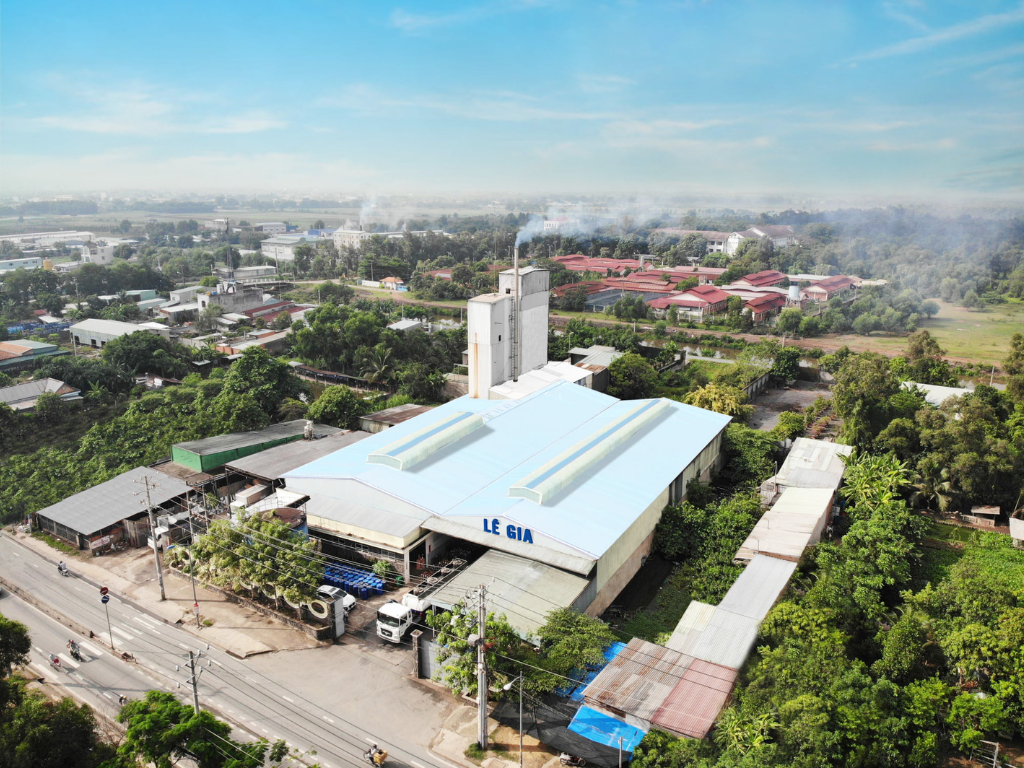
The Le Gia ethanol plant is a specialty ethanol factory in Ho Chi Minh City, operated by Le Gia Co., Ltd. since 2001. The plant has a supply capacity of 12 million liters per year and produces food, medical, industrial and custom-denatured ethanol at up to 99.5% purity. Its medical ethanol line is certified to ISO 13485:2016, every lot ships with its own certificate of analysis (COA), delivery starts from 10 working days, and its products are sold in more than 10 countries and territories.
For procurement and QA/QC teams, choosing among ethanol plants in Vietnam is a decision that directly affects the stability of an entire production line. In our experience, the right question is not which plant is the biggest, but which plant can prove its quality with data from every lot.
In this article, we introduce our plant through the 5 areas every procurement team checks first, namely capacity, production technology, quality control, certification and markets.
Le Gia ethanol plant at a glance
We are an ethanol manufacturer serving food, pharmaceutical, cosmetic and industrial companies. Unlike Vietnam’s large fuel-ethanol plants, which supply E10 gasoline blending, we focus on ethanol grades that need lot-by-lot quality control and customization for each application.
| Item | Details |
| Company | Le Gia Co., Ltd. |
| Founded | 2001 |
| Head office | 108 Khuong Viet, Tan Phu Ward, Ho Chi Minh City |
| Factory address | 63A Nguyen Van Bua, Xuan Thoi Thuong Commune, Hoc Mon District, Ho Chi Minh City |
| Supply capacity | 12 million liters of ethanol per year |
| Maximum purity | 99.5% |
| Certification | ISO 13485:2016 (medical ethanol line) |
| Lead time | From 10 working days |
| Markets | Vietnam and more than 10 countries and territories |
More than 20 years in the ethanol industry
Le Gia started as a small production facility in 2001, and we have since grown into a company specializing in ethanol and essential industrial chemicals. Over the past two decades, we have kept investing in innovation, expanded our operations and raised product quality to meet the needs of a wide range of customers.
Our business philosophy has stayed the same since day one: superior quality and sustainable practice are the foundation of every long-term partnership. We put that philosophy into practice through four commitments, namely consistent product quality, flexible supply, delivering on every commitment and transparency in all information.
More than 20 years of continuous operation have given us a stable supply chain and an experienced team of ethanol specialists. We are also a specialist in ethanol denaturation, designing solvent formulations to each customer’s technical specification instead of selling only fixed concentrations.
Alongside food, medical and industrial ethanol, we supply industrial gases (CO₂, oxygen and argon) and molasses to many manufacturing sectors. You can therefore work with a single partner for several raw materials, with steady supply even when the market fluctuates.
Integrated production model
We control our supply chain from production and trading to blending on request. This lets us supply ethanol at standard concentrations and also blend denatured ethanol to your own technical specification.
Every lot is tested in our in-house laboratory before release, and our packing follows strict industry standards so that products reach you in the same condition they left the factory. We also prioritize environmentally friendly packaging materials to reduce our environmental impact.
Capacity and supply capability of the plant
Our plant supplies 12 million liters of ethanol per year, packs from small jerrycans to ISO tanks, and delivers from 10 working days. Together, these three factors let us serve both small orders from workshops and recurring contracts from large factories.
12 million liters of ethanol per year
A capacity of 12 million liters per year equals about 1 million liters per month, or roughly 5,000 drums of 200 liters. At this scale, we can serve recurring domestic orders and export contracts at the same time.
Vietnam’s fuel-ethanol plants run at far larger volumes to supply gasoline blending, while our plant focuses on food, pharmaceutical, cosmetic and industrial ethanol. In this segment, what our customers need is consistent quality between lots and specifications adjusted to each application, rather than sheer volume.
To keep your supply steady, we encourage customers with regular demand to sign recurring supply contracts. When we know your usage plan in advance, we can schedule production ahead, keep stock ready and deliver on time.
Packaging from jerrycans to ISO tanks
We pack ethanol in several container sizes, from trial orders to large export shipments:
| Packaging | Volume | Suitable for |
| Spray bottles, plastic jerrycans | Spray bottles; 1, 5 and 30 L jerrycans | Clinics, small workshops, samples |
| Drums | 200 L | Factories with recurring use |
| ISO tanks | Dedicated tank container | Large industrial and export orders |
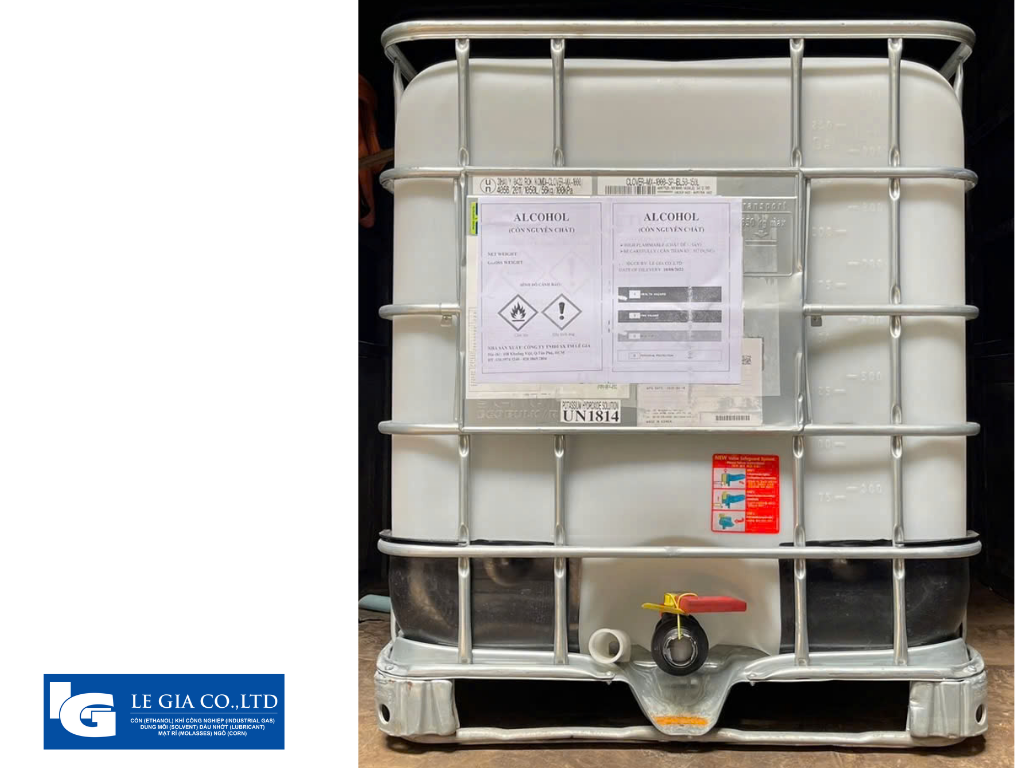
Ethanol is a Class 3 flammable liquid under dangerous-goods rules, classified as UN 1170, Packing Group II, with a flash point of 14°C in our safety data sheet. We therefore fill it into dedicated containers and seal them to prevent cross-contamination and preserve its physical and chemical properties, and for 99.5% ethanol, sealed packaging also stops moisture uptake that would lower its strength.
Production technology for 99.5% ethanol
At our plant, we ferment natural agricultural feedstock, then use multi-column distillation and molecular-sieve dehydration to reach a purity of at least 99.5%.
Fermentation of natural agricultural feedstock
We produce ethanol from natural carbohydrate sources such as cassava, corn and molasses, a by-product of the sugar industry. Fermentation converts sugars into ethanol and produces a fermented mash, which then moves on to distillation.
Agricultural feedstock gives our product a natural origin that suits food and pharmaceutical buyers. Using by-products such as molasses also reduces waste along the agricultural value chain.
For traceability, our product codes identify the feedstock, and the general ethanol product cited in the quality section below, code LGCS, is made from cassava. If you have GMO, allergen or origin requirements, you can ask us which feedstock is used for your product before approval.
Multi-column distillation and molecular-sieve dehydration
At our plant, the fermented mash passes through multi-column distillation, followed by a molecular-sieve dehydration stage:
- Crude column: separates ethanol from the fermented mash to produce crude alcohol.
- Rectifying column: raises strength to about 95–96% v/v and removes aldehydes, methanol and fusel oil.
- Dehydration stage: uses a zeolite molecular sieve to adsorb the remaining water, bringing strength to at least 99.5% v/v.
Dehydration is the decisive step, because an ethanol–water mixture forms an azeotrope at about 95.6% ethanol by mass, so ordinary distillation cannot go beyond this point. The molecular sieve overcomes that limit without auxiliary chemicals, giving us anhydrous ethanol for pharmaceutical uses and other applications that need very low water content.
Lot-by-lot quality control system
We analyze every lot in our in-house laboratory before release, and each lot ships with its own COA. Lot-level control lets you trace quality and compare our results against your own internal specifications.
In-house laboratory and gas chromatography
We use gas chromatography (GC) to quantify volatile impurities such as methanol, acetaldehyde, ethyl acetate and isopropanol, while alcohol strength is measured by density under ASTM D4052. Our other key control parameters are acidity, color, pH and water content.
The table below is taken from our certificate of analysis for general undenatured ethanol, product code LGCS (cassava), dated 3 February 2026:
| Parameter | Specification limit | Lot result | Test method |
| Alcohol strength at 20°C | Min 95% v/v | 96.0% v/v | ASTM D4052 |
| Water content | Max 5.5% vol | 4.6% vol | ASTM E203 |
| Methanol | Max 100 ppm | 32 ppm | Gas chromatography (GC) |
| Acetaldehyde | Max 40 ppm | 10 ppm | Gas chromatography (GC) |
| Acids as acetic acid | Max 50 mg/L | 8.6 mg/L | ASTM D1613 |
The methanol result of 32 ppm is only about one-third of the permitted limit. Lot-specific data like this is how we demonstrate stable quality to our customers, and if you buy food or medical grades, you receive the COA for your own grade and lot.
Documents supplied with every shipment
Every lot leaving our plant comes with a full set of documents, which you can check on delivery and keep in your internal records:
| Document | Content |
| COA (Certificate of Analysis) | Actual test results for the lot, acceptance limits and test methods |
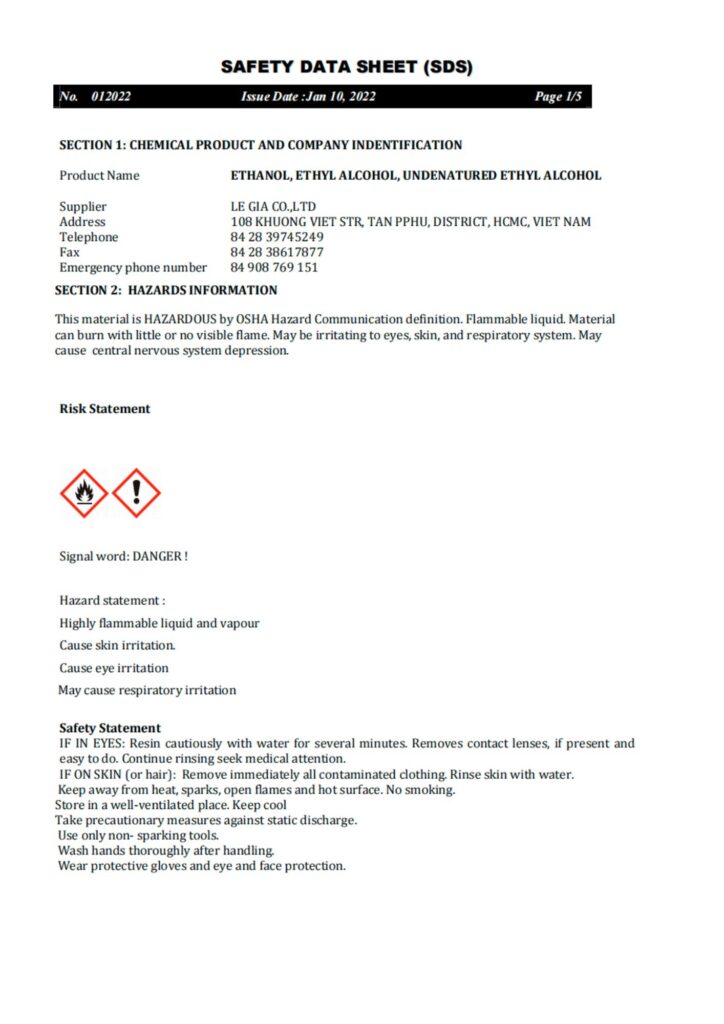
| SDS (Safety Data Sheet) | Hazard classification, safe handling, storage and transport information |
| CO (Certificate of Origin) | Certification of origin for export orders |
We issue the COA for each lot, the SDS belongs to the product and covers its dangerous-goods classification, and we prepare the CO on request for export orders.
Methanol, aldehyde and higher-alcohol values can vary between lots and product codes. That is why each of our COAs states the product code and test date, so you can match it against your delivery documents when the goods arrive.
Quality certification of the Le Gia plant
Our medical ethanol line is certified to ISO 13485:2016, the international quality management standard for medical devices. The certificate is issued by ISSQ, covers the manufacture and trading of medical ethanol, nasal spray and saline solution, and is valid until April 2027.
| Certification | Meaning | Scope |
| ISO 13485:2016 | Quality management for medical devices | Manufacture and trading of medical ethanol, nasal spray and saline solution; valid until April 2027 |
ISO 13485 imposes stricter traceability requirements than general quality management standards, which suits products that come into direct contact with people. The certificate names both our head office and our factory at 63A Nguyen Van Bua, so you can link the certified activity to the physical production site.
A certificate is only as useful as its scope and dates. Before approving any supplier, we recommend checking that the certificate names the site, product line and activities you are buying, and that its expiry date falls after your contract term. When you build your supplier-approval file, we can provide certificate copies showing scope and validity.
Ethanol grades produced at the Le Gia plant
We produce four main ethanol lines at our plant, namely food ethanol, medical ethanol, industrial ethanol and custom-denatured ethanol. Each line has its own specifications and applications, so you can choose the right grade for your production line.
Food ethanol
Our food ethanol reaches up to 99.5% purity and is a clear, colorless liquid, produced by natural fermentation of agricultural feedstock. We supply it in two lines, a Vietnamese-standard line and an international-standard line.
Main applications include:
- Base ingredient for alcoholic beverage production
- Solvent for extracting and formulating food flavorings
- Fermentation feedstock for vinegar production
- Food preservation and cleaning of food-contact surfaces
For each food-grade order, we recommend requesting the COA of the lot you will receive, since impurity values differ between product codes. This lets your QA team compare each parameter directly with your own food-safety specification before the goods enter production.
Medical ethanol
Our medical ethanol, also called pharmaceutical ethanol, comes in 5 concentrations for uses ranging from clinical antisepsis to active-ingredient synthesis:
| Concentration | Main applications |
| 70% v/v | Skin antisepsis, disinfection of medical instruments, wiping clinic surfaces |
| 75% v/v | Hand sanitizers, antiseptic wipes, disinfection of food-processing areas |
| 90% v/v | Disinfection of equipment, sterilization of flasks and bottles |
| 96% v/v | Herbal extraction, granulation in pharmaceutical manufacturing, solvent for cosmetics and perfumes |
| 99.5% v/v | Synthesis of active pharmaceutical ingredients (APIs), solvent where very low water content is required |
We make the 70%, 75% and 90% grades by blending 96% ethanol with purified water. The whole line is produced under our ISO 13485:2016 quality management system.
Industrial ethanol
We produce industrial ethanol for non-food and non-medical processes, where it works as a solvent and a chemical intermediate.
| Parameter | Specification |
| Ethanol content | 95.1–96.9% v/v, or ≥ 99.5% v/v (anhydrous) |
| Relative density (20°C) | 0.8051–0.8124 (96% grade) |
| Methanol | ≤ 200 ppm |
| Non-volatile matter | ≤ 2.5 mg/100 mL |
Our customers use it to dissolve resins and pigments in paints, varnishes and printing inks, clean printed circuit boards, and support chemical synthesis and industrial cleaning.
Custom-denatured ethanol
Blending denatured ethanol on request is one of our leading strengths. Instead of selling only fixed concentrations, we design solvent formulations to your technical specification.
This service suits cosmetics, paint, printing-ink and other industrial processes that need a stable solvent. You save in-house blending work, while the formulation stays consistent from lot to lot.
What to check when choosing among ethanol plants in Vietnam
Many companies judge an ethanol plant by capacity, purity and promises. From our work with procurement teams, the three points below help you ask the right questions and choose a supplier that fits your real application.
Large capacity is not the most important criterion
According to Vietnam’s Ministry of Industry and Trade, the country currently has three operational large-scale ethanol (E100) plants, and their output mainly supplies E10 gasoline blending. Their capacity is very large, but they are built and run for fuel.
Food, pharmaceutical and cosmetic companies need different capabilities, namely a COA for every lot, sector-specific certification and the ability to customize specifications. As a specialty plant with a capacity of 12 million liters per year and a medical line certified to ISO 13485, we are designed for exactly those requirements.
The highest purity is not always the best choice
Many buyers assume 99.5% ethanol is always the best option. In practice, solutions of around 70% are the concentration most widely recommended for skin antisepsis, because the water content helps ethanol act on microorganisms.
99.5% ethanol earns its value where very low water content is essential, such as API synthesis. It needs an extra dehydration step compared with 96% ethanol, so it generally costs more, and choosing the right concentration improves both technical results and raw-material cost.
A lot-level COA is worth more than any promise
An ISO certificate shows that a plant has a quality management system. A COA shows whether the specific lot you receive actually meets the standard.
For example, our COA for product code LGCS, dated 3 February 2026, records methanol at 32 ppm against a 100 ppm limit, and figures like this help your QA/QC team decide quickly and on solid evidence. We therefore encourage you to request the actual COA of a recent lot, rather than relying on catalogue specifications alone.
Request a quotation and sample COA from the Le Gia plant
You can receive a quotation and sample COA from us in three steps, and the more specific your technical information, the closer our quotation will match your real needs.
- Send your request by hotline, email or the contact form on our website.
- Provide technical details, including ethanol line, concentration, application, denaturant formula (if any), expected volume and packaging.
- Receive our quotation and sample COA, so you can compare them with your internal specifications before ordering.
From 1 June 2026, E10 gasoline is mandatory nationwide under Circular 50/2025/TT-BCT, which has sharply increased ethanol demand in Vietnam. Companies that contact us early and agree on a supply plan gain an advantage in delivery scheduling and raw-material stability.
Brands such as Ajinomoto, Acecook, Nutifood, Nippon Paint and Siegwerk already source ethanol from us. Contact us today to receive a sample COA, and let real production data from our plant prove the quality for you.
Le Gia Co., Ltd. – 108 Khuong Viet, Tan Phu Ward, Ho Chi Minh City · Hotline/WhatsApp: (+84) 0908 769 151 (Mrs. Thắm) · Tel: (+84) 028 3865 2804 · Email: ethanol@legia.vn
Frequently asked questions about the Le Gia ethanol plant
Is Le Gia a direct ethanol manufacturer
Yes, Lê Gia has manufactured and traded ethanol since 2001, with our own factory in Ho Chi Minh City and an in-house laboratory that tests every lot.
Where is the Le Gia ethanol plant located
Our plant is located at 63A Nguyen Van Bua, Xuan Thoi Thuong Commune, Hoc Mon District, Ho Chi Minh City, and our head office is at 108 Khuong Viet, Tan Phu Ward.
What is the capacity of the Le Gia plant
Our plant has a supply capacity of 12 million liters of ethanol per year, serving both the domestic market and exports.
What ethanol concentrations does the Le Gia plant produce
We produce ethanol at up to 99.5% purity, and our medical ethanol comes in five concentrations: 70%, 75%, 90%, 96% and 99.5% v/v.
Does Le Gia blend denatured ethanol on request
Yes, we blend denatured ethanol to each customer’s technical specification for both domestic and export markets.
How should ethanol be stored
Store ethanol in a dry, cool, well-ventilated place away from direct sunlight, heat sources and sparks. Keep containers tightly closed after use, and make sure the storage area has fire protection that meets current standards.