Ethanol is produced by converting sugar, starch or cellulose feedstocks into ethyl alcohol (C2H5OH) through 5 main steps: milling, liquefaction and saccharification, yeast fermentation, distillation and dehydration, while a smaller share is made synthetically by hydrating ethylene. For industrial buyers, the process matters because each step, from feedstock choice to the final purification pass, determines whether the finished ethanol qualifies as food, medical, industrial or denatured grade.
Most public guides on the process of ethanol production explain fuel ethanol made from American corn. This guide takes the buyer’s view instead, connecting each production step to the purity grades that pharmaceutical, food and beverage, cosmetics, paint and electronics manufacturers actually purchase.
What are the main steps in the ethanol production process
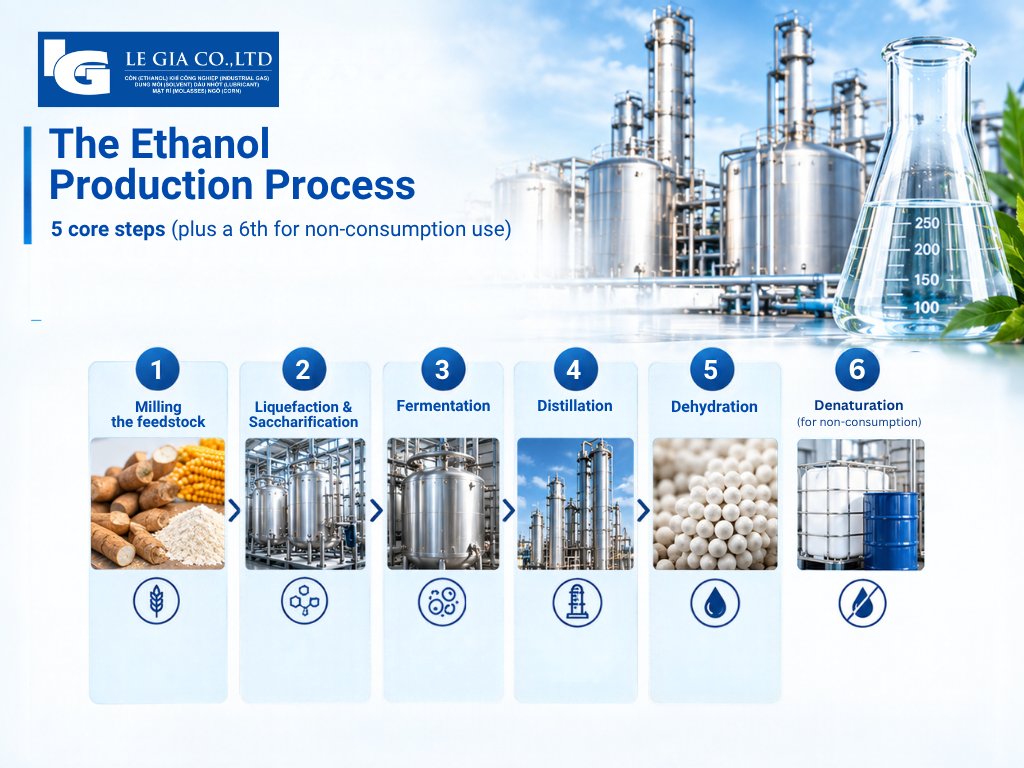
The ethanol production process follows 5 core steps: milling the feedstock, converting starch into sugar through liquefaction and saccharification, fermenting that sugar with yeast, concentrating the alcohol by distillation, and removing the remaining water by dehydration. When the ethanol is not intended for consumption, a sixth step, denaturation, adds a substance that makes it undrinkable. The Renewable Fuels Association’s 2025 Pocket Guide to Ethanol describes nearly all U.S. ethanol as produced by dry mills through milling, cooking, enzymatic breakdown, fermentation, distillation and dehydration, which remains the reference model for starch-based production.
The sequence is easier to evaluate when each step is linked to the output a buyer eventually receives, as the following overview shows.
| Step | Main purpose | Intermediate output |
| Milling | Break feedstock into fine particles | Meal or mash base |
| Liquefaction and saccharification | Convert starch into fermentable sugar | Glucose-rich mash |
| Fermentation | Turn sugar into alcohol using yeast | “Beer” containing ethanol and CO2 |
| Distillation | Separate and concentrate ethanol | Hydrous ethanol (around 95–96% v/v) |
| Dehydration | Remove residual water | Anhydrous ethanol (up to 99.5%) |
| Denaturation (optional) | Make ethanol unfit for drinking | Denatured ethanol |
Sugar-based feedstocks such as sugarcane juice or molasses skip the starch-conversion step entirely, whereas starchy materials such as corn and cassava require it. For a buyer, this difference matters less for purity than for supply stability, because feedstock seasonality affects how consistently a plant can deliver the same specification throughout the year.
Understanding these steps also helps a buyer interpret a CoA. Methanol and higher alcohols are largely controlled during distillation, water content is decided at dehydration, and denaturant identity is fixed at blending, so each line on a CoA points back to a specific stage of the plant. That traceability starts with the very first step, where the physical preparation of feedstock sets the conditions for everything that follows.
How does milling prepare feedstock for fermentation
Milling prepares feedstock for fermentation by grinding grain or root crops into a fine meal, which exposes the starch so that water and enzymes can reach it efficiently. Without adequate milling, starch granules stay locked inside the plant structure and a significant portion of potential sugar never becomes alcohol.
Plants generally use one of two milling approaches. According to the Renewable Fuels Association, dry milling grinds the entire kernel into meal and slurries it with water to form a mash, whereas wet milling first soaks the grain and then separates it into germ, fiber, gluten and starch streams. The Alternative Fuels Data Center adds that wet mills primarily produce corn sweeteners alongside ethanol, corn oil and starch, and that nearly 90% of U.S. ethanol plants are dry mills because of their lower capital costs.
The same logic applies to feedstocks common in Southeast Asia. Le Gia’s certificate of analysis for product code LGCS, dated 3 February 2026, identifies cassava as the feedstock for its undenatured ethanol, and cassava, like corn, is a starch crop that must be milled and converted before yeast can use it.
For buyers, the practical implication is that raw-material consistency at this stage influences batch-to-batch uniformity later, which is one reason to request a CoA for every shipment rather than a single representative sheet. Once the feedstock is milled, the next task is chemical: turning long starch chains into sugars that yeast can ferment.
What happens during liquefaction and saccharification
Liquefaction and saccharification are two enzymatic steps that convert starch into glucose: liquefaction breaks long starch chains into shorter fragments called dextrins, and saccharification splits those dextrins into single glucose molecules. Yeast cannot ferment starch directly, so these steps determine how much of the feedstock’s energy is eventually available for alcohol production.
| Stage | Enzyme | What it does | Output |
| Liquefaction | Alpha-amylase | Cuts starch into shorter chains under heat | Dextrins (thinner mash) |
| Saccharification | Glucoamylase | Releases glucose units from dextrins | Fermentable glucose |
Liquefaction runs at elevated temperature so the mash becomes fluid and pumpable, while saccharification runs cooler because glucoamylase is more sensitive to heat. Some plants carry out saccharification simultaneously with fermentation, which saves time and reduces the risk of bacteria feeding on free sugar.
A simple analogy helps non-technical stakeholders: liquefaction is like cutting a long rope into short pieces, and saccharification unties each piece into individual strands that yeast can consume. Plants monitor sugar levels during these stages because an incomplete conversion leaves residual starch that lowers yield and can affect downstream cleanliness.
Sugar-based feedstocks such as sugarcane juice and molasses skip this step because their sucrose is already fermentable after dilution. Once glucose is available, whatever its origin, the process moves into the biological heart of ethanol production: fermentation.
How does yeast fermentation convert sugars to ethanol
Yeast fermentation converts sugars to ethanol when yeast, most commonly Saccharomyces cerevisiae, consumes glucose in the absence of oxygen and releases ethanol and carbon dioxide. The simplified reaction is C6H12O6 → 2 C2H5OH + 2 CO2, meaning that one glucose molecule yields two ethanol molecules and two carbon dioxide molecules.
Plants control several conditions to keep yeast productive. Temperature must stay within the range the strain tolerates, pH must discourage bacterial competitors, and the fermenter must remain oxygen-free once active fermentation begins. If temperatures rise too far, yeast becomes stressed and produces more unwanted compounds, such as higher alcohols (often called fusel oils), which later have to be removed.
The finished liquid, called “beer” in the industry, contains ethanol at a relatively low concentration together with water, residual solids and trace by-products. The Alternative Fuels Data Center lists carbon dioxide alongside distillers grains as a co-product of dry-mill ethanol plants.
For buyers, fermentation is where much of the impurity profile originates. Contamination or poor temperature control creates compounds such as acetaldehyde and ethyl acetate that distillation must then separate, so a clean fermentation makes a clean final product easier and cheaper to achieve. Separating those compounds from the ethanol is the job of distillation.
Why is distillation critical for ethanol concentration
Distillation is critical because it is the step that raises ethanol from the low concentration found in fermented beer to roughly 95-96% by volume while removing most volatile impurities. The principle is straightforward: ethanol boils at about 78.4 °C and water at 100 °C, so heating the mixture enriches the vapour in ethanol, which is then condensed and collected.
Industrial plants use a series of columns rather than a single boil. A beer (stripping) column first separates alcohol from solids and most water, a rectification column concentrates the alcohol further, and additional refining columns can draw off light impurities, such as acetaldehyde, and heavy impurities, such as fusel oils, at different heights in the column. The number of columns and the degree of refining depend on the grade the plant is targeting, which is why food and medical ethanol usually undergo more rigorous refining than fuel ethanol.
Distillation results are verified by laboratory testing. Le Gia’s certificate of analysis for product code LGCS (cassava), dated 3 February 2026, reports an alcohol strength of 96.0% v/v at 20 °C, methanol at 32.0 ppm, acetaldehyde at 10.0 ppm and ethyl acetate at 15.0 ppm, with the impurities measured by gas chromatography (GC). These figures show how each impurity line on a CoA reflects distillation performance.
Distillation has a physical limit, however, because ethanol and water form an azeotrope at about 95.6% ethanol by mass, a mixture that boils at roughly 78.2 °C with the same composition in liquid and vapour, so simple distillation cannot concentrate it further. Reaching higher purity requires a different technique: dehydration.
How does dehydration achieve high-purity anhydrous ethanol
Dehydration achieves high-purity anhydrous ethanol by removing the water that distillation cannot separate, pushing ethanol beyond the azeotrope to 99.5% or higher. “Anhydrous” simply means “without water,” and this grade is required wherever residual moisture would interfere with the application, such as fuel blending, certain chemical syntheses and moisture-sensitive formulations.
| Method | Working principle | Typical application focus |
| Molecular sieve | Porous zeolite beads adsorb water molecules while letting ethanol pass | Fuel, pharmaceutical and general high-purity use |
| Azeotropic distillation | An entrainer changes the boiling behaviour so water can be separated | Older installations and chemical-synthesis contexts |
Molecular sieves, typically 3A zeolites, are widely used in modern plants because they remove water without introducing a third chemical, unlike the entrainer required in azeotropic distillation. The sieve beds alternate between adsorbing water and being regenerated, allowing continuous operation.
Anhydrous ethanol readily absorbs moisture from the air, so sealed packaging and dry storage matter as much as the dehydration itself. With the core steps established, the next question is how the choice of feedstock and production route changes the process.
What are the different ethanol production routes and feedstocks
Ethanol is produced through three main routes: fermentation of sugar or starch crops, petrochemical hydration of ethylene, and advanced cellulosic processes that convert plant fibre into sugars or gas. Each route suits different raw materials, costs and end uses, and the route a supplier uses can affect both documentation requirements and buyer acceptance in regulated industries.
| Route | Feedstock | Conversion mechanism | Common end uses |
| Sugar/starch fermentation | Corn, sugarcane, molasses, cassava | Yeast fermentation | Food, medical, industrial, fuel |
| Ethylene hydration | Ethylene from petroleum or gas | Acid-catalysed chemical reaction | Industrial solvents, chemical intermediates |
| Cellulosic (biochemical) | Crop residues, grass, wood | Pretreatment, hydrolysis, fermentation | Mainly fuel |
| Cellulosic (thermochemical) | Crop residues, grass, wood | Gasification to syngas, then catalysis | Mainly fuel, still developing |
Feedstock availability largely decides which route a region favours. According to the Alternative Fuels Data Center, most U.S. ethanol is produced from starch-based crops in dry-mill and wet-mill plants, while cellulosic ethanol follows either a biochemical or a thermochemical pathway. In Southeast Asia, cassava and sugarcane molasses are more relevant, a regional reality that most English-language process guides overlook.
For buyers, the route has three practical consequences. First, it shapes the impurity profile, since fermentation and synthesis leave different trace compounds. Second, it affects origin declarations, because buyers in regulated supply chains often need to state whether their ethanol is of agricultural or synthetic origin. Third, it influences price stability, since fermentation costs track crop markets while synthetic ethanol tracks petrochemical prices.
A supplier that cannot state its production route clearly is a red flag in any regulated supply chain. The most common comparison buyers face is between fermentation feedstocks themselves, starting with corn and sugarcane.
How does fermentation of corn and sugarcane differ
Corn and sugarcane fermentation differ mainly in preparation: corn is a starch crop that must be milled and enzymatically converted to glucose before fermentation, whereas sugarcane already contains sucrose that yeast can ferment after juice extraction. This single difference shapes plant design, energy use and co-products.
| Factor | Corn (starch) | Sugarcane / molasses (sugar) | Cassava (starch) |
| Preprocessing | Milling, liquefaction, saccharification | Crushing and juice extraction, or molasses dilution | Chipping, milling, liquefaction, saccharification |
| Sugar source | Glucose from starch | Sucrose, directly fermentable | Glucose from starch |
| Seasonality | Storable grain, year-round | Harvest-season dependent | Dried chips storable |
Sugarcane plants often burn bagasse, the fibrous residue left after crushing, to generate process steam and electricity, which reduces their external energy demand. Corn plants, by contrast, typically purchase fuel for heating but earn revenue from distillers grains, which the Renewable Fuels Association identifies as a key co-product alongside corn distillers oil.
Cassava sits between the two in practice. Chemically it behaves like corn, since its starch requires enzymatic conversion, but dried cassava chips can be stored and transported, which smooths seasonal supply.
For a buyer, feedstock matters mostly for supply continuity and origin documentation rather than for final purity, because well-run distillation and refining can bring ethanol from any of these crops to a high specification. Synthetic ethanol follows an entirely different path.
What is the petrochemical ethylene hydration process
The petrochemical ethylene hydration process produces ethanol by reacting ethylene gas (C2H4) with steam over an acid catalyst, following the reaction C2H4 + H2O → C2H5OH. Ethylene is typically obtained from cracking petroleum fractions or natural gas liquids, so this route uses no agricultural feedstock at all.
The reaction runs at high temperature and pressure over a solid acid catalyst, commonly phosphoric acid on a porous support. Because each pass converts only part of the ethylene, unreacted gas is recycled, and the resulting ethanol–water mixture is then distilled in much the same way as fermented ethanol.
Synthetic ethanol has a distinct impurity profile. It lacks fermentation by-products such as fusel oils but can contain traces linked to the petrochemical process, such as diethyl ether, so buyers should review the CoA against their application rather than assuming it is “cleaner” or “dirtier” than bioethanol.
The commercial significance of this route lies in its economics and acceptance. Its cost follows oil and gas prices rather than crop harvests, and it is used mainly as an industrial solvent and chemical intermediate, while its use in food and pharmaceutical products depends on customer specifications and destination-market rules. Buyers in regulated industries should therefore always confirm whether ethanol is of fermentation or synthetic origin. A third route aims to avoid both food crops and fossil feedstocks.
How is cellulosic ethanol produced via biochemical pathways
Cellulosic ethanol is produced via biochemical pathways by breaking down plant fibre, such as crop residues, grass or wood, into sugars and then fermenting those sugars in the same way as conventional ethanol. According to the Alternative Fuels Data Center, the biochemical process uses a pretreatment to release hemicellulose sugars, followed by hydrolysis to break cellulose into sugars, which are then fermented, while the recovered lignin is used to produce energy for the process.
The challenge lies in the structure of plant fibre. Cellulose and hemicellulose are bound together with lignin, a tough polymer that shields the sugars from enzymes, so pretreatment with acid, alkali or steam explosion is needed to open this structure. Hydrolysis then releases a mix of six-carbon sugars, such as glucose, and five-carbon sugars, such as xylose, and fermenting the five-carbon sugars requires specialised yeast strains because standard yeast cannot use them efficiently.
The Alternative Fuels Data Center also describes a thermochemical alternative, in which heat and chemicals turn biomass into syngas, a mixture of carbon monoxide and hydrogen, that a catalyst then reforms into ethanol and other liquid co-products.
For Southeast Asian readers, rice straw and bagasse are frequently cited as potential feedstocks, but cellulosic ethanol remains mainly a fuel-sector development rather than a source for food or medical grades today. For most B2B buyers, purity grade is a far more immediate concern than feedstock innovation.
How does production process determine ethanol purity grades
The production process determines ethanol purity grades through three variables: how thoroughly the ethanol is refined during distillation, whether it is dehydrated to remove residual water, and whether a denaturant is added. Two batches can share the same alcohol strength yet belong to different grades because their impurity limits, testing requirements and intended uses differ.
| Grade | Typical strength | Process emphasis | Typical documentation | Typical uses |
| Medical grade | As defined by the applicable pharmacopoeia | Intensive refining, strict impurity control, controlled production environment | Batch CoA against pharmacopoeia, quality system certificate | Antiseptics, pharmaceutical excipients |
| Food grade | Hydrous, around 95–96% v/v | Neutral taste and odour, low methanol and fusel oils | Batch CoA against food standards | Beverages, extracts, flavours |
| Industrial grade | Hydrous or anhydrous | Specification fitted to application, cost-efficient refining | Batch CoA, SDS | Paints, inks, coatings, electronics cleaning |
| Denatured | Up to 99.5% base ethanol | Dehydration plus approved denaturant | CoA, denaturant formula, SDS | Cosmetics, sanitizers, solvents, fuel |
Testing methods are as important as limits. Le Gia’s 2026 certificate of analysis references ASTM D4052 for density-based alcohol strength, ASTM D1209 for colour, ASTM D1613 for acidity, ASTM E203 for water content by Karl Fischer titration, and gas chromatography for volatile impurities. When a buyer compares two suppliers, checking that both CoAs use equivalent methods prevents misleading comparisons.
Pharmacopoeial standards, such as the USP, EP and BP monographs, define medical-grade requirements, while national food regulations define food-grade limits. Because these limits change with new editions, buyers should always specify the edition their QA team applies. The strictest requirements apply to medical-grade ethanol.
What process steps produce medical-grade ethanol
Medical-grade ethanol is produced through intensive distillation and refining, strict control of toxic impurities such as methanol and benzene, and manufacture within a documented quality management system that allows every batch to be traced. The goal is ethanol safe for contact with patients, whether as an antiseptic or as an ingredient in medicines.
Beyond standard distillation, medical-grade production typically adds extra rectification passes, and some producers use activated carbon treatment to remove trace organic compounds. The finished product is tested against a pharmacopoeial monograph, which covers parameters such as ethanol content, methanol, acetaldehyde, benzene and non-volatile residue, and microbial quality may also be specified depending on the end use.
Quality system certification provides a second layer of assurance. Le Gia holds an ISO 13485:2016 certificate issued by ISSQ, first granted on 26 April 2024 and valid until 25 April 2027, covering the manufacture and trading of medical alcohol, nasal spray and saline solution. ISO 13485 is a quality management standard for medical devices, so buyers of pharmaceutical excipient ethanol should still request pharmacopoeia conformity data in addition to the certificate.
For procurement teams, the lesson is clear: a “medical grade” label means little without a batch CoA stating which monograph and edition were applied. Industrial buyers, by contrast, work with more flexible specifications.
How is industrial-grade ethanol manufactured for solvents
Industrial-grade ethanol is manufactured through standard distillation, and dehydration where required, to a specification defined by the application rather than by a pharmacopoeia, which allows producers to balance purity against cost. The result is ethanol that performs reliably as a solvent, cleaning agent or chemical intermediate without paying for refinement the application does not need.
A typical hydrous ethanol specification can be illustrated with a real certificate. Le Gia’s certificate of analysis for undenatured cassava ethanol, product code LGCS, dated 3 February 2026, reported the following results.
| Parameter | Specification limit | Test result | Method |
| Alcohol strength at 20 °C | Min 95% v/v | 96.0% v/v | ASTM D4052 |
| Colour (Pt-Co) | Max 10 | <5.0 | ASTM D1209 |
| Acidity as acetic acid | Max 50 mg/L | 8.6 mg/L | ASTM D1613 |
| Water content | Max 5.5% vol | 4.6% vol | ASTM E203 |
| Ethyl acetate | Max 100 ppm | 15.0 ppm | GC |
| Acetaldehyde | Max 40 ppm | 10.0 ppm | GC |
| Methanol | Max 100 ppm | 32.0 ppm | GC |
| Isopropanol | Max 1000 ppm | 130.0 ppm | GC |
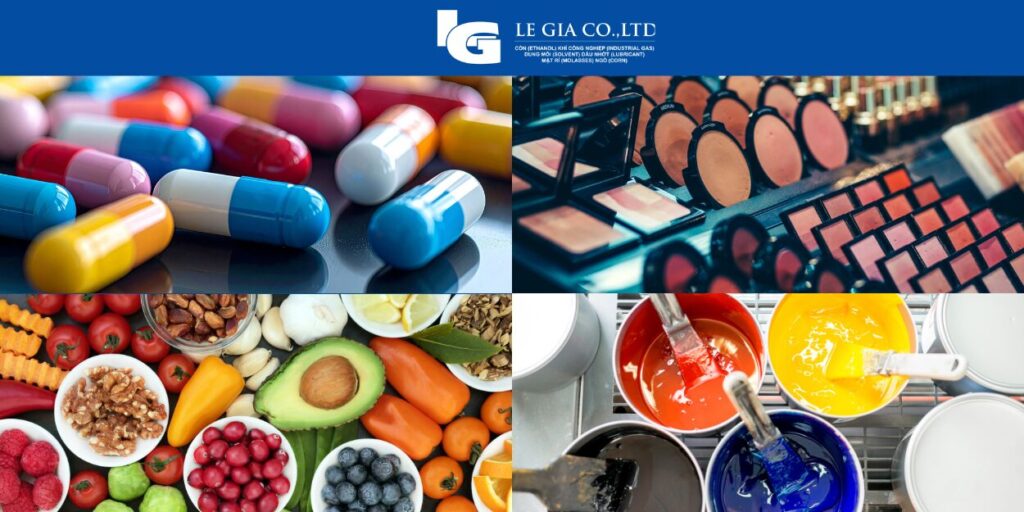
According to Le Gia’s company profile (2025), the company supplies ethanol to industries including paint, electronics, cosmetics, pharmaceuticals and food and beverage. Paint and ink formulators typically focus on water content and acidity, because excess water affects drying and acidity can react with pigments, while electronics cleaning applications prioritise low non-volatile residue so that no film remains on components.
Industrial buyers can also request denatured variants where their application allows. Food manufacturers, however, operate under a different set of standards.
What makes food-grade ethanol meet international standards
Food-grade ethanol meets international standards when it is produced from food-approved feedstock, refined to a neutral taste and odour, and certified as meeting the methanol, higher-alcohol and other impurity limits set by the destination market’s food regulations. The defining quality attribute is neutrality: food-grade ethanol should add no off-flavour to the beverage, extract or flavouring it carries.
Achieving that neutrality depends mainly on distillation and refining. Higher alcohols, aldehydes and esters produce solvent-like or fruity notes even at trace levels, so food-grade production removes these compounds more thoroughly than a basic industrial run. Many producers also conduct sensory evaluation alongside laboratory testing, because the human nose can detect some off-notes that are hard to quantify.
How is 99.5% high-purity denatured ethanol achieved
High-purity denatured ethanol at 99.5% is achieved by first dehydrating ethanol, typically with molecular sieves, to reach anhydrous purity, and then blending in an approved denaturant under controlled conditions so the product becomes unfit for drinking while remaining suitable for its technical application. For ethanol denturation requirements, Le Gia specialises in ethanol denaturation and offers ethanol at purities of up to 99.5%.
The process follows 4 stages: dehydration to the target base purity, dosing of the denaturant according to the required formula, homogenisation in a blending tank, and verification by density measurement and gas chromatography to confirm both ethanol content and denaturant concentration.
Denaturant choice depends entirely on the end use and the destination market’s regulations.
| Denaturant | Purpose | Typical context |
| Gasoline | Makes ethanol undrinkable for fuel use | Fuel ethanol |
| Denatonium benzoate (Bitrex) | Intensely bitter taste deters ingestion | Sanitizers, consumer products |
| Isopropanol | Compatible with skin-contact formulations | Cosmetics, personal care |
| Methanol | Low-cost denaturant | General industrial uses where permitted |
According to the Renewable Fuels Association, fuel ethanol is blended with about 2% denaturant, such as gasoline, to render it undrinkable. For other applications, the exact denaturant and dosage must follow the formulas approved in the destination market, which is why choosing the right formula is one of several decisions that separate a capable ethanol partner from a commodity trader.
How do B2B buyers select the right ethanol production partner
B2B buyers select the right ethanol production partner by evaluating 5 factors: documented batch quality, verifiable certifications, ability to customise grades and denaturants, reliable supply capacity, and responsive technical support. Price matters, but a cheaper supplier that causes one rejected batch or production stoppage quickly becomes the more expensive option.
The following framework helps procurement and QA teams structure a supplier assessment.
| Criterion | What to ask | Warning sign |
| Batch documentation | A CoA for every shipment, with test methods | One generic spec sheet for all shipments |
| Certification | Certificate scope, number and validity dates | Expired certificates or unclear issuing body |
| Customisation | Blending and denaturation to your specification | Only fixed standard grades |
| Supply capacity | Annual volume and lead time | No stated capacity or vague delivery promises |
| Safety and logistics | Current SDS, transport classification, packaging options | Missing or outdated SDS |
Supply capacity should match your forecast with a comfortable margin. According to Le Gia’s company profile (2025), the company has a supply capacity of 12,000,000 litres of ethanol per year and can deliver from 10 working days, supported by control over production, trading and blending.
Safety documentation is equally important for logistics planning. Le Gia’s Safety Data Sheet No. 012022 (2022) classifies undenatured ethanol under UN 1170 as a Class 3 flammable liquid, Packing Group II, with a flash point of 14 °C, which determines how the product must be packaged, labelled and transported.
A supplier that answers these questions quickly and with documents, rather than assurances, is usually one that manages its process well. The first document to scrutinise is the purity specification itself.
What purity specifications should pharma and F&B buyers require
Pharmaceutical and food and beverage buyers should require a batch-specific certificate of analysis against a named standard, plus supporting documents that confirm safety, traceability and certification validity. A named standard, such as a specific pharmacopoeia monograph and edition or a national food regulation, turns a vague “high purity” promise into a testable commitment.
A complete documentation package for regulated buyers typically includes the following items.
- A certificate of analysis for each batch, listing every parameter, its limit, the result and the test method used.
- A statement of the standard applied, including pharmacopoeia monograph and edition for medical use or the food regulation for F&B use.
- A current Safety Data Sheet reflecting the destination market’s regulatory format.
- Quality system certificates with scope, certificate number, issuing body and validity dates clearly visible.
- Declarations of feedstock origin and, where relevant, residual solvent, heavy metal or pesticide assessments.
Beyond documents, buyers reduce risk by testing samples in their own laboratory before placing a bulk order, confirming packaging and transport conditions, and agreeing contractually on how quality disputes will be resolved. Comparing a supplier’s CoA with your own incoming test results over several batches also reveals whether the supplier’s figures are reliable.
This checklist protects both patient or consumer safety and the buyer’s own regulatory standing. Once the specification is fixed, many buyers also need the ethanol tailored to their formulation through denaturation.
How does custom denaturation meet industry-specific needs
Custom denaturation meets industry-specific needs by matching the denaturant type and dosage to the buyer’s product, so the ethanol is unfit for drinking while remaining fully compatible with the formulation it goes into. A denaturant that suits fuel, such as gasoline, would ruin a cosmetic, so the choice must be made application by application.
Different industries prioritise different properties, as the following examples show.
- Cosmetics and personal care makers usually prefer denaturants that are compatible with skin contact and leave no strong odour in the finished product.
- Hand sanitizer producers often choose a bittering agent such as denatonium benzoate to discourage accidental ingestion by children.
- Coatings and ink manufacturers may select denaturants that support their evaporation profile and resin compatibility.
- Fuel blenders use gasoline as a denaturant, which also prevents diversion into beverages.
What quality certifications validate production standards
Quality certifications validate production standards by confirming, through independent audit, that a supplier’s management systems meet an internationally recognised framework. The most relevant certifications for ethanol buyers depend on the end use.
- ISO 9001 covers general quality management and applies across all grades.
- ISO 13485 covers quality management for medical devices and related products.
- GMP (Good Manufacturing Practice) is relevant for pharmaceutical supply chains.
- ISO 22000 or FSSC 22000 covers food safety management for F&B supply.
- ISO 14001 and ISO 45001 cover environmental and occupational health and safety management.
A certificate is only meaningful if it is current and covers the right activity. Buyers should check three details on every certificate: the scope, which must name the product or activity being purchased; the validity dates; and the issuing body, including whether it carries an accreditation mark.
With a partner’s quality credentials confirmed, many buyers also want to understand the plant economics behind the price they are offered.
What are the efficiency metrics and co-products in ethanol plants
The efficiency of an ethanol plant is measured mainly by three metrics: yield (litres of ethanol per tonne of feedstock), energy consumption per litre produced, and the value recovered from co-products. Together they determine production cost, and production cost ultimately shapes the price and price stability a buyer can expect.
| Metric | What it measures | Why it matters to buyers |
| Yield | Ethanol produced per tonne of feedstock | Higher yield lowers cost per litre |
| Energy intensity | Heat and power used per litre | Distillation and dehydration require sustained heating |
| Co-product revenue | Value from grains, oil, CO2 or residues | Offsets part of production cost |
| Water use | Water consumed per litre | Affects cost and sustainability reporting |
Efficiency gains in the industry have been substantial. According to the Renewable Fuels Association, natural gas and electricity use at U.S. dry-mill ethanol plants has fallen nearly 40% since 1995 and consumptive water use has been cut in half, while producers now obtain 15% more ethanol from a bushel of corn than they did 20 years ago.
For procurement teams, these metrics are not just engineering concerns. A plant with good yield and diversified co-products is typically less exposed to feedstock price swings, which translates into more stable pricing across long-term contracts. Conversely, a supplier whose cost structure depends on a single feedstock and a single product may pass volatility straight to the buyer. Yield and energy use are the first places where these differences appear.
How do yield and energy consumption impact production costs
Yield and energy consumption impact production costs because feedstock and energy are among the largest inputs in producing a litre of ethanol, so every improvement in conversion efficiency or heat recovery lowers the cost per litre directly. A plant that extracts more alcohol from each tonne of raw material needs to buy less feedstock for the same output.
Yield depends on how completely each step converts its input. Incomplete starch conversion in saccharification, bacterial contamination in fermentation and alcohol losses in distillation all subtract from the theoretical maximum. Energy use depends heavily on distillation design, heat integration between columns and the dehydration technology the plant has installed.
Feedstock choice also changes the energy balance. Sugarcane plants can burn bagasse to generate their own steam and electricity, while starch-based plants typically rely on purchased fuel, which makes their costs more sensitive to energy prices.
For buyers, understanding these drivers helps interpret price movements. When crop prices rise, fermentation-based ethanol typically follows, and when energy prices spike, plants with poor heat recovery feel it most. Asking a supplier how it manages feedstock sourcing and energy costs gives a useful indication of how stable its pricing will be. Much of the answer lies in how well a plant monetises what it does not sell as ethanol.
What valuable co-products come from ethanol manufacturing
Ethanol manufacturing generates several valuable co-products, including distillers grains, corn oil and carbon dioxide from corn plants, and bagasse and molasses from the sugarcane chain. According to the Renewable Fuels Association, dry-mill stillage is separated into solids and solubles that become distillers grains and corn distillers oil, while the Alternative Fuels Data Center lists carbon dioxide as a dry-mill co-product and corn oil and starch as wet-mill co-products.
Each co-product serves a separate market. Distillers grains, the protein- and fibre-rich residue left after fermentation, are sold as livestock feed. Corn oil extracted from the stillage can serve as a biodiesel feedstock. Carbon dioxide captured from fermenters can be purified for use in beverages, food processing and dry ice. In the sugarcane chain, bagasse fuels boilers or feeds paper and board production, while molasses is used for animal feed, yeast production and further fermentation.
For buyers, a supplier with diversified revenue streams is often better positioned to hold prices steady and maintain supply through market disruptions. Yet even the best-run plants face practical issues that standard process guides rarely mention.
What do most ethanol process guides fail to explain
Most ethanol process guides fail to explain the practical factors that decide whether a shipment actually works for the buyer: regional feedstocks, batch-to-batch variation, CoA interpretation, packaging, transport classification and the hidden costs of quality disputes. Public guides tend to stop at the plant gate, while buyers’ problems usually begin there.
Regional feedstock is the first gap. Guides focused on American corn or Brazilian sugarcane rarely discuss cassava and molasses, even though these are central to Southeast Asian production. Le Gia’s 2026 certificate of analysis identifies cassava as its ethanol feedstock, a reminder that buyers sourcing from Asia should understand these raw materials rather than assuming corn-based benchmarks apply.
CoA interpretation is the second gap. A CoA shows both the specification limit and the actual result, and the distance between them indicates how much safety margin a batch has. Le Gia’s 2026 certificate of analysis, for example, shows methanol at 32.0 ppm against a 100 ppm limit, which tells a buyer far more than a simple “pass” statement.
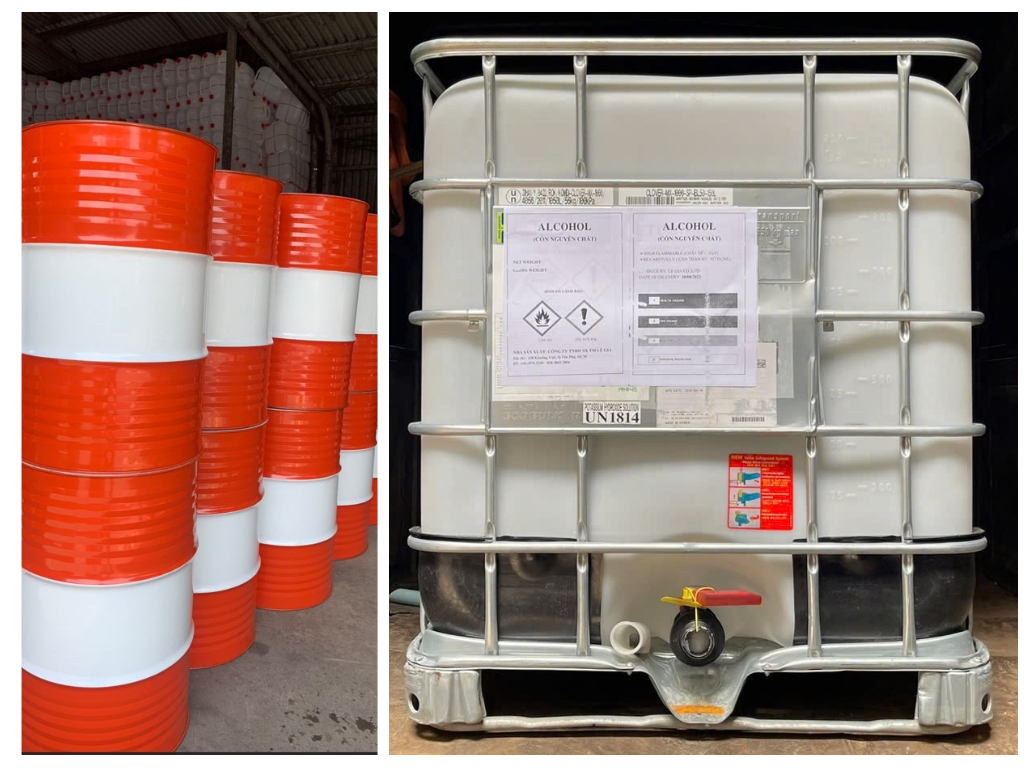
Logistics is the third gap. Ethanol is a dangerous good, classified in Le Gia’s SDS No. 012022 (2022) as UN 1170, Class 3, Packing Group II, so packaging and transport choices, whether drums, jerrycans or ISO tank containers, affect cost, lead time and compliance. Moisture pickup during storage or transfer can also push water content out of specification, particularly for anhydrous grades.
Finally, disputes carry hidden costs such as re-testing fees, demurrage while containers wait at port, and production downtime. Agreeing in advance on test methods and dispute procedures prevents most of them. Managing these realities well is largely a matter of accumulated experience.
Why does 20+ years of production experience matter for quality
Twenty-plus years of production experience matters for quality because long operating history builds the process knowledge, supplier relationships and batch data that allow a plant to deliver the same specification consistently and to resolve deviations quickly. Ethanol chemistry does not change, but feedstock quality, regulations and customer requirements do, and experienced teams have already met most of the problems a new buyer might face.
Le Gia started as a small production facility, with a history dating back to 2001, and has since expanded its operations, invested in product quality and grown into an exporter serving more than 10 countries and territories, including Taiwan, South Korea, Australia, Canada, Thailand, Laos, Cambodia, Indonesia, India and Singapore. Over that period, its portfolio has broadened from ethanol into denatured formulations, industrial gases and molasses.
Experience shows up in practical ways. A seasoned plant team recognises how a change in feedstock batch will affect fermentation, adjusts distillation before impurities drift, and knows which documentation each export market expects. That institutional knowledge reduces the risk of a new buyer becoming the supplier’s learning case.
The client list of our comapny includes C.P. Group, Ajinomoto, Acecook, Nippon Paint, Siegwerk and Nutifood, spanning food, paint and ink industries with demanding quality systems of their own.
What compliance risks arise from incorrect ethanol specifications
Incorrect ethanol specifications create compliance risks that range from rejected shipments and product recalls to tax penalties and reputational damage, because ethanol that does not match its stated grade can breach food, pharmaceutical, cosmetic and customs rules at the same time. The cost of a single failure often exceeds the price difference between a cheap and a reliable supplier many times over.
The most common risk scenarios include the following.
- In pharmaceutical manufacturing, ethanol that exceeds methanol or other impurity limits can force a batch recall and trigger regulatory investigation.
- In food and beverage production, a CoA that does not match the destination country’s standards can lead to products being held or rejected at customs.
- In cosmetics, residual impurities can cause skin irritation complaints and damage a brand’s reputation.
- In export trade, a mismatch between the contract specification and the CoA can result in shipment rejection at the destination port.
- In tax compliance, declaring ethanol as denatured when it is not, or the reverse, can expose a company to excise penalties.
Most of these risks can be controlled before shipment. Independent pre-shipment testing by an inspection company, contract clauses that name the test methods and standard edition, and sample approval before bulk orders all shift problems upstream, where they are cheaper to fix. Keeping the SDS current is also essential, since outdated safety documentation can itself be a compliance breach. Specification risk is ultimately managed through clear communication between buyer and supplier, starting with a precise enquiry.
Ready to source high-purity ethanol for your industry
Le Gia supplies food-grade, medical-grade, industrial and denatured ethanol from Vietnam, with blending and denaturation tailored to each customer’s specification. In addition, we offer ethanol at purities of up to 99.5%, a supply capacity of 12,000,000 litres per year and delivery from 10 working days.
Whether you are a formulator in cosmetics, a procurement manager in food and beverage or a QA lead in pharmaceuticals, the most efficient way to start is with a clear specification. Share the grade you need, the standard and edition your QA team applies, your denaturant requirements if any, and your target volume and delivery schedule, and Le Gia’s team can then confirm feasibility, provide sample documentation and propose a supply plan.
Buyers who switch suppliers because of repeated quality issues often wish they had asked for batch-level CoAs and certificate scopes earlier. Starting the conversation with documentation first saves weeks of back-and-forth and protects your production schedule.
Contact Le Gia to discuss your ethanol specification
Email: ethanol@legia.vn
Phone / WhatsApp: +84 908 769 151 (Mrs. Thắm)
Address: 108 Khuong Viet, Tan Phu Ward, Ho Chi Minh City
Frequently asked questions about ethanol production
The following answers address edge cases that buyers often raise after understanding the main production process.
What is the difference between denatured and undenatured ethanol
Denatured ethanol contains an added substance, such as gasoline, isopropanol or a bittering agent, that makes it unfit for drinking, whereas undenatured ethanol contains no denaturant and is used where purity must be preserved, such as in food and many pharmaceutical applications.
How do export markets like Japan and Korea verify ethanol purity
Ethanol exporters shipping to markets such as Japan and South Korea should match the batch CoA to the importing country’s specifications and confirm documentation, testing and denaturant requirements with the importer before shipment, because verification rules differ by product grade and end use.