An ethanol denaturation specialist turns a written specification into a compliant, production-ready denatured alcohol – selecting the denaturant system your destination market accepts, blending it into base ethanol at the statutory loading, and releasing each lot against its own certificate of analysis. Lê Gia works this way: you send a specification, we return formula options built around the market you sell into, then a trial sample for your own stability testing, with production delivery from 10 working days once that sample is approved. This page answers the question buyers actually have at this stage: how to brief a denaturing supplier, and what a competent one should send back before you commit a purchase order.
What ethanol denaturation is as a manufacturing service
Most buyers believe they are purchasing a product. They are purchasing a specification, plus the documentation that proves the specification was met. The liquid is the easy part – every competent distillery can make 96% ethanol. What separates suppliers is whether the denaturant system was chosen against your destination market and your formulation, and whether the paperwork survives an audit.
| Buying from a price list | Buying to a specification | |
| What you choose | A grade name | Denaturant, loading, destination market, end use |
| What arrives | Whatever is in the tank that week | A formula built for your product |
| Documentation | A product datasheet | A certificate tied to your lot |
| When problems surface | In your stability testing | Before production, in the sample |
That last row is the whole argument. A denaturation partner moves the failure point backwards, into a trial sample you can reject cheaply.
What a denaturing specification actually contains
Five inputs. Send all five and a specialist can respond without a discovery call.
- Base ethanol grade and strength: the starting alcohol, before anything is added.
- Denaturant identity and loading: expressed the way your destination market expresses it: gallons per 100 gallons for US formulas, litres per hectolitre for EU procedures.
- Destination market and end-use category: this pair determines which formulas are legal for you, and it eliminates more options than any other input.
- Finished-product constraints: odour, residue, colour, water content: whatever your formulation cannot tolerate.
- Pack format and documentation set: including any certificate your quality team or customs broker will require.
Buyers who send only volume and purity get a quote. Buyers who send all five get a formula.
Where denaturing sits in the production chain
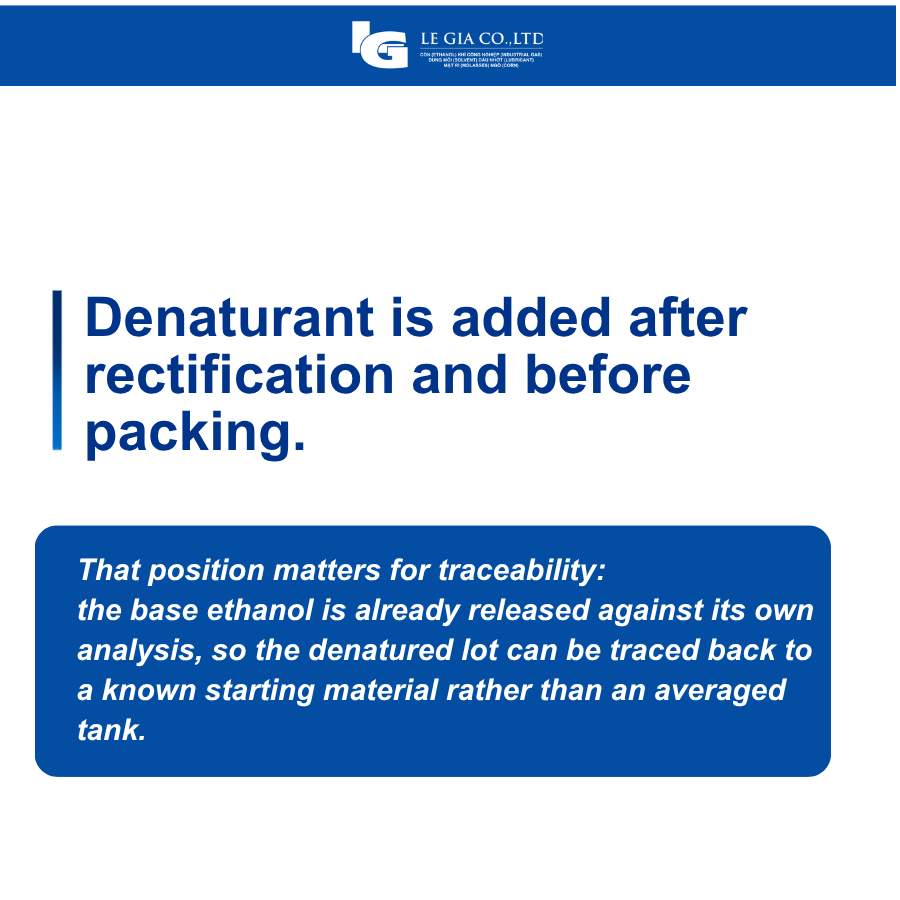
Denaturant is added after rectification and before packing. That position matters for traceability: the base ethanol is already released against its own analysis, so the denatured lot can be traced back to a known starting material rather than an averaged tank.
| Step | What happens | What is recorded |
| Distillation | Fermented feedstock to crude ethanol | Feedstock and batch |
| Rectification | Strength and congeners brought to grade | Base analysis |
| Blending / denaturing | Denaturant added at the statutory loading | Formula, loading, operator |
| QC and COA | Lot released against specification | Lot certificate |
| Packing | Filled to the agreed format | Pack, lot, date |
Which class of denatured ethanol fits your permit situation
Here is the assumption worth breaking early: CDA is not simply the cheap option and SDA is not simply the premium one. Completely denatured alcohol carries lighter user obligations precisely because it is harder to reverse – the permit burden follows reversibility, not quality. Cost follows the permit burden.
The second assumption worth breaking: “SDA is skin-safe, CDA is toxic” is wrong. Toxicity follows the individual formula. CDA Formula No. 20 (hydrocarbons, fuel use only) and CDA Formula No. 35 (ethyl acetate) sit in the same class with completely different profiles.
One practical check before you shortlist. Ask which of these formulas a supplier actually produces. The table below is the regulatory landscape, not an availability guarantee – most producers run a working set of denaturants rather than the full statutory range, and the honest answer to that question tells you more than a capability page will.
| Specially denatured alcohol (SDA) | Completely denatured alcohol (CDA) | |
| Base spirit | Not less than 185 proof | Varies by formula |
| User obligation | TTB permit required | No user permit |
| Use control | Authorised use codes per formula | Use restrictions per formula |
| Example formulas | 3-C, 23-A, 40-B | 18, 19, 20, 12-A, 35 |
| Typical destinations | Cosmetics, personal care, external pharmaceutical, cleaning | Inks, industrial cleaning, coatings, fuel |
When specially denatured alcohol is the right class
Whenever the finished product touches a consumer externally. SDA is produced on alcohol of not less than 185 proof, and users hold a permit, the trade-off you accept in return for formulas engineered to disappear into a formulation.
One boundary is absolute: denatured ethanol is never a raw material for medicines taken internally, and never for mucosal contact. The pharmaceutical authorisations attached to these formulas cover external preparations. Anything ingested or absorbed through mucosa requires undenatured ethanol meeting the applicable pharmacopoeia monograph.
Three carry most personal-care work. SDA 40-B adds one-sixteenth of an ounce of denatonium benzoate and 1/8 gallon of tert-butyl alcohol per 100 gallons; its authorised uses include perfumes, toilet waters, lotions, shampoos and inks. SDA 3-C uses five gallons of isopropyl alcohol. SDA 23-A uses eight gallons of acetone, and is authorised for coatings, adhesives, inks, lotions and antiseptic solutions U.S.P. or N.F.
When completely denatured alcohol is enough
Where nothing touches a consumer, the permit burden is avoidable. CDA covers inks, industrial cleaning, coatings and fuel, and the formulas now listed in 27 CFR Part 21 Subpart C are No. 18, No. 19, No. 20, No. 12-A and No. 35.
Read the authorised use before the price. Formula No. 20 is restricted to fuel use – it cannot be redeployed into a solvent application because it happens to be cheaper. That restriction is the reason the permit is lighter.
Which class export buyers usually need
Frame the question by destination, not preference. The US separates CDA from SDA with different permit paths; the EU works from accepted denaturing procedures rather than a permit class; Japan licenses industrial alcohol at 90 degrees and above. A single formula rarely clears every market, because each regime sets its own accepted denaturants and loadings.
If you sell into more than one region, ask your supplier which single specification covers the most destinations before you qualify three. The formula-by-formula detail sits in our guide to which denaturant suits your application.
How custom denaturant blending works
This is the part no competitor publishes, and the part every buyer wants to know: how do I start, and how long until I have material in hand.
What information to send with a blending request
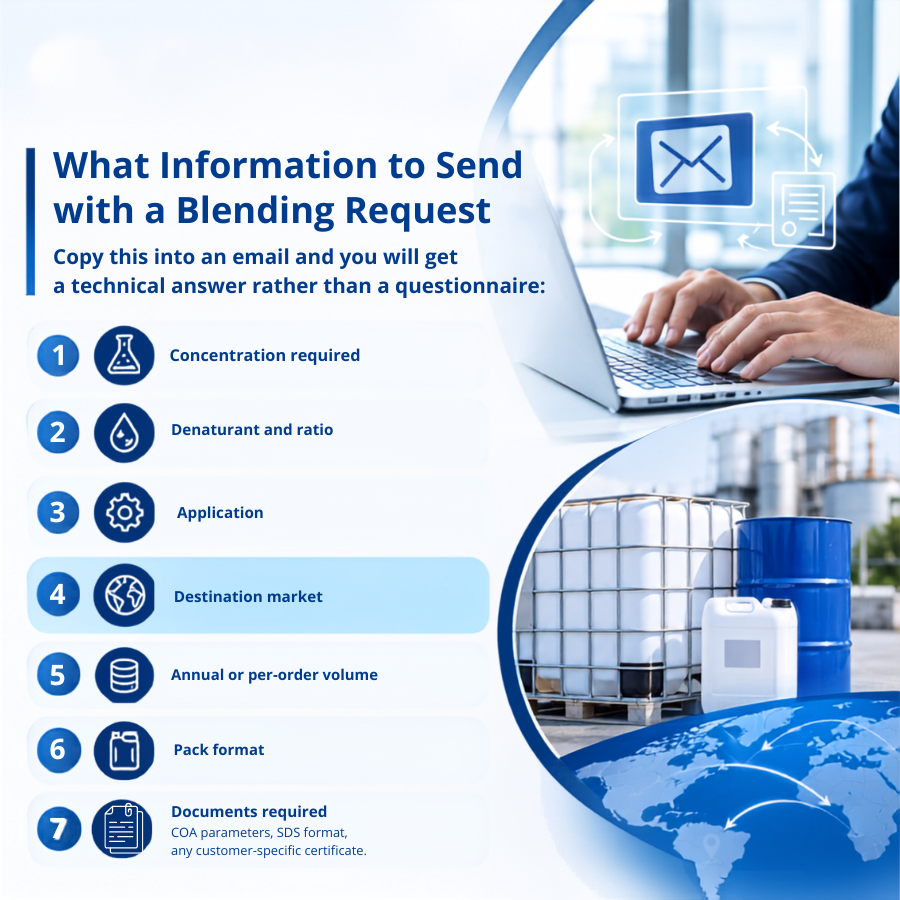
Copy this into an email and you will get a technical answer rather than a questionnaire:
- Concentration required: target strength of the finished denatured product.
- Denaturant and ratio: if one is already qualified in your formulation, name it.
- Application: what the ethanol does in your product, not just the industry.
- Destination market: where the finished goods are sold, not where you are based.
- Annual or per-order volume: enough to size the run.
- Pack format: jerrycan, drum or ISO tank.
- Documents required: COA parameters, SDS format, any customer-specific certificate.
Point 4 is the one most often left out, and the one that changes the answer most.
How long consultation, sampling and first production take
| Stage | What happens | What you receive |
| Technical consultation | Destination market and end use narrow the legal formulas | Formula options and a feasibility answer |
| Trial sample | A bench blend is released against your stated constraints | Sample with its own certificate |
| First production delivery | The approved formula goes to production | Production lot with its own certificate, from 10 working days |
The sequence is designed so the expensive decision comes last. You approve a sample against your own stability and compatibility testing before any production volume is committed. Ask for consultation and sample turnaround in writing alongside the quote – a supplier who cannot commit to either without escalating internally is not set up for custom work.
What minimum order quantities apply
Two figures matter, and they are set separately: the volume that gets you a trial sample, and the production minimum for a first order. Ask for a sample volume large enough to run a real compatibility test rather than a paper assessment. Production minimums depend on pack format and denaturant, since some denaturants are economic only above a certain batch size. Ask for both in the same reply, so you can plan the trial and the first order together rather than discovering the production minimum after the sample has already passed.
What documentation ships with every batch
Capability claims cost nothing to make. Documents can be checked before you order, which is why the paperwork is where a specialist is separated from a trader. The distinction that matters most is a per-lot certificate versus a product-line datasheet reissued indefinitely.
What a batch certificate of analysis must show
A real certificate names the lot, the date, the method against each parameter, and the result. Here is the released parameter set from a recent cassava-based lot of base ethanol, before denaturing:
| Parameter | Method | Result |
| Alcohol strength at 20°C | ASTM D4052 | 96.0% v/v |
| Appearance | Visual | Clear and bright |
| Colour, Pt-Co | ASTM D1209 | <5.0 |
| Acids as acetic acid | ASTM D1613 | 8.6 mg/L |
| pH | ASTM D4623 | 7.4 |
| Water content | ASTM E203 | 4.6% vol |
| Ethyl acetate / acetaldehyde / methanol / isopropanol | GC | 15.0 / 10.0 / 32.0 / 130.0 ppm |
Each lot carries its own certificate. If a document has no lot code and no date, it is a datasheet, and the quality system behind it is a claim rather than a control.
Which safety and transport documents you receive
A safety data sheet, the transport classification and packing group, and the dangerous-goods paperwork the carrier requires. Ethanol solutions move as UN 1170, Class 3, Packing Group II. Export documentation is issued on request against the destination.
Ask which SDS format you will receive and to which regulation it is written, formats differ by jurisdiction, and a sheet written to the wrong standard will be rejected at the receiving plant even when the content is correct.
What to verify before approving any denatured ethanol supplier
- Lot traceability from the certificate back to a production batch.
- Denaturant identity disclosed in writing, for your product safety file.
- Certificates with visible validity dates, not scans without expiry.
- Documented blending capability, not a willingness to try.
- A physical sample before any commitment.
How denatured ethanol is packed, stored and delivered
Logistics is the last objection before an RFQ, and usually the easiest to resolve – provided pack format is matched to draw-down rate rather than to whatever is on the shelf.
Which pack formats are available
| Format | Volume | Suited to |
| Plastic jerrycan | 5 L / 20 L / 30 L | Trials, lab work, small-batch production |
| Steel or plastic drum | 200 L – 225 L | Standard production volumes |
| ISO tank | Bulk | Large-scale export orders |
Match the format to how fast you draw the material down. Oversized packs on a slow-moving line mean repeated opening of the same container, which works against the storage conditions below.
What storage and handling conditions apply
Drawn from the product safety data sheet, not from general advice:
- Store in a cool, well-ventilated place, away from heat, sparks, open flames and hot surfaces.
- Keep containers tightly closed and upright; reseal carefully once opened.
- Take precautionary measures against static discharge; bond and ground during transfer.
- Use only non-sparking tools, and explosion-proof electrical equipment in the transfer area.
- Wear protective gloves with eye and face protection; wash hands thoroughly after handling.
Consult local fire codes for storage quantities and separation distances. Those thresholds are set by your jurisdiction, not by the supplier.
Why buyers move their denatured ethanol supply
The switch is rarely triggered by price. It is triggered by a formulation that failed and a supplier who had no one to put on the call. The pattern repeats: long import lead times that force over-ordering, minimum quantities set for someone else’s volume, no specification flexibility when a second SKU needs a different denaturant, and a generic certificate that the quality team will not accept. Each of those is survivable alone. Together they turn a raw material into a scheduling risk, and that is usually the point at which procurement starts looking.
Which industries we formulate for
Lê Gia has manufactured and traded ethanol from Ho Chi Minh City since 2001, with a capacity of 12 million litres per year and products supplied to more than 10 countries and territories.
- Cosmetics and personal care: perfumes, toilet waters, lotions, shampoos and deodorants, where the denaturant must not fight the fragrance.
- Printing inks: colour stability and residue decide whether the denaturant is invisible on press.
- Paints and coatings: flash-off speed is a throughput variable.
- Industrial cleaning and disinfection: consumer accessibility drives the formula choice.
- External pharmaceutical preparations and medical device cleaning: topical and surface use only; denatured ethanol never enters an internally administered formulation.
- F&B processing
Ready to brief us on your denaturant specificaation
Send the specification, not a request for a price list. Give us the five inputs above and you get formula options plus a sample certificate of analysis your quality team can assess immediately.
Qualification calendars do not compress. Every week you spend on the wrong denaturant is a week added to your own launch date – start the sample now.
Contact: ethanol@legia.vn | +84 908 769 151 (WhatsApp)
FAQ: Ordering custom denatured ethanol
Can you match a denaturant formula our overseas supplier already uses
Send the formula and the destination market. Matching is usually possible, but the loading must still be legal where you sell.
Do you supply the denaturant identity for our product safety file
Yes, in writing. Your safety assessor needs it even where on-pack labelling does not require disclosure.
Can we send our own denaturant for blending
Ask when you send your specification, acceptance depends on the material, its documentation and the production schedule.