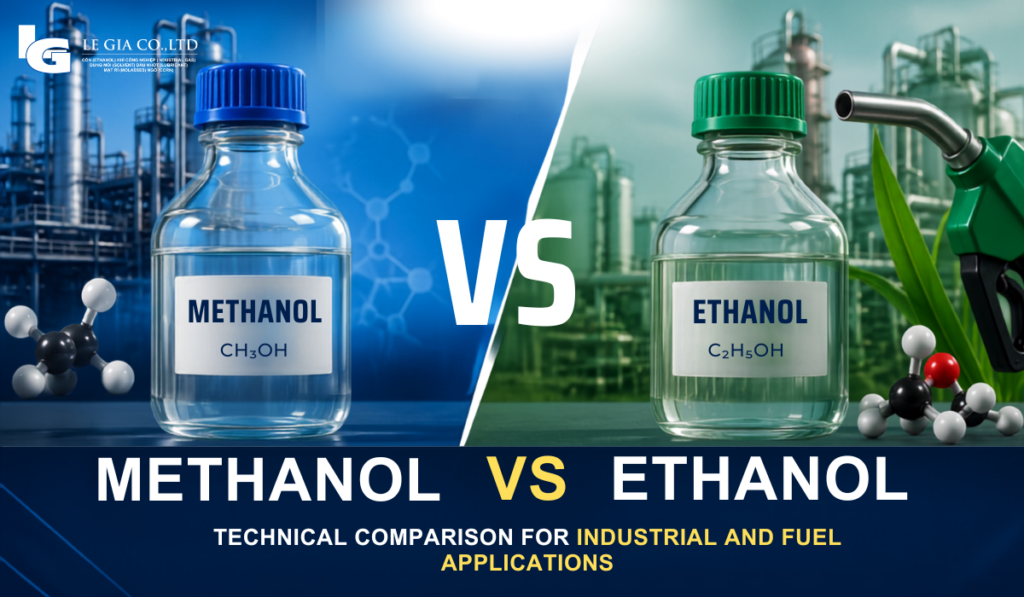
| Methanol (CH₃OH) and ethanol (C₂H₅OH) differ on three axes that decide procurement outcomes: toxicity, energy density, and permitted end use. Methanol metabolises to formic acid and causes blindness or death at doses ethanol tolerates routinely – its OSHA permissible exposure limit is 200 ppm against ethanol’s 1,000 ppm, and it carries a skin notation ethanol does not. Methanol’s lower heating value is 19.9 MJ/kg against ethanol’s 26.8 MJ/kg, so delivering equal energy requires roughly 35% more methanol by mass and by volume. Methanol dominates chemical feedstock chains – formaldehyde, acetic acid, methanol-to-olefins, and is an emerging marine fuel. Ethanol dominates every application involving human contact: pharmaceuticals, food and beverage, cosmetics, disinfectants. Choose methanol for closed industrial systems where cost per tonne of derivative governs. Choose ethanol wherever the molecule touches a person, a food surface, or a regulated consumer product. |
The methanol-versus-ethanol decision looks like a chemistry question. It is not. It is a liability question wearing a chemistry costume. One carbon atom separates these molecules. Everything downstream – exposure monitoring, tank metallurgy, dangerous goods placarding, product recall exposure – diverges from that single structural difference.
Most comparison articles stop at “methanol is toxic, ethanol is drinkable.” That is true and useless. This guide gives you the numbers, the standards, and the decision logic your technical and commercial teams need to defend a sourcing choice internally.
Key differences between methanol and ethanol
Methanol and ethanol differ by one carbon atom, and that single difference changes the occupational exposure limit fivefold, the energy density by roughly a quarter, and the regulatory treatment almost completely. Methanol is a one-carbon alcohol produced predominantly from natural gas or coal via syngas. Ethanol is a two-carbon alcohol produced predominantly by fermenting biomass – cassava, sugarcane, molasses, corn.
| Property | Methanol (CH₃OH) | Ethanol (C₂H₅OH) |
| Molecular weight | 32.04 g/mol | 46.07 g/mol |
| Boiling point | 64.7 °C | 78.3 °C |
| Specific gravity | ~0.792 | ~0.789–0.792 |
| Lower heating value (mass) | 19.9 MJ/kg | 26.8 MJ/kg |
| Lower heating value (volume) | ~15.8 MJ/L | ~21.3 MJ/L |
| Flash point (closed cup) | ~11 °C | ~13 °C |
| Lower explosive limit | 6.0 % vol | 3.3 % vol |
| OSHA PEL (8-hr TWA) | 200 ppm (260 mg/m³) | 1,000 ppm (1,900 mg/m³) |
| Skin notation | Yes | No |
| UN transport number | UN 1230 | UN 1170 |
| Primary feedstock | Natural gas, coal (syngas) | Fermented biomass |
| Human-contact applications | Prohibited | Permitted, widely regulated |
Global methanol production sits in the range of 106-116 million tonnes per year depending on the analyst, with Asia-Pacific consuming more than half (Sources: Mordor Intelligence, 2026; 360 Research Reports, 2026). Methanol and ethanol are large markets that barely compete with each other – which is precisely why buyers who treat them as substitutes get hurt.
How their chemical structures and properties compare
Methanol’s single carbon makes it smaller, more polar, and more volatile than ethanol. That structural fact drives three practical consequences for process engineers.
- Solvent behaviour: Methanol’s higher polarity makes it aggressive toward some polar resins, coatings and elastomers. Ethanol’s additional methylene group gives it broader compatibility with mid-polarity organics – the reason extraction and pharmaceutical formulation default to ethanol.
- Vapour and storage: Methanol’s lower boiling point (64.7 °C against 78.3 °C) means higher vapour pressure at ambient temperature. Headspace concentrations build faster, which matters when your exposure ceiling is five times lower.
- Water and blending: Both are fully miscible with water. In gasoline blending, methanol is markedly more prone to phase separation than ethanol and requires co-solvents such as isopropanol or tert-butanol even at low concentrations (Source: IEA-AMF, methanol fuel properties).
Methanol’s complete absence of carbon-to-carbon bonds gives it theoretically soot-free combustion — a genuine advantage in marine and stationary power applications, and one of the few property arguments that runs in methanol’s favour.
What makes methanol more toxic than ethanol
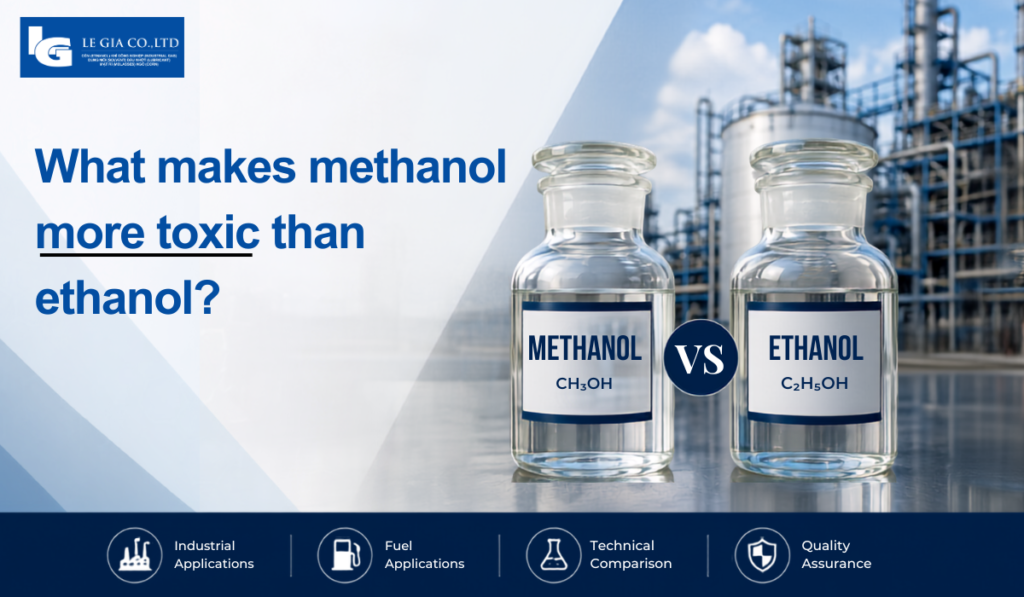
Methanol is more toxic because the liver converts it into two compounds that attack the optic nerve and blood chemistry directly. The pathway runs in three steps:
- Alcohol dehydrogenase oxidises methanol to formaldehyde. The same enzyme that processes ethanol handles methanol, but produces a far more reactive intermediate.
- Formaldehyde is oxidised to formic acid. Formate accumulates because human folate-dependent clearance is slow.
- Formate inhibits cytochrome c oxidase, producing metabolic acidosis and selective damage to the optic nerve and basal ganglia.
Ethanol follows a parallel route to acetaldehyde and then acetic acid, both cleared efficiently at normal exposure levels. Critically, ethanol competes for the same alcohol dehydrogenase enzyme. Fomepizole is the first-line antidote in methanol poisoning, with ethanol used as an established alternative where fomepizole is unavailable. The molecule you are comparing against is also a treatment for the molecule you are comparing.
The uncomfortable part for procurement: odour is an unreliable warning for methanol, because the reported detection threshold spans a wide range and does not track toxicity. Symptom onset after ingestion is typically delayed 12–24 hours, meaning an exposed worker often feels fine during the window when treatment is most effective.
Why methanol safety is critical for industrial operations
Methanol safety is critical because the exposure limits, monitoring obligations and PPE requirements attached to it are five times stricter than ethanol’s — and non-compliance is enforceable, documented and expensive. Facilities that switch from ethanol to methanol on a per-litre price argument frequently discover the compliance delta only after the first inspection.
The regulatory driver is specific. Methanol carries a skin notation in both NIOSH and ACGIH documentation, meaning dermal absorption contributes materially to total body burden. Air monitoring alone does not demonstrate compliance. Ethanol carries no skin notation in the NIOSH Pocket Guide.
Beyond the regulator, the operational costs stack up: continuous lower-explosive-limit sensing, explosion-proof electrical fit-out, dedicated spill protocols, medical surveillance, and training documentation that has to survive audit. None of this appears on the per-tonne quotation.
Methanol health risks and exposure limits
Methanol’s occupational limit is 200 ppm as an 8-hour time-weighted average under the current OSHA PEL — five times stricter than ethanol’s 1,000 ppm.
| Limit | Methanol (CAS 67-56-1) | Ethanol (CAS 64-17-5) |
| OSHA PEL | 200 ppm (260 mg/m³) TWA | 1,000 ppm (1,900 mg/m³) TWA |
| NIOSH REL | 200 ppm TWA; 250 ppm STEL [skin] | 1,000 ppm (1,900 mg/m³) TWA |
| ACGIH TLV | 200 ppm TWA; 250 ppm STEL [skin] | 1,000 ppm STEL |
| NIOSH IDLH | 6,000 ppm (10 % of LEL) | 3,300 ppm (10 % of LEL) |
(Sources: NIOSH Pocket Guide to Chemical Hazards; NIOSH Documentation for IDLH Concentrations, 1994; OSHA 29 CFR 1910.1000 Table Z-1. ACGIH TLVs are proprietary – confirm against the current TLV® and BEI® Book edition before quoting in a controlled document.)
The health evidence behind these numbers is specific. OSHA’s rulemaking record documents severe recurrent headaches in workers exposed between 200 and 375 ppm, and diminished visual capacity in studies of exposures between 1,200 and 8,300 ppm. Ethanol’s clinical record at comparable concentrations shows irritation rather than irreversible optic damage: reported human data indicate work could continue with discomfort between roughly 5,200 and 10,400 ppm, with continuous lacrimation and coughing at 15,000 ppm.
Lê Gia’s undenatured ethanol SDS lists the ethanol TWA at 1,000 ppm with no carcinogen category allocated (Source: Lê Gia SDS No. 012022, Section 8).
How facilities should handle and store methanol safely
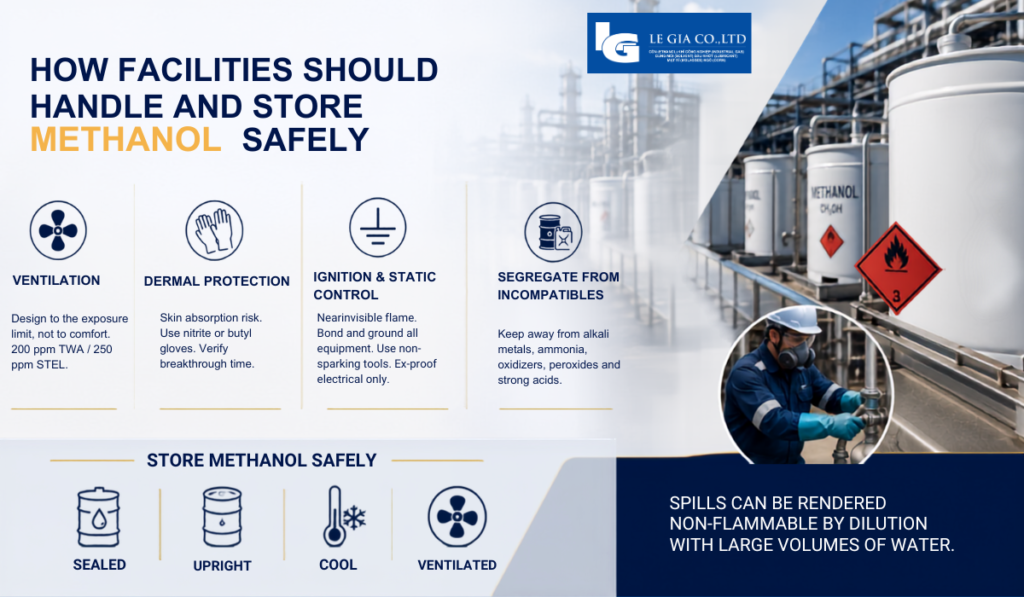
Methanol handling requires four controls that ethanol handling does not demand at the same intensity. Apply them as a protocol, not a checklist.
- Ventilation designed to the exposure limit, not to comfort. Size dilution ventilation against the 200 ppm TWA and 250 ppm STEL, then verify by personal sampling. General exhaust sized for solvent odour control will not clear the STEL.
- Dermal protection as a primary control. The skin notation means gloves are not optional PPE. Specify nitrile or butyl for methanol service and confirm breakthrough time against the manufacturer’s chemical resistance data.
- Ignition and static control. Methanol burns with a near-invisible flame in daylight – a documented cause of delayed fire response. Bond and ground all transfer equipment, use only non-sparking tools, and install explosion-proof electrical fit-out throughout the transfer envelope.
- Segregation from incompatibles. Keep both alcohols away from alkali metals, ammonia, oxidising agents, peroxides and strong inorganic acids (Source: Lê Gia SDS No. 012022, Section 10).
Storage vessels must be sealed, upright, cool and ventilated. Spills of either alcohol can be rendered non-flammable by dilution with large volumes of water – a control worth writing into your emergency procedure verbatim.
| Sourcing high-purity ethanol instead? Lê Gia manufactures food-grade, medical-grade and industrial ethanol at 12,000,000 litres per year, with a batch Certificate of Analysis on every shipment. Talk to us: (+84) 0908 769 151 or ethanol@legia.vn |
How methanol and ethanol compare as industrial fuels
Methanol delivers roughly 74% of ethanol’s energy per kilogram and per litre, so any fuel comparison that ignores volumetric throughput will misprice the decision. Both alcohols are high-octane, oxygenated and knock-resistant. Both require fuel system modification relative to gasoline. Neither is a drop-in.
The infrastructure question separates them further. Ethanol slots into existing gasoline blending infrastructure at E5, E10 and E85 through mature standards and an installed base of flex-fuel vehicles. Methanol blends demand co-solvents to resist phase separation and face tighter material compatibility constraints across fuel system elastomers and light alloys.
Marine is where methanol has real momentum — but read the direction of travel carefully. Methanol is a clear second to LNG in the alternative-fuel orderbook, and new methanol orders have fallen sharply: 61 methanol vessel orders in 2025 against 149 in 2024, with only two methanol orders recorded in the first half of 2026 (Source: DNV Alternative Fuels Insight, January and July 2026 releases). Deliveries tell the other half of the story, with 38 methanol-fuelled vessels delivered in the first half of 2026 as the earlier orderbook works through the yards. Methanol’s handling advantage is real – liquid at ambient temperature and pressure, unlike LNG, hydrogen or ammonia — at the cost of roughly 2.5 times the storage volume of heavy fuel oil.
Energy content and combustion differences
Methanol’s lower heating value is 19.9 MJ/kg against ethanol’s 26.8 MJ/kg — around 26% less energy per kilogram, or equivalently 35% more methanol required for the same delivered energy.
| Metric | Methanol | Ethanol | Gasoline (95 RON) |
| Lower heating value (MJ/kg) | 19.9 | 26.8 | 43.2 |
| Lower heating value (MJ/L) | ~15.8 | ~21.3 | ~32.2 |
| Higher heating value (MJ/kg) | 23.0 | 29.7 | – |
| Research octane number | >100 | >100 | 95 |
| Flame visibility | Near-invisible in daylight | Blue, visible | Visible |
Read the higher-heating-value row carefully, it is where most published comparisons go wrong. A widely circulated figure pairs methanol at 19.9 MJ/kg against ethanol at 29.7 MJ/kg, implying a 33% gap. That comparison mixes methanol’s lower heating value with ethanol’s higher heating value. Compared consistently, the gap is 19.9 against 26.8 on an LHV basis, or 23.0 against 29.7 on an HHV basis. If your internal fuel model inherited the mismatched pair, your energy-equivalent volumes are wrong by several percent – in the direction that flatters methanol.
Both alcohols carry high latent heat of vaporisation, which cools intake air and permits higher compression ratios. Methanol’s effect is stronger: heat of vaporisation equals 5.9% of its lower heating value, against 3.4% for ethanol.
Which fuel offers better cost per unit energy
Cost per unit energy, not cost per litre, is the only defensible basis for a fuel comparison and it consistently narrows the gap that headline pricing appears to show.
The calculation is simple. Divide delivered price per litre by megajoules per litre:
- Methanol: price per litre ÷ 15.8 MJ/L = cost per MJ
- Ethanol: price per litre ÷ 21.3 MJ/L = cost per MJ
The break-even point sits at roughly 26%. A methanol price about 26% below ethanol on a per-litre basis is cost-neutral per megajoule, because you burn about 35% more volume for the same delivered energy. Anything less than a 26% discount means methanol is the more expensive energy carrier before you have added tankage, monitoring or compatibility retrofit.
Industrial applications that require methanol over ethanol
Methanol is required where the molecule is consumed as a chemical building block inside a closed process, and ethanol is required wherever the finished product contacts a human being. That single line resolves the majority of selection questions.
| Application | Preferred alcohol | Governing constraint |
| Formaldehyde, acetic acid, MTO/MTP | Methanol | Feedstock chemistry – ethanol cannot substitute |
| Biodiesel transesterification | Methanol | Reaction kinetics, cost per tonne |
| Marine dual-fuel propulsion | Methanol | Ambient-liquid handling, engine availability |
| Pharmaceutical and medical formulation | Ethanol | Toxicity, GMP, pharmacopoeia compliance |
| Food, beverage, flavour extraction | Ethanol | Food safety regulation – methanol prohibited |
| Cosmetics, hand sanitiser | Ethanol | Dermal contact, consumer safety law |
| Printing inks, coatings, paints | Either | Polarity match and workplace exposure policy |
Where methanol is used as chemical feedstock
Formaldehyde is methanol’s single largest chemical derivative, absorbing roughly 23-28% of global methanol demand depending on the analyst (Sources: Grand View Research, 2026 — 23.6% in 2025; other market analyses published 2024–2026 — 28%). The spread between published estimates is itself informative: derivative shares shift with construction cycles and with China’s methanol-to-olefins capacity, and some analyses rank MTO above formaldehyde on volume.
Methanol’s principal feedstock roles:
- Formaldehyde – resins for engineered wood, insulation, coatings
- Acetic acid – via carbonylation, feeding packaging and textiles
- MTO/MTP – olefins production, concentrated in China; reported at around 31% of consumption in some analyses (Source: 360 Research Reports, 2026)
- MTBE – octane enhancement in gasoline
- Biodiesel – transesterification of vegetable oils and fats
- Methyl methacrylate – acrylic polymers
None of these accept ethanol as a substitute. The chemistry is not negotiable – this is a specification boundary, not a preference.
When to choose ethanol for solvents or disinfectants
Choose ethanol whenever the product, the process residue or the operator has any credible route of human contact. Four criteria settle it:
- Human-contact end use: Hand sanitisers, topical antiseptics, oral pharmaceuticals, cosmetics. Methanol is categorically excluded, and contamination incidents in sanitiser supply chains have triggered international recalls.
- Food and beverage adjacency: Flavour and colour extraction, food-processing sanitation, food-contact surfaces. Regulatory frameworks worldwide prohibit methanol here.
- Regulated dossier requirements: GMP, ISO 13485 and pharmacopoeia monographs require documented impurity profiles. Ethanol has established monographs; methanol does not exist as an option.
- Mid-polarity extraction: Where the target compound’s polarity favours ethanol’s two-carbon structure, substituting methanol changes both yield and impurity profile before regulation even intervenes.
Lê Gia manufactures ethanol against ISO 9001:2015 (Cert. No. 764894) and GMP (Cert. No. N711875), both issued by Guardian Independent Certification Ltd for the manufacture and trade of ethanol alcohol, plus ISO 13485:2016 issued by ISSQ (Institute for Standards and Quality Research and Development, Vietnam) covering the manufacture and trade of medical ethanol, nasal spray and saline solution, and VietCert conformity to QCVN 6-3:2010/BYT for food-grade supply.
How regulatory and compliance requirements differ
Methanol and ethanol diverge most sharply in regulation, because ethanol is controlled and taxed as a potable substance while methanol is controlled as an industrial poison. Both classifications create paperwork – different paperwork.
Transport classification illustrates the split precisely. Ethanol ships as UN 1170, Class 3 flammable liquid (Source: Lê Gia SDS No. 012022, Section 14). Methanol ships as UN 1230, Class 3, Packing Group II – with a 6.1 subsidiary toxicity risk applied under the UN Model Regulations, IMDG, ADR and IATA, requiring a second hazard label. US domestic DOT shipments are the exception: DOT does not assign the 6.1 subsidiary risk, so a single Class 3 label suffices domestically (Source: Methanol Institute, Methanol Small Quantities Bulletin). If your consignment crosses a border, assume the toxicity label applies.
The documentation burden also differs in kind. Ethanol imports commonly trigger excise, denaturing declarations and food-safety or pharmaceutical registration depending on grade. Methanol imports trigger poison-control registration and, in some jurisdictions, precursor-control reporting.
Fuel standards applying to methanol and ethanol
Methanol and ethanol are governed by separate specifications that are not interchangeable in a contract.
| Standard | Scope |
| ASTM D1152 | Standard Specification for Methanol (Methyl Alcohol), 99.85% grade |
| ASTM D4806-25 | Standard Specification for Denatured Fuel Ethanol – current edition; incorporated into US federal law at 40 CFR §1090.95 |
| EN 15376:2014 | Automotive fuels – Ethanol as a blending component for petrol, blends up to 85% v/v, referenced by EN 228 |
ASTM D4806 deserves attention from anyone specifying fuel ethanol. It sets minimum ethanol content at 92.1% by volume, caps methanol content, and lists non-conforming methanol among prohibited denaturants alongside pyrroles, turpentine, ketones and tars. The fuel ethanol standard exists partly to keep methanol out of ethanol. EN 15376:2014 takes a parallel approach, specifying minimum ethanol plus higher saturated alcohols at 98.7% m/m before denaturing.
Workplace exposure regulations you must follow
Methanol triggers monitoring, medical surveillance and skin-absorption controls that ethanol does not. Build your compliance programme around four obligations:
- Personal exposure monitoring against the 200 ppm TWA and 250 ppm STEL, repeated at a documented frequency.
- Dermal exposure assessment, because the skin notation makes air sampling alone insufficient evidence of control.
- Hazard communication and training, with SDS availability and documented worker instruction on delayed-onset symptoms.
- Emergency preparedness, including eyewash and deluge access plus a written response for near-invisible flame fires.
Ethanol’s programme is real but lighter: flammability control, ventilation and standard PPE, against a 1,000 ppm TWA and no skin notation.
ROI comparison for methanol versus ethanol in manufacturing
Total cost of ownership, not unit price, decides this comparison and the gap between the two figures is where most sourcing errors live. Build the model across four cost layers.
Layer 1 – Acquisition: Delivered price per litre, normalised to price per megajoule or price per tonne of derivative output.
Layer 2 – Conversion efficiency: Yield per unit of alcohol in your specific process, measured rather than assumed.
Layer 3 – Handling and compliance: Monitoring, PPE, ventilation, training, medical surveillance, insurance loading. Methanol carries a structural premium here.
Layer 4 – Risk-adjusted exposure: Probability-weighted cost of an incident, a recall or a rejected export consignment.
A one-off saving in Layer 1 that adds a permanent charge in Layer 3 is not a saving. It is deferred cost with a compliance risk attached.
How lifecycle costs compare across applications
Lifecycle cost divergence is driven less by raw material price than by what each alcohol demands from the plant around it. In a closed feedstock reactor, methanol’s lifecycle cost approaches its acquisition cost. In an open transfer, drumming or blending operation, methanol’s true cost climbs with every additional control.
Waste treatment favours neither dramatically. Ethanol is readily biodegradable and practically non-toxic to aquatic organisms (Source: Lê Gia SDS No. 012022, Section 12), and methanol’s aquatic profile is also comparatively benign. Methanol’s cost premium sits in workplace controls, not effluent.
Infrastructure investment considerations
Infrastructure cost is where a methanol switch becomes visible on the capital budget. Check five items before committing:
- Tank and pipe metallurgy. Methanol attacks certain aluminium, magnesium and zinc components and some coatings. Verify compatibility against the actual alloy specification, not the generic material class.
- Gaskets and elastomers. Seal compounds qualified for ethanol service are not automatically qualified for methanol.
- Ventilation upgrade. Sized to a five-times-stricter exposure limit.
- Vapour and LEL detection. Continuous sensing across the transfer envelope.
- Fire response. Alcohol-resistant foam compatibility and training for near-invisible flame conditions.
How to avoid common methanol selection mistakes
Most methanol selection failures trace to one of three errors, and all three are preventable with documentation you can request before signing.
Mistake 1 – Buying “denatured alcohol” without reading the denaturant. In several jurisdictions methanol is a permitted denaturant for industrial ethanol. A quote for cheap denatured alcohol may be methylated spirit, which permanently disqualifies the batch from any human-contact application. Correction: require the denaturant identity and concentration in writing on the specification sheet, not the invoice.
Mistake 2 – Assuming ethanol is methanol-free. It never is. Fermentation ethanol contains trace methanol arising from pectin in the feedstock. The correct question is not “does it contain methanol” but “at how many parts per million, against which limit.” Correction: demand a batch COA with a numeric methanol result and a stated specification limit.
Mistake 3 – Switching on price without re-qualifying the formulation. Correction: run a compatibility and stability trial before any substitution reaches production scale.
Risks arising from substituting methanol for ethanol
Substitution failures cluster in three categories, ordered by how expensive they get.
| Risk | Mechanism | Typical cost |
| Material failure | Elastomer swell, alloy corrosion, coating attack | Unplanned shutdown, leak |
| Regulatory rejection | Methanol present in a human-contact product | Batch loss, recall, market suspension |
| Performance drift | Polarity change alters extraction yield or blend stability | Off-spec output, customer claim |
The regulatory category is the one that ends careers. A methanol-contaminated consumer product is not a quality deviation 0 it is a public health event.
How to verify alcohol purity and specifications
Verification rests on a batch-specific Certificate of Analysis with named test methods, and nothing less should be accepted. The parameters that matter:
- Alcohol strength (ASTM D4052) against your minimum
- Methanol content in ppm (gas chromatography) against a stated limit
- Acetaldehyde, ethyl acetate, isopropanol (GC) – the impurity profile that determines odour and downstream suitability
- Acids as acetic acid (ASTM D1613), water content (ASTM E203, Karl Fischer), and pH [VERIFY: see production note — the method designation on the current COA needs correcting]
- Colour Pt-Co (ASTM D1209) and appearance
A worked example. Lê Gia’s LGCS cassava ethanol COA dated 03 February 2026 reports: alcohol strength 96.0 %v/v at 20 °C against a MIN 95 specification; methanol 32.0 ppm against a MAX 100 limit; isopropanol 130.0 ppm against MAX 1,000; acetaldehyde 10.0 ppm against MAX 40; ethyl acetate 15.0 ppm against MAX 100; acids as acetic acid 8.6 mg/L against MAX 50; pH 7.4 within a 6.6–7.6 range; water content 4.6 %vol against MAX 5.5; colour below 5.0 Pt-Co against MAX 10 (Source: Lê Gia Certificate of Analysis, LGCS Cassava, 03 February 2026).
That is what a defensible document looks like: every parameter numeric, every method named, every result placed against a limit. Ask for that. If a supplier offers a generic specification sheet instead of a batch COA, you are being shown a brochure.
Sustainability and decarbonisation pathways
Both alcohols have credible low-carbon pathways, but they scale against different constraints: methanol against captured CO₂ and green hydrogen, ethanol against agricultural feedstock and land. Policy is pushing both, and buyers with 2030 emissions targets need to know which bottleneck applies to them.
Conventional methanol is produced from natural gas or coal, giving it a carbon intensity that varies widely by route, with coal-based methanol at the high end. Fermentation ethanol from cassava or molasses starts from biogenic carbon, which places it structurally ahead on lifecycle emissions before any process optimisation.
How bio-methanol and bio-ethanol compare environmentally
Bio-ethanol is the more mature pathway; bio-methanol and e-methanol are the faster-growing but less proven ones. Bio-ethanol runs on established fermentation infrastructure with agricultural feedstocks already in commercial supply chains. Its constraint is land, water and feedstock competition.
E-methanol requires two inputs that are themselves scarce: biogenic CO₂ and low-cost green hydrogen. Sector analysis identifies securing both at port hubs as the primary bottleneck, with production lagging vessel delivery schedules.
The role of green methanol in the energy transition
Green methanol’s clearest role is deep-sea shipping, though its trajectory has cooled from the 2023–2024 peak. LNG leads the alternative-fuel orderbook; methanol sits second, with orders down to 61 vessels in 2025 from 149 in 2024, and just two methanol orders in the first half of 2026 (Source: DNV Alternative Fuels Insight, 2026). Deliveries remain strong – 38 methanol-fuelled vessels in the first half of 2026 – because the earlier orderbook is still arriving.
The constraint is supply, not demand. Vessel capacity has arrived faster than green methanol production capacity, which is why operators are building fuel-switching flexibility into procurement rather than committing to single-fuel operation. For anyone modelling methanol demand growth, the honest reading is that the fuel is established but no longer accelerating.
Ethanol’s decarbonisation story runs through road transport blending mandates rather than shipping — a parallel market, not a competing one.
Sourcing high-purity ethanol for your application
If your application involves human contact, food, pharmaceuticals or a regulated consumer product, the alcohol you need is ethanol and what you need from the supplier is documentation you can put in front of an auditor.
Lê Gia has manufactured ethanol since 2001, with 12,000,000 litres per year of supply capacity and blending capability to customer-specified formulations. Certifications: ISO 9001:2015 (No. 764894), ISO 13485:2016, GMP (No. N711875) issued by Guardian Independent Certification Ltd, and VietCert conformity to QCVN 6-3:2010/BYT. Customers include Acecook, Ajinomoto, Nutifood, Nippon Paint, CP Group, Lotteria and Siegwerk. Export markets include Taiwan and South Korea.
Request a batch COA and a formal quotation: ethanol@legia.vn or (+84) 0908 769 151. Specify your grade, volume and required impurity limits, and we will respond with the actual test data for the batch you would receive – not a generic specification sheet.
Why partner with an experienced ethanol manufacturer
An experienced manufacturer removes three costs from your procurement cycle.
- Documentation that survives audit. Batch COAs with named ASTM and GC methods, SDS, and certification numbers you can verify independently.
- Formulation to specification. Custom denaturation and blending to your exact technical requirement, so you are not re-qualifying a standard grade against a non-standard process.
- Supply continuity. Twelve million litres per year of capacity and a controlled production-to-blending chain, with delivery from 10 working days.
FAQ
Can methanol be used instead of ethanol in fuel blends?
No, not as a direct substitute. Methanol requires co-solvents to resist phase separation in gasoline, attacks fuel system components that tolerate ethanol, and is capped and listed among prohibited denaturants under ASTM D4806 for fuel ethanol.
How can you distinguish methanol from ethanol practically?
Rely on gas chromatography and a batch COA, not field tests. Flame colour and odour are unreliable and unsafe as identification methods, and never taste-test – methanol poisoning symptoms are typically delayed 12–24 hours.
What are the signs of methanol contamination in products?
There are no reliable sensory signs, which is exactly why contamination incidents happen. Detection requires GC analysis reporting methanol in parts per million against a specification limit, performed batch by batch.
Is methanol or ethanol better for solvent applications?
Ethanol is better for any solvent application involving human contact, food adjacency or pharmaceutical registration. Methanol may suit closed industrial systems where polarity matching favours it and exposure controls are already in place.