
Biofuel is reshaping how businesses in the UK and Australia plan their decarbonisation strategies. This guide explains what biofuel is, how ethanol fits into the picture, what the national roadmaps recommend, and how your organisation can build a compliant, cost-effective biofuel strategy – including where a specialist ethanol supplier like Lê Gia fits into the supply chain.
Your operations are under mounting pressure. Net-zero mandates are tightening. Fuel costs are volatile. And your procurement team is still trying to figure out whether biofuel is a genuine transition pathway or just another compliance box to tick. You are not alone. Fleet managers, energy directors, and sustainability leads across the UK and Australia are asking the same questions – and most of the content they find online is either too academic or too vague to act on.
This guide does not recycle the same definitions. It maps the actual national roadmaps for both countries, translates policy into procurement decisions, and shows you exactly where ethanol-based biofuels deliver commercially viable results. By the end, you will have a working framework to evaluate biofuel adoption for your sector.

What is biofuel and how does it support decarbonisation
Biofuel is a liquid or gaseous fuel derived from biomass – organic materials such as plant matter, agricultural residues, and waste oils, that substitutes or blends with fossil fuels in existing engines and infrastructure. Unlike fossil fuels, biofuels re-release carbon recently captured by growing plants, creating a shorter carbon cycle and enabling meaningful greenhouse gas (GHG) reductions when feedstock is managed responsibly.
For UK and Australian businesses, biofuels are one of the few low-carbon fuel options that work within existing engine fleets, logistics networks, and aviation assets without requiring full infrastructure overhaul. Well-managed biofuel pathways can reduce lifecycle GHG emissions by 50–90% compared to fossil fuels, depending on feedstock and production method – though actual savings vary significantly and must be verified via lifecycle assessment (LCA).
Sectors best placed to benefit include heavy road transport, aviation, maritime, and energy-intensive manufacturing, all areas where battery-electric or hydrogen alternatives remain commercially premature at scale.
What are the main types of biofuels used today
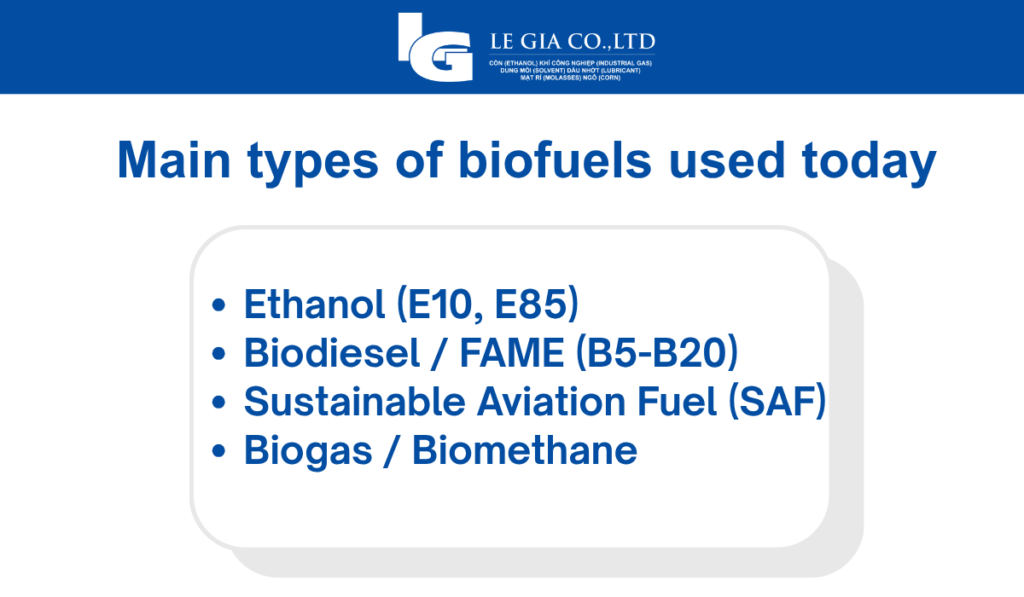
The biofuel market spans four commercially relevant categories, each with distinct feedstocks, applications, and maturity levels in the UK and Australian markets.
| Biofuel Type | Primary Feedstock | Key Application | Market Maturity (UK/AU) |
| Ethanol (E10, E85) | Sugarcane, corn, cassava | Road transport, petrol blending agent | Mature – mandated in both markets |
| Biodiesel / FAME (B5-B20) | Vegetable oils, used cooking oil | Diesel fleets, generators | Established – HVO gaining share |
| Sustainable Aviation Fuel (SAF) | Waste oils, biomass, agricultural residues | Commercial aviation | Emerging – UK mandate from Jan 2025 |
| Biogas / Biomethane | Organic waste, wastewater | Heat, power, bus fleets | Growing – grid injection increasing |
First-generation biofuels (ethanol, FAME biodiesel) use food-crop feedstocks and represent the largest current volumes. Second-generation and advanced biofuels use non-food residues and waste, reducing land-use pressure. Policy in both the UK and Australia is deliberately shifting incentive structures toward advanced pathways.
How does biomass convert into usable liquid fuels
Understanding the conversion process matters for procurement: it determines feedstock sourcing requirements, supply security, and compliance documentation. The three main industrial pathways are:
- Fermentation: Sugars or starches in crops such as sugarcane or cassava are fermented by yeast to produce ethanol (C₂H₅OH). This is the dominant pathway for fuel ethanol globally and the basis for Lê Gia’s cassava-sourced ethanol production in Vietnam.
- Transesterification: Vegetable oils or animal fats react with an alcohol (usually methanol) in the presence of a catalyst to produce biodiesel (FAME) and glycerol. Energy density is close to fossil diesel.
- Gasification and Fischer-Tropsch synthesis: Solid biomass is converted to synthesis gas (syngas), then catalytically converted to liquid fuels including renewable diesel and SAF. This pathway underpins advanced biofuels.
From an energy density perspective, ethanol delivers approximately 21.4 MJ/litre versus petrol at approximately 32–34 MJ/litre and biodiesel at approximately 32.7 MJ/litre. (Source: EU Eurostat, Renewable Energy Agency; IEA-AMF Fuel Information, 2024) The energy density gap in ethanol is why higher blend ratios such as E85 require engine calibration adjustments.
For UK and Australian operators with existing petrol-engine fleets, ethanol blends up to E10 are drop-in compatible without engine modification – making them the lowest-friction entry point into biofuel adoption.
What is the relationship between ethanol and biofuel
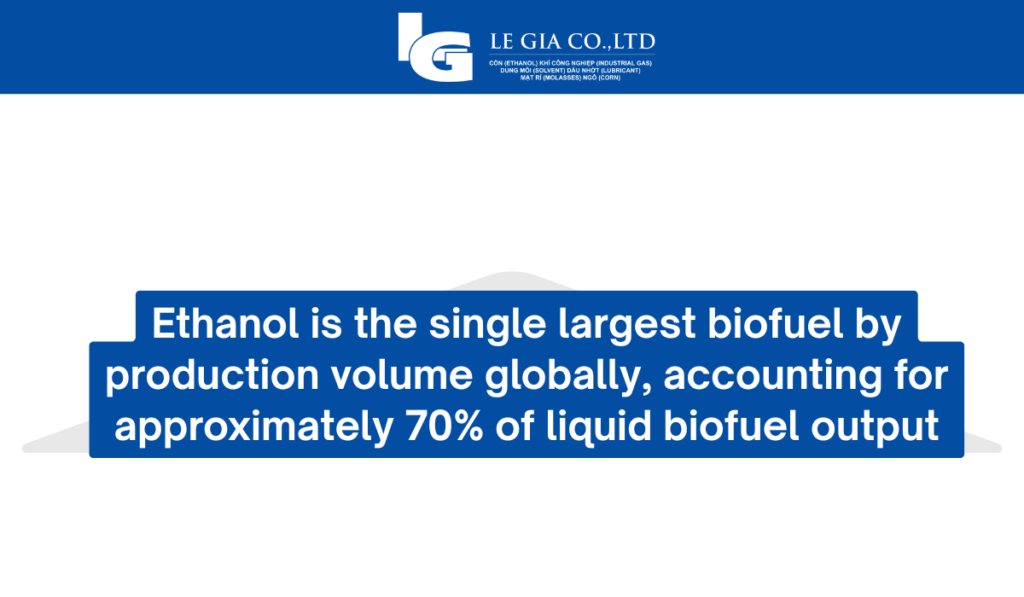
Ethanol is the single largest biofuel by production volume globally, accounting for approximately 70% of liquid biofuel output. It is an alcohol compound (C₂H₅OH) produced through the fermentation of sugar or starch crops and blended into petrol to increase octane rating, reduce particulate emissions, and displace fossil carbon. In the context of biofuel strategy, ethanol is not just one option – it is the commercially proven foundation from which most corporate roadmaps begin.
Global ethanol fuel production in 2023 reached approximately 116 billion litres, with the United States (corn-based) and Brazil (sugarcane-based) together accounting for around 81% of global supply. (Source: World Bioenergy Association, Global Bioenergy Statistics 2024; Statista/RFA, 2024)
The UK and Australia are net importers of fuel ethanol, which makes reliable international supply chains, such as those operated by producers in Vietnam, Thailand, and Southeast Asia – commercially significant.
Why is ethanol the dominant first-generation biofuel
Ethanol holds its market position for four structural reasons that matter to procurement decision-makers:
- Mature production technology: Fermentation at industrial scale has been optimised over decades. Production costs per litre are lower than biodiesel, SAF, or biogas equivalents at comparable volumes.
- Existing blending infrastructure: Petrol distribution networks already handle ethanol blends. No separate storage or dispensing equipment is required for E5 or E10 blends.
- Regulatory alignment: Both the UK E10 mandate (1 September 2021) and Australia’s state-level biofuel requirements are built around ethanol blends. The UK Department for Transport confirmed that switching from E5 to E10 reduces road transport CO₂ emissions by an estimated 750,000 tonnes annually – equivalent to removing approximately 350,000 cars from UK roads. (Source: UK DfT, 2021)
- Carbon intensity credentials: Sugarcane and cassava-based ethanol can deliver lifecycle GHG reductions of 60–80% vs petrol when production and transport emissions are properly accounted. Actual savings depend on feedstock origin and LCA methodology.
For a logistics operator or fuel distributor, ethanol blends represent the lowest-capex, fastest-to-implement biofuel transition available today. The next section covers how different blend concentrations affect fleet performance.
How do E10 and E85 blends impact fleet performance
| Blend | Ethanol Content | Engine Compatibility | Estimated Fuel Economy Impact | Fleet Notes |
| E5 | 5% ethanol | All petrol vehicles | Negligible (<1%) | UK standard until Aug 2021; still available as ‘Protection’ grade (97+ octane) |
| E10 | 10% ethanol | Most vehicles built post-2000 | -1% to -3% vs E5 | UK standard since 1 Sep 2021; AU state mandates (NSW, QLD) |
| E85 | 85% ethanol | Flex-fuel vehicles only | -25% to -30% vs petrol | Requires OEM flex-fuel approval; not widely available at UK/AU retail |
| E100 | 100% ethanol | Brazil-spec engines only | Requires full engine redesign | Not commercially viable in UK/AU markets |
The practical takeaway: E10 is your default short-term option. It requires no fleet investment beyond fuel switching. E85 delivers larger carbon savings but applies only to purpose-built flex-fuel vehicles — a viable medium-term strategy for new fleet procurement cycles. Most OEMs void warranties on older engines running blends above E10, so always verify against your specific fleet’s manufacturer fuel approval list before switching above the standard blend.
Need a bulk ethanol supply quote for your blending operation? Contact Lê Gia: (+84) 0908 769 151 | ethanol@legia.vn
What do Australia’s and UK’s biofuel roadmaps recommend
Australia and the UK have each published structured bioenergy or biofuel roadmaps with sector-specific findings. Both documents share a common direction: they prioritise feedstock sustainability, push advanced biofuels over first-generation crop-based pathways, and identify transport and aviation as the sectors requiring the most urgent fuel transition. Understanding what each roadmap actually says – not just that it exists, is what separates effective procurement strategy from wishful planning.

What does Australia’s Bioenergy Roadmap prioritise for business
Australia’s Bioenergy Roadmap was developed by Enea Consulting and Deloitte for ARENA (Australian Renewable Energy Agency), published in November 2021. It presents a framework to 2030 and finds that a well-developed bioenergy sector could contribute approximately A$10 billion in additional GDP per year, create 26,200 new jobs, reduce national emissions by around 9%, and divert an extra 6% of waste from landfill. (Source: ARENA, Australia’s Bioenergy Roadmap, November 2021)
For B2B operators, the Roadmap’s three key priorities are:
- Waste and residue feedstocks first: Agricultural residues (sugarcane bagasse, wheat straw), municipal solid waste, and forestry residues are the preferred feedstock pathways. This directly reduces food-vs-fuel conflict and land-use risk.
- Regional production hubs: Queensland and New South Wales are identified as primary bioenergy production zones. Existing sugar industry infrastructure provides a foundation for potential ethanol scale-up.
- Hard-to-abate sectors: The Roadmap specifically targets renewable industrial heat, sustainable aviation fuel, and biogas grid injection as priority application areas where bioenergy has a comparative advantage.
For road transport operators, state-level mandates remain the primary driver. NSW mandates a minimum 6% ethanol blend (E10) for petrol sold by major retailers under the NSW Biofuels Act 2007. Queensland mandates a minimum 3% ethanol blend for petrol and 5% biodiesel for diesel.
How does the UK Sustainable Fuels Road-Map affect transport operators
The UK’s strategy for low-carbon transport fuels operates via the Renewable Transport Fuel Obligation (RTFO), which has been in force since 2008 and is administered by the Department for Transport. Key regulatory facts for operators:
- RTFO main obligation for 2025: The obligation is 14.054% for the main obligation year. This means fuel suppliers above the threshold (450,000 litres/year of road transport fuel) must demonstrate that approximately 14% of the fuel they supply meets renewable fuel criteria. (Source: UK DfT, RTFO Compliance Guidance 2025)
- Buy-out price: Suppliers who cannot meet their RTFO obligation in full pay a fixed buy-out fee of 50p per litre shortfall (increased from 30p in 2022). This creates a structural floor for biofuel market pricing. (Source: UK DfT, RTFO Consultation Outcome, 2020)
- SAF mandate from 1 January 2025: At least 2% of jet fuel supplied at UK airports must be SAF, rising linearly to 10% by 2030 and 22% by 2040. The mandate is administered separately from the RTFO. (Source: UK Government SAF Mandate, gov.uk, January 2025)
For road freight operators, HVO (hydrotreated vegetable oil) is currently the fastest-growing biofuel category in the UK market, valued for drop-in diesel compatibility. However, HVO supply remains constrained and carries a price premium. For petrol-based fleets, E10 adoption requires no capital expenditure, delivers immediate GHG benefits, and is fully mandated – making it the most accessible near-term option.
Which biofuel pathway fits your sector’s decarbonisation strategy
The right biofuel pathway depends on your sector’s fuel type, fleet age, operational geography, and regulatory exposure. There is no universal answer, but there is a structured decision process. The table below maps the most commercially viable biofuel options by sector.
| Sector | Recommended (Short-term) | Recommended (Medium-term) | Key Constraint |
| Road logistics / HGV diesel | HVO (drop-in renewable diesel) | Advanced biodiesel, biomethane | HVO supply scarcity and cost premium |
| Petrol-based fleets | E10 ethanol blend | E85 (flex-fuel vehicles) | OEM warranty on older vehicles |
| Aviation | SAF (blended with Jet-A1) | 100% SAF (advanced pathway) | ASTM certification, supply volume |
| Maritime | Biodiesel (B20+) | Biomethane, advanced biofuels | Bunkering infrastructure availability |
| Agribusiness / off-road | Biodiesel (B5–B20) | Waste-derived ethanol, biogas | Remote supply chain logistics |
How should logistics and heavy transport evaluate biofuel options
For logistics and heavy transport operators, biofuel evaluation should begin with total cost of ownership (TCO), not carbon metrics alone. A procurement decision that looks sound on ESG reporting but increases operational fuel cost by 15% without incentive offset will not survive a board review.
The evaluation checklist for fleet operators:
- Fuel compatibility: Can existing engines run HVO or B20 without warranty risk? Check OEM approval lists before committing to volume.
- Supply security: Is there a reliable, consistent supplier within acceptable lead times? Biofuel supply chains are thinner than fossil fuel networks.
- RTFC value modelling: If you are a fuel supplier, calculate the Renewable Transport Fuel Certificate (RTFC) value against the price premium. With the buy-out price set at 50p/litre, RTFCs can partially or fully offset the biofuel cost differential depending on the fuel type and market price.
- Carbon intensity documentation: Third-party verified lifecycle emissions data is required for RTFO compliance. Ensure your supplier provides a full chain-of-custody certificate per batch.
What makes Sustainable Aviation Fuel critical for airlines
SAF is not optional for airlines operating in the UK beyond 2025 – it is a statutory compliance requirement that entered into force on 1 January 2025. Technically, it is the only scalable near-term decarbonisation pathway for commercial aviation: battery-electric aviation remains limited to very small aircraft, and hydrogen aircraft are at least a decade from mainline commercial deployment.
SAF is certified to ASTM D7566 standards, ensuring chemical compatibility with Jet-A1 fuel and existing aircraft engines without modification. Current blending limits allow up to 50% SAF in the fuel mix, though most commercial operations today blend at 10–30% due to supply constraints.
The price premium for biofuel-based SAF (primarily HEFA – hydroprocessed esters and fatty acids) over conventional jet fuel in 2025 is approximately 2–4x, with e-fuel SAF pathways reaching up to 10x. (Source: ICCT, ‘Why and How to Bring Down the Cost of SAF’, November 2025; EASA reference prices 2024) Policy instruments including the UK SAF mandate certificates, EU ETS, and proposed revenue certainty mechanisms are designed to progressively close this gap.
How do you build a business case for biofuel adoption
A biofuel business case that gets approved at board level has three components: a financial model with credible assumptions, a risk register with mitigation strategies, and a regulatory compliance pathway. Generic sustainability arguments without numbers will not move procurement committees.
What ROI metrics should decision-makers track
Track these five financial metrics when modelling biofuel adoption:
- Carbon abatement cost (£/AUD per tonne CO₂e): Calculate total incremental biofuel cost divided by tonnes of CO₂e avoided. Compare this to the cost of purchasing carbon offsets or paying ETS compliance penalties.
- Payback period on conversion capex: Flex-fuel vehicle upgrades, storage tank modification, or blending equipment costs should be modelled against fuel savings and RTFC revenue across 3–7 year horizons.
- RTFC or renewable fuel certificate revenue: For fuel suppliers, this is a direct revenue line, not just a cost offset. Model RTFC market price trajectories alongside the 50p/litre buy-out price floor.
- Operational fuel cost differential: Biofuels carry a price premium. Model the sensitivity of your business case to ±20% feedstock price movements.
- Contract retention and ESG value: Logistics contracts, airport slots, and procurement frameworks increasingly require demonstrated GHG reduction. Quantify the risk of contract loss against the cost of non-adoption.
How do policy incentives reduce implementation costs
| Incentive Programme | Market | Mechanism | Key Details |
| RTFO Certificates (RTFCs) | UK | Certificates issued per litre of qualifying biofuel; tradeable on open market or offset against obligation | Buy-out floor: 50p/litre (from 2022). Main obligation 2025: 14.054%. (Source: UK DfT, 2025) |
| SAF Mandate Certificates (SAFCs) | UK | Certificates issued for SAF supplied under the SAF Mandate (separate from RTFO from 2025) | 2% obligation in 2025; rising to 10% by 2030. (Source: UK gov.uk SAF Mandate, Jan 2025) |
| ARENA Grant Programme | Australia | Co-funding for bioenergy feasibility studies and demonstration projects | – |
| NSW Biofuels Act Mandate | Australia (NSW) | Mandatory minimum 6% ethanol blend for major petrol retailers | Demand guarantee; reduces offtake risk for ethanol suppliers |
| QLD Biofuels Mandate | Australia (QLD) | Minimum 3% ethanol blend for petrol, 5% biodiesel for diesel | Applies to major fuel retailers above volume threshold |
The key strategic insight: policy incentives are not static. RTFC market prices, grant availability, and mandate thresholds change with each compliance year. Organisations that build conservative incentive revenue into their base-case models are better positioned to secure internal investment approval.
Request a sample Certificate of Analysis and ethanol pricing: ethanol@legia.vn | (+84) 0908 769 151
What sustainability and compliance standards must biofuels meet
Biofuels do not automatically qualify as sustainable. Both the UK and Australia impose lifecycle emissions thresholds and documentation requirements that suppliers must meet before their fuel qualifies for RTFC credits or mandate compliance. Supplier vetting is as important as price negotiation.
How do RTFO and Australian mandates affect procurement
| Requirement | UK (RTFO) | Australia (NSW/QLD mandates) |
| Minimum GHG saving vs fossil fuel | 65% lifecycle GHG reduction required for RTFO eligibility | No federal threshold; state mandates focus on volume compliance, not GHG intensity |
| Sustainability certification accepted | ISCC, RSB, Bonsucro, or RTFO default values accepted | State-level verification; ISCC accepted for import/export-grade ethanol |
| Chain of custody documentation | Required from feedstock to point of supply; independent verification mandatory | Required for mandate compliance audit; verified by state energy authorities |
| ILUC factor applied | ILUC risk factors applied to crop-based feedstocks in RTFO carbon calculation | Not yet systematically applied at state mandate level |
| Reporting frequency | Annual RTFO report submission; quarterly provisional data published by DfT | Quarterly reporting to NSW/QLD state energy authorities |
The practical implication: if your ethanol or biodiesel supplier cannot provide ISCC or equivalent third-party certification, the fuel will not qualify for RTFC issuance in the UK. Lê Gia’s ethanol is produced under GMP and ISO 9001:2015 quality management systems, with full Certificate of Analysis per batch.
What lifecycle emissions thresholds apply to biofuel projects
Lifecycle assessment (LCA) for biofuels uses a well-to-wheel (WtW) boundary – capturing emissions from feedstock cultivation, processing, transport, and combustion. The 65% GHG reduction threshold under the UK RTFO means total WtW emissions must be at least 35% below the fossil fuel comparator across the full supply chain.
Third-party LCA verification is conducted against internationally recognised standards:
- ISCC (International Sustainability and Carbon Certification): the most widely accepted standard for ethanol and biodiesel in European and Asia-Pacific markets.
- RSB (Roundtable on Sustainable Biomaterials): covers social and environmental sustainability alongside carbon intensity.
- Bonsucro: specific to sugarcane-derived ethanol, widely used for Brazilian and Southeast Asian supply chains.
For cassava-based ethanol produced by Lê Gia from Vietnamese feedstock, lifecycle GHG performance will depend on the specific production process, electricity source, and transport route to the UK or Australian market.
What environmental risks should B2B buyers understand
Biofuels are not inherently sustainable. The environmental performance of any biofuel depends entirely on feedstock origin, cultivation methods, and supply chain management. UK and Australian regulators, and the B2B buyers they scrutinise now require documented evidence, not assumptions.
How does land-use change affect biofuel carbon savings
Land-use change (LUC) is the most significant environmental risk in biofuel supply chains. It occurs in two forms:
- Direct land-use change (dLUC): feedstock production directly converts forest, grassland, or wetland to cropland, releasing stored carbon that can negate years of biofuel GHG savings.
- Indirect land-use change (iLUC): crop diversion to biofuel use displaces food production elsewhere, causing agricultural expansion in high-carbon ecosystems through market price effects.
The UK RTFO applies iLUC risk factors to crop-based feedstocks, effectively penalising their carbon intensity in the RTFO calculation. Feedstocks with high iLUC risk including palm oil and soy, are progressively being restricted or excluded from qualifying RTFO biofuel volumes. (Source: UK DfT, RTFO Guidance 2025)
The primary mitigation strategy is sourcing from certified waste, residue, and non-food crop feedstocks. Cassava cultivation for industrial use in Vietnam typically takes place on marginal land that would not otherwise support primary food crop production, giving it lower iLUC risk than corn or soy ethanol. This still requires third-party verification to be accepted under RTFO.
What feedstock choices minimise food-vs-fuel concerns
The feedstock hierarchy for responsible biofuel procurement, from most to least preferable:
- Tier 1 – Preferred: Waste and residues used cooking oil, animal fats, agricultural residues (bagasse, straw, husks), municipal solid waste. Zero competition with food supply; highest GHG savings; double RTFC reward in UK.
- Tier 2 – Acceptable with certification: Non-food energy crops – cassava on marginal land, miscanthus, camelina, jatropha. Requires ISCC or equivalent certification confirming no displacement of food production.
- Tier 3 – Requires scrutiny: Food-competing crops – corn, wheat, sugarcane in food-sensitive regions. Accept only with verified ILUC risk assessment and GHG compliance.
- Tier 4 – Avoid: High-risk feedstocks – virgin palm oil, soy from deforestation-risk regions. Being phased out of RTFO eligibility in the UK; not recommended in any responsible biofuel strategy.
Lê Gia’s primary feedstock is cassava (Tier 2), sourced from Vietnamese industrial crop zones.
How can partners like Lê Gia accelerate your biofuel roadmap
Lê Gia is a Vietnamese ethanol manufacturer and exporter with over 20 years of production experience, an annual capacity of 12 million litres, and confirmed export presence in Japan, South Korea, Taiwan, and Australia. For UK and Australian buyers building or scaling their biofuel supply chain, what Lê Gia provides is a manufacturing partnership with documented quality controls and custom specification capability – not a commodity transaction.
What ethanol supply and blending solutions does Lê Gia provide
Lê Gia’s product range relevant to biofuel and blending applications:
- Food-grade ethanol (International and ATVSTP standards) – 96%+ purity, suitable for pharmaceutical, F&B, and cosmetics sectors. Batch COA confirms: alcohol strength 96% V/V, methanol content 32 ppm (within 100 ppm limit), pH 7.4, acetaldehyde 10 ppm. (Source: Lê Gia COA, LGCS cassava, February 2026)
- Industrial ethanol – for fuel blending, solvent applications, and manufacturing processes requiring consistent purity at high volume.
- Denatured ethanol (up to 99.5% purity) – custom formulated to client specification. Lê Gia’s core differentiator is the ability to formulate denaturant blends that meet the exact regulatory requirements of each destination market.
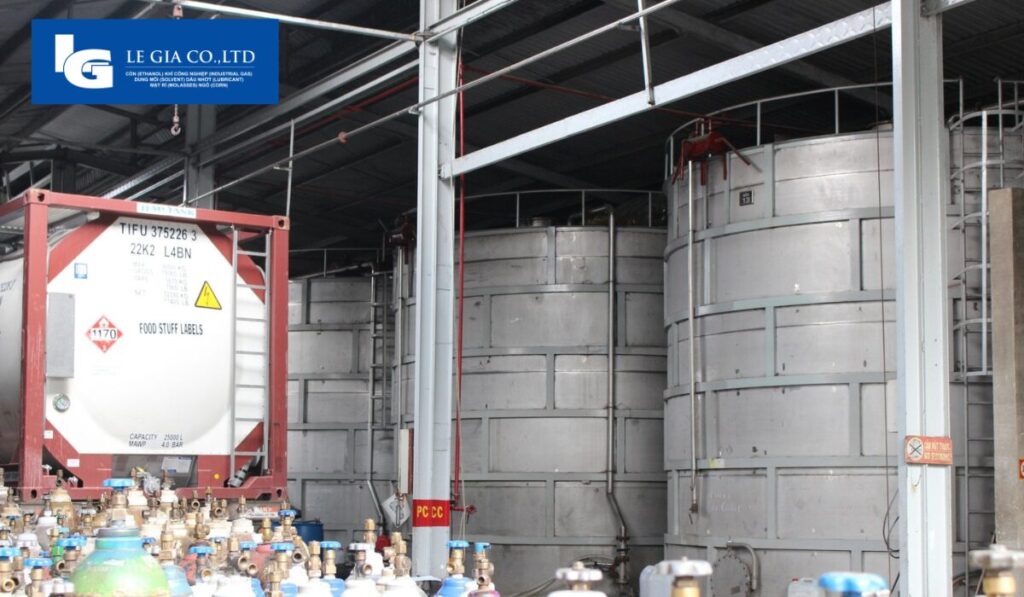
- Cassava-based ethanol (LGCS grade) – produced from Vietnamese cassava with documented Certificate of Analysis per batch. Batch-consistent, export-ready in ISO tank containers with full SDS and COA documentation per shipment.
Supply chain logistics: Lê Gia controls the full production-to-blending-to-export chain, enabling delivery within 10 working days for standard orders. Export markets confirmed include Japan, South Korea, Taiwan, and Australia.
How does expert partnership de-risk project implementation
| Risk Area | Without Expert Partner | With Lê Gia Partnership |
| Supply consistency | Spot market exposure; price and volume volatility | Volume commitments with 10-day delivery; long-term supply agreements available |
| Specification compliance | Generic product may not meet destination market regulatory spec | Custom denaturation to exact market requirement; COA per batch |
| Documentation for compliance | Buyer must source third-party LCA and chain-of-custody documents independently | Full COA, SDS, and export documentation per shipment; |
| Quality control | Reliance on distributor quality assurance alone | In-house QC: GC analysis, ASTM D-method testing, ISO 9001:2015 and GMP certified |
| Order flexibility | Large minimum orders typical for commodity ethanol suppliers | Scalable order volumes for market entry or pilot programmes |
For biofuels to deliver regulatory and carbon compliance, supply chain integrity must be fully documented. A single batch rejected due to a missing COA or out-of-spec methanol reading can invalidate an entire quarterly RTFO submission. Lê Gia’s quality management infrastructure – ISO 9001:2015, GMP certification, and ASTM batch testing – provides the documentation chain that compliance-sensitive buyers need.
How do biofuels compare to EVs and hydrogen for heavy industry
Biofuels are not competing with electrification, they fill the decarbonisation space that electrification cannot reach today at commercial scale. The comparison below is designed for strategic planners evaluating multi-pathway portfolios.
| Technology | Energy Density | Infrastructure Readiness | Best Use Case | 2025 Commercial Status |
| Biofuels (ethanol, biodiesel, SAF) | 21–34 MJ/litre (feedstock dependent) | Existing fuel networks | Long-haul road, aviation, maritime, remote operations | Commercially available at scale |
| Battery electric (BEV) | ~0.9–1.0 MJ/kg usable (Li-ion) | Urban charging networks, growing | Last-mile delivery, urban fleets, light vehicles | Commercially mature for light vehicles |
| Green hydrogen (fuel cell) | 33.3 MJ/kg (LHV) | Very limited; requires new infrastructure | Heavy industry, long-haul HGV (future) | Pre-commercial; high delivered cost |
| Renewable diesel (HVO) | ~34 MJ/litre (close to fossil diesel) | Existing diesel distribution | Drop-in diesel replacement for any fleet | Growing; supply-constrained in UK/AU |
Where do biofuels outperform electrification options
Biofuels outperform battery-electric alternatives in four specific operational scenarios:
- Aviation: No battery technology currently exists that can power a commercial aircraft beyond very small aircraft at range. SAF is the only viable aviation decarbonisation option at scale before 2040.
- Long-haul road transport: A fully loaded 44-tonne HGV has high energy demand per kilometre. Current battery technology requires very heavy battery packs for long-range operation, consuming payload capacity. Biofuel-powered trucks carry equivalent payload with comparable refuelling speed to diesel.
- Maritime operations: Ship refuelling infrastructure for hydrogen or ammonia does not exist at commercial scale in UK or Australian ports. Biodiesel and advanced biofuel blends can use existing bunkering infrastructure immediately.
- Remote and rural operations: Where grid connection is unreliable or unavailable, biofuel-powered generators and equipment avoid charging infrastructure dependency entirely.
When is a hybrid decarbonisation strategy most effective
The most commercially resilient decarbonisation strategies combine biofuels with electrification across different asset types – not as a compromise, but as an intentional portfolio approach aligned to each asset class’s technical constraints and replacement cycle.
A practical phased framework for a mixed-fleet operator:
- Phase 1 (0–3 years): Switch petrol light vehicles and vans to BEV as natural replacement occurs. Switch petrol-based fuel supply to E10 immediately – no capital cost, immediate carbon reduction.
- Phase 2 (3–7 years): Procure new HGVs with OEM biodiesel or HVO approval. Establish HVO or advanced biodiesel supply agreements. Evaluate biomethane for depot heating and CNG fleet expansion.
- Phase 3 (7–15 years): As hydrogen corridor infrastructure matures, introduce fuel cell HGVs for high-utilisation routes. Maintain biofuels for remaining diesel assets and all aviation commitments.
This phased approach avoids the false dilemma of choosing a single technology and delivers measurable GHG reductions at each stage – satisfying regulatory requirements, investor ESG expectations, and operational continuity simultaneously.
FAQ
Is biofuel truly carbon neutral or just lower emissions
Biofuels are not carbon neutral – they are lower-carbon. When biomass grows, it absorbs CO₂; when burned as fuel, that CO₂ is re-released. This short carbon cycle differs fundamentally from fossil fuels, which release carbon stored over millions of years. Certified biofuels typically achieve 50–90% lifecycle GHG reductions versus fossil fuel equivalents, depending on feedstock and production method. (Source: World Bioenergy Association, Global Bioenergy Statistics 2024) Achieving a carbon neutral claim requires full carbon sequestration accounting, which most current biofuel pathways do not meet. The 65% GHG reduction threshold required by the UK RTFO is the minimum commercial benchmark for regulatory compliance.
Can existing engines use higher ethanol or biodiesel blends
Most petrol vehicles built after 2000 are E10-compatible without modification. Going above E10 risks damage to fuel seals, injectors, and fuel pumps not designed for high-alcohol environments, and most OEMs void warranties on non-flex-fuel engines running E20 or above. Check your vehicle’s E10 compatibility at the UK Government’s official checker (gov.uk/check-vehicle-e10-petrol-compatible). For biodiesel, B5 and B7 are generally safe in modern diesel engines. B20 and above require OEM approval. Always verify against your specific fleet manufacturer’s approved fuel specification before changing blend ratios.
What is the cost per litre of biofuel vs fossil diesel in 2024–2025
As a general guide: E10 carries minimal premium over E5 at retail — typically less than 2p/litre difference in the UK as the ethanol component cost is offset by lower fossil content. HVO commands a 15–40% wholesale premium over fossil diesel, partially offset by RTFC certificate revenue for qualifying suppliers. SAF is currently approximately 2–4x the price of conventional jet fuel for biofuel-based pathways (HEFA), and up to 10x for e-fuel pathways. (Source: ICCT, 2025; UK DfT RTFO Guidance 2025)
How long does a biofuel project take from feasibility to operation
For fuel switching projects such as E10 adoption or HVO procurement: implementation can begin within weeks with no capital project. For infrastructure projects such as blending facility upgrades or on-site storage: expect 12–18 months from feasibility study to commissioning, including environmental permitting. For production-scale biofuel plants (advanced biofuel or SAF facility): 36–60 months is typical from greenfield concept to first production, with critical path items being environmental permits, project financing, and construction of conversion units. Off-the-shelf technologies and co-location with existing industrial sites can compress timelines significantly.
Ready to accelerate your biofuel supply chain
Whether you are entering the biofuel market for the first time or scaling an existing blending operation, securing a reliable, documented ethanol supply chain is the first operational decision that determines whether your roadmap succeeds or stalls. Lê Gia has supplied ethanol to pharmaceutical, F&B, industrial, and export customers across Asia-Pacific for over 20 years — with full batch documentation, custom denaturation capability, and 12 million litres per year of production capacity.
Request a sample COA and pricing: ethanol@legia.vn | (+84) 0908 769 151