Your production line is running. A batch of oral solution is ready for QC. Then the lab flags it: residual methanol above the USP limit. The root cause? Your ethanol supplier shipped industrial-grade material with a certificate that looked pharmaceutical-grade but was not. The batch is rejected. The cost – reprocessing, regulatory documentation, potential supplier audit -runs to six figures.
This is not a hypothetical. Impurity-driven batch failures remain one of the top three causes of production deviations in pharmaceutical and personal care manufacturing. The fix is not more QC. The fix is sourcing the right grade of ethanol with the right documentation from a verified supplier.
This guide gives procurement managers, QA leads, and formulation scientists a complete technical and commercial framework for pharmaceutical-grade ethanol. You will understand exactly what specifications separate pharma-grade from food-grade and industrial ethanol, which pharmacopoeia standards apply in EU, US, and Australia, how to evaluate suppliers, and what documentation is non-negotiable before you sign a supply agreement.
What is pharmaceutical-grade ethanol and what standards must it meet?
Pharmaceutical-grade ethanol is high-purity ethyl alcohol (C₂H₅OH) manufactured and tested to meet official pharmacopoeia monographs – USP, EP, BP, or JP – with strict upper limits on impurities such as methanol, aldehydes, ketones, and benzene. It is classified as a pharmaceutical excipient, meaning it is not just a solvent: it enters the formulation directly and must comply with the same regulatory rigor as an active ingredient.
The global pharmaceutical ethanol market was valued at USD 1.74 billion in 2023 and is forecast to reach USD 3.62 billion by 2033, growing at a CAGR of 7.60%. (Source: Spherical Insights, 2023.) This growth reflects rising demand from injectable manufacturing, hand sanitizer production, and herbal extraction, all sectors where impurity control is non-negotiable.
Four pharmacopoeias define the global standard. Each has a dedicated monograph with assay ranges, impurity ceilings, and mandatory testing methods:
- USP (United States Pharmacopeia): primary reference for the US market and CDMO supply chains globally
- EP (European Pharmacopoeia): mandatory for EU manufacturing and recognized in 40 signatory countries
- BP (British Pharmacopoeia): primary reference for the UK, Australia (TGA-recognized), and many Commonwealth markets
- JP (Japanese Pharmacopoeia): required for PMDA-regulated supply chains serving Japan
A supplier who cannot provide batch-specific certificates of analysis (CoA) mapped to one of these pharmacopoeias is not a pharmaceutical-grade supplier – regardless of what their marketing materials say.
How does USP/EP/BP/JP compliance define pharmaceutical-grade purity?
Each pharmacopoeia specifies a different ethanol monograph, but all four share the same underlying principle: impurity profiles must be controlled, tested, and documented on a per-batch basis. The table below compares key parameters:
| Standard | Region | Ethanol % | Key Requirements |
| USP (United States Pharmacopeia) | USA | ≥94.9% v/v (Dehydrated); 94.7–96.0% v/v (Alcohol) | Methanol ≤200 ppm, higher alcohols ≤300 ppm, aldehydes ≤40 ppm, GC-FID testing |
| EP (European Pharmacopoeia) | EU & 40 countries | 95.1–96.9% v/v (Ethanol 96%); ≥99.7% v/v (Anhydrous per EP monograph) | Methanol ≤200 ppm, benzene ≤2 ppm, non-volatile residue ≤1 mg/mL |
| BP (British Pharmacopoeia) | UK, Australia, others | ≥99.7% v/v (Absolute); 95.1–96.9% v/v (Ethanol 96%) | Aligned with EP; additional UV absorbance test at 240 nm |
| JP (Japanese Pharmacopoeia) | Japan | ≥95.1% v/v (JP Ethanol) | Methanol ≤0.04% v/v, specific gravity 0.807–0.815 at 15°C |
A practical implication for cross-border sourcing: USP and EP are largely harmonized on impurity thresholds but differ on assay ranges and specific gravity. A CoA issued to EP 96% specifications is accepted by most EU regulatory authorities, but a US FDA submission will require a separate USP-mapped CoA. Buyers importing from Asia into Australia should request BP-referenced documentation for TGA submissions.
What are the exact impurity limits for methanol, aldehydes, and ketones?
Impurity limits are the single most important differentiator between pharmaceutical-grade and food- or industrial-grade ethanol. Exceeding any one limit triggers batch rejection and regulatory non-conformance. The limits below are based on USP and EP monographs:
| Impurity | USP Limit | EP Limit | Health / QA Risk |
| Methanol | ≤200 ppm | ≤200 ppm | Optic nerve damage; fatal at high doses |
| Acetaldehyde | ≤40 ppm | ≤10 ppm (GC) | Carcinogen precursor; mucosal irritant |
| Higher alcohols (propanol, etc.) | ≤300 ppm | ≤300 ppm | Batch rejection; API interaction risk |
| Acetone & ketones | ≤500 ppm | ≤300 ppm | Formulation incompatibility |
| Benzene | Not specified | ≤2 ppm | Known carcinogen; critical for EU export |
| Non-volatile residue | ≤1 mg/mL | ≤1 mg/mL | Particulate contamination; sterility failure |
Testing method matters as much as the limit itself. Gas chromatography with flame ionization detection (GC-FID) is the pharmacopoeia-specified method for volatile impurities. GC-MS is used for trace identification. Any supplier who cannot provide GC-FID results, not just a density measurement, is not testing to pharmacopoeia standards.
Le Gia’s Certificate of Analysis for its LGCS (Cassava) grade undenatured ethanol, dated February 2026, confirms methanol at 32 ppm (internal limit: 100 ppm), acetaldehyde at 10 ppm (internal limit: 40 ppm), and ethyl acetate at 15 ppm (internal limit: 100 ppm) – tested by GC, with density verified by ASTM D4052. These results sit well within USP methanol limits (≤200 ppm) and EP methanol limits (≤200 ppm), and within USP aldehyde limits (≤40 ppm).
How does pharmaceutical-grade differ from food-grade and industrial ethanol?
Pharmaceutical-grade ethanol requires stricter impurity testing, more rigorous production controls, and mandatory regulatory documentation that food-grade and industrial ethanol do not. The distinction is not only about purity percentage – it is about the entire quality system behind the product.
| Grade | Purity | Key Standard | Primary Applications | Typical Cost |
| Pharmaceutical | ≥ 95.1% v/v | USP / EP / BP / JP | Injectables, oral solutions, sanitizers, herbal extraction | Highest |
| Food-Grade (FCC) | ≥ 94.9% v/v | FCC / ATVSTP | Beverages, food processing, flavor extraction | Medium-High |
| Industrial | Variable | None (spec-driven) | Solvents, coatings, cleaning agents, fuel | Lowest |
The critical misconception in the market is that food-grade ethanol is ‘almost pharmaceutical-grade.’ It is not. The FCC (Food Chemicals Codex) monograph allows methanol up to 200 ppm in some specifications – identical to USP. But FCC does not require GC-FID testing on every batch. It does not require a documented CAPA system at the manufacturer. It does not require GMP certification. A supplier can issue an FCC-compliant CoA with minimal testing infrastructure. A pharmacopoeia-compliant CoA cannot be issued without validated analytical methods, calibrated instruments, and a documented QC system.
For formulations entering regulated markets – pharmaceuticals, medical devices, registered cosmetics, using food-grade ethanol when pharma-grade is required creates a qualification gap that regulatory inspectors will find.
Which grade should you choose for your specific application?
Application determines grade. Over-specifying wastes budget; under-specifying creates compliance risk. Use the following criteria:
- Injectables and sterile products: pharmaceutical-grade is mandatory. No exceptions. Even trace impurities interact with APIs or degrade sterility.
- Oral solutions and syrups: pharmaceutical-grade required. The ethanol enters the patient’s systemic circulation.
- Topical formulations (gels, creams, antiseptics): pharmaceutical-grade strongly preferred; food-grade may be acceptable where supported by a risk assessment and regulatory acceptance in the target market.
- Hand sanitizers for consumer market: WHO formulation guidelines specify pharmaceutical-grade or food-grade ethanol. Industrial-grade is prohibited.
- Herbal extraction for licensed medicines: pharmaceutical-grade required. Residual solvent limits in the finished extract are governed by ICH Q3C.
- Cosmetic formulations (non-medicinal): food-grade is generally acceptable. Pharma-grade is not required but is not disqualifying.
- Industrial cleaning, coatings, electronics: industrial-grade is appropriate and cost-effective.
When in doubt, consult your regulatory affairs team before specifying the grade. Switching grades mid-project often requires a change control event and re-qualification of the solvent.
When is 96% ENA vs 99.5% anhydrous ethanol required?
The choice between 96% Extra Neutral Alcohol (ENA) and anhydrous ethanol (≥99.5% v/v) is driven by water sensitivity, not by purity preference.
96% ENA (azeotropic ethanol) contains approximately 4% water. It is the standard grade for oral solutions, topical formulations, herbal tinctures, and hand sanitizers. The water content is consistent and predictable, making it easier to formulate aqueous-ethanol systems.
99.9% anhydrous ethanol is required when:
- The API or excipient is moisture-sensitive (e.g., certain anhydrous salts, effervescent bases)
- The manufacturing process requires a non-aqueous solvent system
- Tablet film coating formulations require fast evaporation with minimal water
- API synthesis steps require anhydrous conditions
Anhydrous ethanol (≥99.5% v/v) is produced via molecular sieve dehydration, which removes water without introducing chemical denaturants. It is typically more expensive and requires specialized storage to prevent moisture uptake. Le Gia supplies anhydrous-grade ethanol up to 99.5% purity. Most pharmaceutical applications use 96% ENA. Confirm with your formulation team before ordering anhydrous grade.
Need a bulk pharmaceutical-grade ethanol quote for EU, US, or Australia supply? Contact Le Gia at Email: ethanol@legia.vn or WhatsApp: (+84) 0908 769 151. Capacity: 12 million liters/year.
What are the key applications of pharmaceutical-grade ethanol in manufacturing?
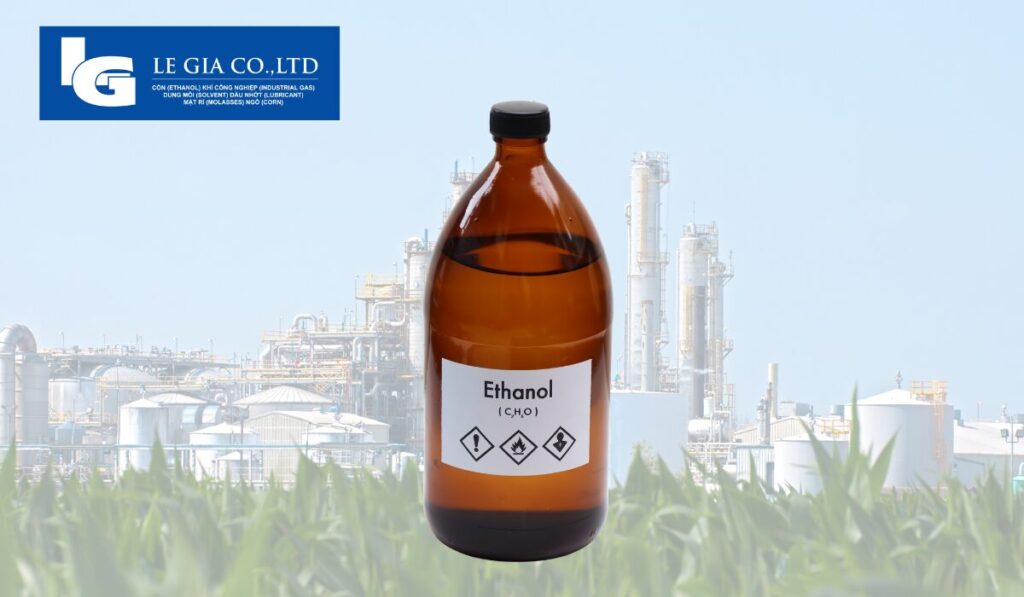
Pharmaceutical-grade ethanol serves six primary functions in regulated manufacturing: as an API solvent, excipient, process solvent, disinfectant, extraction medium, and tablet coating component. Each application has its own concentration requirement, pharmacopoeia reference, and documentation standard.
The six primary B2B applications, in order of regulatory stringency:
- Injectable formulations: co-solvent for hydrophobic APIs; antimicrobial preservative at ≥15% v/v; requires sterile-grade ethanol with sub-ppm impurity profiles
- Oral liquid solutions (syrups, drops, elixirs): solubilizer and preservative; ICH Q3C Class 3 solvent with permitted daily exposure (PDE) of 50 mg/day
- Topical preparations (gels, creams, antiseptics): penetration enhancer; rapid evaporation carrier; antimicrobial at 60–90% v/v
- Hand sanitizers and antiseptic sprays: WHO formulation standard specifies 80% ethanol (v/v); pharmaceutical-grade or food-grade acceptable
- Herbal extraction and tincture production: selective solvent for alkaloids, glycosides, and essential oils; ICH Q3C residual solvent limits apply to the finished extract
- Tablet film coating: solvent carrier for hydroxypropyl methylcellulose (HPMC) and other film formers; fast evaporation rate is a key functional parameter
How is it used in injectables, oral solutions, and topical formulations?
Each dosage form imposes distinct purity and concentration requirements on the ethanol it uses.
Injectables: Ethanol is used as a co-solvent for poorly water-soluble APIs in parenteral formulations. At concentrations above 5% v/v in an IV formulation, CNS effects become clinically relevant, so injectable ethanol is carefully dosed. The ethanol itself must meet sub-ppm impurity requirements – often more stringent than the standard EP or USP monograph – and must be sourced from a manufacturer with an injectable-grade GMP system. Benzene is a critical impurity in this context: the EP monograph caps it at 2 ppm; injectable applications may require testing below 1 ppm.
Oral solutions: Ethanol acts as a solubilizer and preservative. ICH Q3C classifies ethanol as a Class 3 solvent – low toxicity risk with a PDE of 50 mg/day in oral formulations. The ethanol percentage in an oral liquid is typically 5-20% v/v. Taste masking and compatibility with other excipients (glycerin, sorbitol) are formulation considerations that drive concentration selection.
Topical formulations: Ethanol at 60-90% v/v is the active antimicrobial agent in hand sanitizers, skin antiseptics, and wound disinfectants. It also functions as a penetration enhancer in transdermal gels. Evaporation rate – directly linked to ethanol concentration – affects both efficacy and skin feel. For regulated topical drug products, the CoA must reference a pharmacopoeia monograph. For cosmetic topicals, food-grade with a supplier MSDS is typically sufficient.
Why do hand sanitizer and herbal extraction require pharma-grade purity?
Hand sanitizers directly contact human skin often multiple times per day. Methanol contamination in hand sanitizer has caused documented mass poisoning events when consumers absorbed or ingested the product. The FDA issued an import alert and warning letters to multiple manufacturers in 2020–2021 specifically for methanol levels exceeding 630 ppm – more than three times the USP limit. Sourcing pharmaceutical-grade or FCC-grade ethanol with a GC-verified CoA is the only way to ensure methanol stays below the safety threshold.
Herbal extraction presents a different risk. The extract, not the ethanol is the final product. But residual ethanol in the extract is governed by ICH Q3C, which sets a 5,000 ppm limit for Class 3 solvents. If the ethanol used in extraction contains methanol at 200 ppm, and the extraction process concentrates the residue by 10x, the finished extract could carry 2,000 ppm methanol – in excess of the permitted daily exposure for a Class 2 solvent (methanol PDE: 3 mg/day). Pharma-grade ethanol with verified methanol content below 50 ppm is the only risk-managed choice for medicinal herbal products.
How is pharmaceutical-grade ethanol produced to achieve superior purity?
Pharmaceutical-grade ethanol is produced through a multi-stage process starting from agricultural fermentation and ending with validated analytical release testing. Each step adds a layer of purity control that industrial and fuel-grade production processes skip or compress.
The production sequence:
- Feedstock selection: Non-GMO sugarcane molasses or grain is fermented under controlled conditions. Feedstock traceability is documented – a requirement for GMP-compliant excipient manufacturing.
- Primary distillation: The fermented wash is distilled to remove water and heavy congeners. Output is approximately 92–95% ethanol.
- Rectification: Multiple distillation passes through rectification columns remove lighter impurities (acetaldehyde, ethyl acetate) and heavier alcohols. Output reaches ≥96% v/v.
- Molecular sieve dehydration (for anhydrous grade): Zeolite molecular sieves adsorb residual water to achieve ≥99.5% ethanol without introducing chemical denaturants.
- Activated carbon polishing: Removes residual color bodies, trace organics, and odor compounds. Critical for achieving the ‘clear and bright’ appearance specified in pharmacopoeia monographs.
- Batch analysis and release: GC-FID impurity testing, assay (density), pH, and color tests are performed. The batch is held until all parameters are within pharmacopoeia limits. The CoA is issued only on passing results.
What purification steps separate pharma-grade from fuel-grade ethanol?
The operational difference between pharmaceutical-grade and fuel-grade ethanol is not fermentation – it is everything that happens after primary distillation.
| Production Step | Fuel-Grade | Pharmaceutical-Grade |
| Fermentation feedstock | Corn, wheat, sugarcane (no restriction) | Non-GMO sugarcane preferred; full traceability required |
| Distillation passes | 1–2 passes; ~92–95% purity | 3+ passes; rectification columns; ≥96% purity |
| Dehydration (for anhydrous) | Azeotropic distillation with benzene (hazardous) | Molecular sieve dehydration; no hazardous co-solvents |
| Post-distillation polishing | Not required | Activated carbon filtration; UV treatment |
| Impurity testing | Basic GC; density check | GC-FID, GC-MS per pharmacopoeia monograph |
| Batch documentation | Delivery note only | Full CoA, CoC, MSDS, batch traceability record |
The key insight for procurement: a supplier producing fuel-grade and ‘upgrading’ batches to pharmaceutical-grade by adding a better-looking CoA is not actually producing pharmaceutical-grade ethanol. Genuine pharmaceutical-grade production requires dedicated equipment, validated cleaning procedures between batches, and a calibrated analytical laboratory. Auditing the facility – or reviewing a third-party audit report – is the only way to confirm the production system matches the documentation.
How should B2B buyers evaluate pharmaceutical ethanol suppliers?
Supplier evaluation for pharmaceutical ethanol involves three parallel tracks: technical fit, regulatory compliance, and supply chain reliability. Procurement teams that focus only on price-per-liter consistently underperform on QA metrics. The cost of a single batch rejection exceeds 12 months of price savings from a cheaper supplier in most pharmaceutical manufacturing contexts.
An 8-point supplier evaluation framework:
- GMP certification: Is the supplier GMP-certified by an accredited third-party body? Le Gia holds GMP certification (Certificate No. N711875, Guardian Independent Certification Ltd) for manufacturing and trading of ethanol alcohol. This is the baseline for pharmaceutical supply.
- ISO 9001:2015: Quality management system certification (Certificate No. 764894, Guardian Independent Certification Ltd). Confirms documented processes, CAPA system, and management review.
- ISO 13485:2016: Medical quality management standard. Le Gia holds this certification with scope covering the manufacturing and trading of medical-grade ethanol, nasal spray solution, and saline solution – directly relevant for pharmaceutical and medical product supply chains.
- Pharmacopoeia-mapped CoA: Does the CoA reference a specific monograph (USP, EP, BP, or JP)? Generic ‘high-purity’ claims without a monograph reference are not pharmaceutical-grade documentation.
- GC-FID impurity testing: Is the testing method GC-FID or GC-MS? Density testing alone is insufficient for pharmacopoeia compliance.
- Batch traceability: Can the supplier trace a batch to feedstock origin, production date, and all QC results? This is a GMP requirement and a prerequisite for FDA, EMA, or TGA inspection readiness.
- Capacity and lead time: Capacity must exceed your peak demand to ensure supply continuity. Le Gia’s annual capacity is 12 million liters, with delivery from 10 working days.
- Export track record: Has the supplier successfully exported to your target market? Le Gia exports to Japan, South Korea, Taiwan, Australia, Canada, and 10+ countries including Thailand, Indonesia, India, and Singapore. Regulatory expertise in your destination market reduces import friction.
What documentation and certifications are non-negotiable?
Before signing a supply agreement for pharmaceutical-grade ethanol, verify that the supplier can provide all of the following on request:
- Certificate of Analysis (CoA) – per batch, mapped to a pharmacopoeia monograph, signed by QC manager
- Certificate of Conformance (CoC) – confirming the batch meets the agreed specification
- Safety Data Sheet (MSDS/SDS) – current, compliant with GHS/OSHA/REACH
- GMP Certificate – issued by accredited third-party, currently valid
- ISO 9001:2015 Certificate – currently valid
- Batch traceability record – production date, feedstock lot, equipment used
- Drug Master File (DMF) reference – required for US FDA regulated submissions; confirm availability before selecting supplier
- REACH registration confirmation – required for import into EU
Reject any supplier who cannot provide all of the above, or who asks you to accept a generic specification sheet in place of a batch-specific CoA.
How do you assess QA systems, audits, and supply chain reliability?
Documentation review is necessary but not sufficient. A supplier’s QA maturity is best assessed by examining three areas:
- CAPA system: Does the supplier have a documented Corrective and Preventive Action process? Ask for evidence of a CAPA closure in the past 12 months.
- Audit frequency and outcomes: How often does the supplier undergo third-party GMP audits? What were the findings? Le Gia holds GMP (Certificate No. N711875) and ISO 9001:2015 (Certificate No. 764894) certifications issued by Guardian Independent Certification Ltd.
- Supply continuity plan: What happens to your supply if the supplier’s primary production line is down? Le Gia controls the full supply chain – production, trading, blending, and logistics – which reduces single-point-of-failure risk.
What regulatory requirements apply in EU, US, and Australia markets?
Pharmaceutical ethanol is regulated differently in each major market. A CoA that satisfies EU authorities may not satisfy FDA without additional documentation. Understanding the regional framework before finalizing your supplier selection prevents costly re-qualification after sourcing.
| Market | Governing Pharmacopoeia | Regulatory Body | Key Documentation Required |
| United States | USP (Alcohol & Dehydrated Alcohol monographs) | FDA | CoA to USP spec, Drug Master File (DMF) for API use, GMP certificate |
| European Union | EP (Ethanol 96%, Anhydrous Ethanol monographs) | EMA / national agencies | CoA to EP spec, REACH registration, Excipient GMP (ICH Q7) |
| Australia | BP (primary) / USP accepted | TGA | TGA Excipient Master File, CoA to BP/USP, GMP certification |
| Japan | JP (Ethanol monograph) | PMDA | CoA to JP spec, Foreign Manufacturer Accreditation (FMA) |
Le Gia exports to Japan, South Korea, Taiwan, Australia, Canada, and 10+ countries. Its GMP and ISO certifications are issued by Guardian Independent Certification Ltd, an IAF-accredited body, providing a credible documentation baseline for regulatory submissions in these markets.
How do regional pharmacopoeia standards affect cross-border sourcing?
Cross-border sourcing creates a documentation gap when the supplier’s CoA references a different pharmacopoeia than the one required by the destination market’s regulator. This gap is manageable but must be planned for.
USP ↔ EP harmonization: ICH Q4B Annex 12 provides guidance on pharmacopoeia equivalence for ethanol. However, the USP and EP assay ranges differ slightly (USP Alcohol: 94.7–96.0%; EP Ethanol 96%: 95.1–96.9%). A batch produced to EP specification may technically fall outside the USP assay range. Always request a dual CoA mapping to both standards if you supply into both markets.
BP and TGA (Australia): The TGA accepts BP and USP references for excipient specifications. Most BP requirements for ethanol align with EP. An EP-compliant CoA will typically satisfy TGA, but confirm with your regulatory affairs team for each product submission.
JP (Japan): Japan’s pharmacopoeia differs on specific gravity and methanol limit methodology. Suppliers exporting to Japan should confirm their testing method aligns with JP standards, not just EP or USP.
What are common procurement mistakes that cause batch rejections?
Five procurement errors account for the majority of pharmaceutical ethanol-related batch rejections and compliance failures.
- Accepting non-pharmacopoeia CoAs: The supplier provides a generic ‘high-purity’ specification sheet that meets some but not all pharmacopoeia parameters. The batch passes internal testing but fails at a customer or regulatory audit because the documentation does not reference a specific monograph.
- Mismatching grade to application: Food-grade ethanol is purchased for an application that requires pharmaceutical-grade – typically to reduce cost. The product passes initial formulation testing but fails at regulatory submission review.
- Single-sourcing without qualification backup: One supplier, one production site. When that site faces a raw material shortage, production shutdown, or logistics disruption, your supply chain has no fallback. This was a major failure mode during the 2020–2021 hand sanitizer demand surge.
- Inadequate storage at the buyer’s facility: Pharmaceutical-grade ethanol is shipped within specification, but absorbed moisture or contamination at the buyer’s warehouse degrades the product before use. The supplier’s CoA is accurate; the incoming QC is not.
- Failing to audit the supplier: Relying on paper certifications without a facility audit or third-party audit report. Certifications can lapse; production standards can slip. A supplier who passed an audit three years ago may not meet the same standard today.
How can you avoid compliance failures and supply disruptions?
Four practices systematically reduce both compliance failures and supply disruptions:
- Dual qualification: Qualify at least two suppliers for every critical raw material. Run parallel CoA comparisons to confirm both meet your specification before you need the backup.
- Incoming QC sampling: Test incoming ethanol against your internal specification – at minimum: assay, methanol, and appearance – before releasing to production. Do not rely solely on the supplier’s CoA.
- Quality agreement: Execute a written quality agreement with your supplier that defines specification limits, testing responsibilities, notification timelines for out-of-spec results, and change control procedures.
- Consult your supplier’s full supply chain disclosure: Know where the feedstock comes from, where distillation occurs, and where final QC testing is performed. This matters for both quality assurance and regulatory country-of-origin declarations.
Request a quality agreement template
How can the right supplier improve ROI and reduce quality deviations?
The business case for sourcing pharmaceutical-grade ethanol from a verified, GMP-certified supplier is measurable in three ways: reduced batch rejection costs, reduced revalidation frequency, and faster regulatory approvals.
Batch rejection is the most visible cost. Reprocessing a batch of oral solution typically costs USD 15,000–50,000 in direct labor and materials, plus regulatory documentation, delay penalties, and potential customer claims.
Revalidation frequency decreases when ethanol quality is consistent batch-to-batch. If your validated process uses ethanol with methanol at 30–50 ppm, and your supplier consistently delivers within that range, your process validation remains stable. A supplier whose methanol content swings from 20 ppm to 190 ppm across batches – both technically within USP – forces you to expand your validated range or increase incoming testing frequency, adding cost.
Regulatory inspections go more smoothly when every raw material in the batch record has a complete, pharmacopoeia-referenced CoA. FDA 483 observations and EMA GMP non-conformances related to excipient documentation are preventable with the right supplier.
With 20+ years of manufacturing experience and clients including CP Group, Ajinomoto, Acecook, Nutifood, Nippon Paint, Siegwerk, and Lotteria, Le Gia has a documented track record of consistent batch quality across high-volume, technically demanding supply chains.
What results have manufacturers achieved with compliant sourcing partners?
Le Gia has supplied ethanol into pharmaceutical and regulated manufacturing supply chains in Japan, South Korea, Taiwan, Australia, and Canada since its founding in 2001.
A structured approach to supplier qualification – combining GMP audit review, CoA analysis, and incoming QC sampling – consistently delivers measurable outcomes: fewer out-of-spec events, cleaner regulatory inspection records, and more predictable supply lead times.
Ready to source GMP-compliant pharmaceutical ethanol for your operations?
Request a sample CoA and pricing now: ethanol@legia.vn | (+84) 0908 769 151 | legia.vn
Le Gia Co., Ltd. has manufactured and exported high-purity ethanol since 2001. With a 12-million-liter annual capacity, GMP and ISO 9001:2015 certification, and export experience to Japan, South Korea, Taiwan, Australia, Canada, and 10+ countries worldwide, Le Gia is positioned as a verified supply partner for pharmaceutical, personal care, and food & beverage manufacturers.
Le Gia’s key advantages for pharmaceutical procurement teams:
- GMP-certified manufacturing and trading of ethanol alcohol (Certificate No. N711875)
- ISO 9001:2015 quality management system (Certificate No. 764894)
- ISO 13485:2016 for medical-grade applications
- GC-verified CoAs with methanol, acetaldehyde, ethyl acetate, and isopropanol data per batch
- Custom denaturation: formulations engineered to your exact specification
- Delivery from 10 working days; flexible packaging: drums (200L), IBCs (1,000L), ISO tank containers
- Export to 10+ countries including Japan, South Korea, Taiwan, Australia, Canada, Thailand, Indonesia, India, and Singapore
FAQ
Is denatured pharmaceutical ethanol suitable for medical products?
Denatured ethanol – ethanol to which a denaturant (e.g., isopropanol, bitrex, or methyl isobutyl ketone) has been added – is suitable for external-use medical products such as topical antiseptics, skin disinfectants, and medical device cleaning. It is not suitable for oral or injectable formulations because the denaturants are toxic by ingestion and cannot be removed in the formulation process. The choice of denaturant matters: EU regulations govern which denaturants are permitted for medical-use topicals, and the denaturant must be identified on the CoA. Le Gia specializes in custom denaturation, formulating to each client’s exact specification and regulatory requirement.
What is the current global market outlook for pharmaceutical ethanol?
The global pharmaceutical ethanol market was valued at USD 1.74 billion in 2023 and is projected to reach USD 3.62 billion by 2033 at a CAGR of 7.60%. (Source: Spherical Insights, 2023.) Growth is driven by expanding pharmaceutical manufacturing in Asia-Pacific, sustained demand for hand sanitizers post-COVID, rising herbal medicine production, and growth in vaccine and biologic manufacturing – all of which use ethanol as a process solvent or excipient. The highest-growth segment is Asia-Pacific, where manufacturers in Japan, South Korea, and India are scaling GMP-compliant production.
Can pharmaceutical-grade ethanol be used in cosmetic formulations?
Yes. Pharmaceutical-grade ethanol is over-qualified but fully acceptable for cosmetic formulations. It meets and exceeds the purity standards required by EU Cosmetics Regulation (EC) No 1223/2009 and equivalent regulations in the US (FDA 21 CFR) and Australia (NICNAS/AICIS). The practical trade-off is cost: pharmaceutical-grade carries a price premium over cosmetic- or food-grade ethanol. For registered cosmeceuticals or products making therapeutic claims, the higher-grade documentation may also satisfy regulatory reviewers. For standard cosmetics, food-grade ethanol is typically sufficient and more cost-effective.
What packaging options are available for bulk B2B orders?
Le Gia supplies pharmaceutical-grade ethanol in multiple packaging formats to match order volume and logistics requirements: 200-liter HDPE or steel drums (standard for LCL ocean freight), 1,000-liter intermediate bulk containers (IBCs, standard for FCL or warehouse-to-warehouse), and ISO tank containers (20,000–25,000 liters, standard for bulk export to Japan, South Korea, Taiwan, Australia, and other markets). All packaging meets ADR/IMDG Class 3 flammable liquid requirements. Product labels comply with GHS hazard communication standards.
Le Gia Co., Ltd. | ethanol@legia.vn | (+84) 0908 769 151 | legia.vn