On February 28, 2026, the United States and Israel launched joint military strikes on Iran, triggering the largest oil supply disruption in the history of global energy markets. Iran responded by effectively shutting the Strait of Hormuz, the chokepoint through which approximately 20 million barrels of oil per day flow, representing nearly 20% of global supply, according to the International Energy Agency’s March 2026 Oil Market Report. Brent crude surged to a peak near $120 per barrel before settling in the $100-106 range through mid-March 2026, per CNBC and Al Jazeera.
The impact on ethanol markets was immediate and measurable. According to the U.S. Grains & BioProducts Council’s March 4, 2026 pricing report, FOB Houston ethanol prices jumped 10.4% in a single week, while U.S. Gulf C&F prices to Southeast Asia rose more than 10% year-over-year. This is not a temporary spike to wait out, it is a structural signal that procurement teams need to act on now, especially in Vietnam, where the mandatory E10 blending deadline of June 1, 2026 is weeks away and domestic ethanol supply covers only around 40% of projected demand.
How Does the Iran-Hormuz Crisis Transmit Into Ethanol Prices?
The common assumption is that ethanol, a biofuel produced from corn and sugarcane in the Americas and Southeast Asia – is insulated from Middle Eastern oil conflicts. The data from March 2026 shows the opposite. According to Resourcewise (March 18, 2026), while Nymex heating oil surged approximately 34% from pre-conflict levels, feedstock inputs for ethanol production such as soybean oil rose only around 7% over the same period. This divergence dramatically widened biofuel producer margins – now at their strongest in several years, and simultaneously triggered a wave of spot buying across all ethanol-consuming markets as buyers rushed to lock in blending economics before prices corrected.
The transmission mechanism works in three steps. When petroleum prices spike, the cost gap between fossil gasoline and ethanol-blended fuel widens rapidly, making higher blend ratios (E10, E15, E20) commercially attractive for fuel distributors. Demand for spot ethanol increases across global markets simultaneously.
Since ethanol production capacity cannot scale in days or weeks, spot prices rise even when physical supply chains remain intact. In parallel, the U.S. Grains Council noted in its March 4 report that Middle East developments have “dramatically altered ocean shipping rates, insurance costs, and vessel availability” – adding a logistics cost layer on top of the demand surge.
Why Ethanol Supply Chains Are More Resilient Than Crude Oil – But Not Immune
Unlike crude oil, ethanol is produced and shipped from regions entirely outside the conflict zone. The United States, Brazil, and Southeast Asia collectively account for the overwhelming majority of global ethanol supply, and none of their export corridors traverse the Strait of Hormuz or the Persian Gulf.
This is precisely why import-dependent energy economies – Japan, South Korea, India – are accelerating their pivot toward biofuels as a long-term energy security strategy, independent of whether the current conflict resolves quickly or extends for months.
However, “resilient” does not mean “unaffected.” The U.S. Grains Council’s March 4, 2026 data shows C&F prices for U.S. ethanol to Southeast Asia at $716–760 per metric ton, up over 10% year-on-year. The cost increase is driven by elevated global freight rates and insurance premiums, not by direct disruption to ethanol logistics.
For procurement teams, this means ethanol remains physically available, but the price floor has shifted upward. Buyers operating on spot contracts are absorbing the full cost premium, while those with long-term framework agreements are protected. This is the most important procurement distinction in the current market environment.
The Long-Term Demand Story: 6.6% CAGR Through 2030 Regardless of Geopolitics
The Iran war of 2026 is accelerating a structural trend that was already well-established before February 28. According to Research and Markets, the global fuel ethanol market is valued at $114.33 billion in 2026 and is projected to grow at a CAGR of 6.6% annually, reaching $147.71 billion by 2030.
Growth drivers include expanding decarbonization mandates, rising investment in second-generation biofuels, and growing export market depth across Asia-Pacific, the fastest-growing regional market according to Coherent Market Insights.
The Renewable Fuels Association formally called on the Trump administration in early March 2026 to fast-track nationwide E15 approval, citing the Iran conflict as evidence of the need for domestic fuel security. Brazil and Indonesia are actively considering mandate increases, per Resourcewise (March 18, 2026).
For procurement professionals and ethanol suppliers operating in Southeast Asia, the practical implication is straightforward: demand growth is locked in at a structural level through the end of the decade, regardless of whether the current crisis de-escalates in weeks or extends into months.
Vietnam’s E10 Mandate – June 1, 2026: The Legal Facts, Supply Gap, and Procurement Deadline
Vietnam’s Ministry of Industry and Trade issued Circular 50/2025/TT-BCT on November 7, 2025, effective January 1, 2026, mandating that all unleaded gasoline sold nationwide must be blended into E10 fuel starting June 1, 2026. The legal basis was further cemented by Decision No. 46/2025/QD-TTg, signed by Deputy Prime Minister Bui Thanh Son on December 11, 2025, which repealed the previous 2012 blending roadmap entirely.
One important clarification for market participants: E5RON92 gasoline continues to be permitted in parallel until December 31, 2030 – the mandate applies to unleaded gasoline, not the complete elimination of all non-E10 fuel types.
The supply gap is the critical operational challenge. Vietnam’s Ministry of Industry and Trade has officially assessed that even at full operational capacity across all six domestic ethanol production facilities, domestic output reaches approximately 500,000 cubic meters per year – covering only around 40% of estimated national E10 blending requirements.
E10 adoption is expected to increase demand for imported ethanol by approximately 600,000–700,000 metric tons per year. The remaining 60% supply gap must be met through imports, sourced from a global market currently experiencing price pressure from the Iran crisis.
Fuel distributors and blending operators who have not confirmed their ethanol supply arrangements for Q2 and Q3 2026 are now in the highest-risk category: they face the double pressure of a mandatory compliance deadline and a tightened global spot market.
Vietnam as an Ethanol Export Hub: The Strategic Opportunity for Global Buyers
Beyond the domestic compliance story, Vietnam is emerging as a strategically important origin point for high-purity ethanol in the Asia-Pacific supply chain. Vietnam’s cassava production exceeds 10 million metric tons annually, providing domestic producers with a significant feedstock cost advantage over importers in other Asian markets, according to Le Gia’s industry analysis. The country’s agricultural base, combined with established ISO-certified production infrastructure, makes Vietnam-sourced ethanol increasingly competitive for pharmaceutical, cosmetic, food-grade, and industrial-grade applications across the region.
The U.S. Grains Council and Vietnam’s Ministry of Industry and Trade have a formal MOU on expanding ethanol trade, and the U.S. Deputy Agriculture Secretary referenced Vietnam’s E10 mandate at USDA’s 2026 Agricultural Outlook Forum as a benchmark for regional policy development. This positions Vietnam simultaneously as a growing domestic market and as a supplier of premium-grade ethanol to quality-sensitive buyers in Japan, South Korea, Australia, and Canada — markets where supply chain verification and certification continuity matter more than price alone.
Le Gia – Vietnam’s Verified Ethanol Supplier for Strategic Procurement
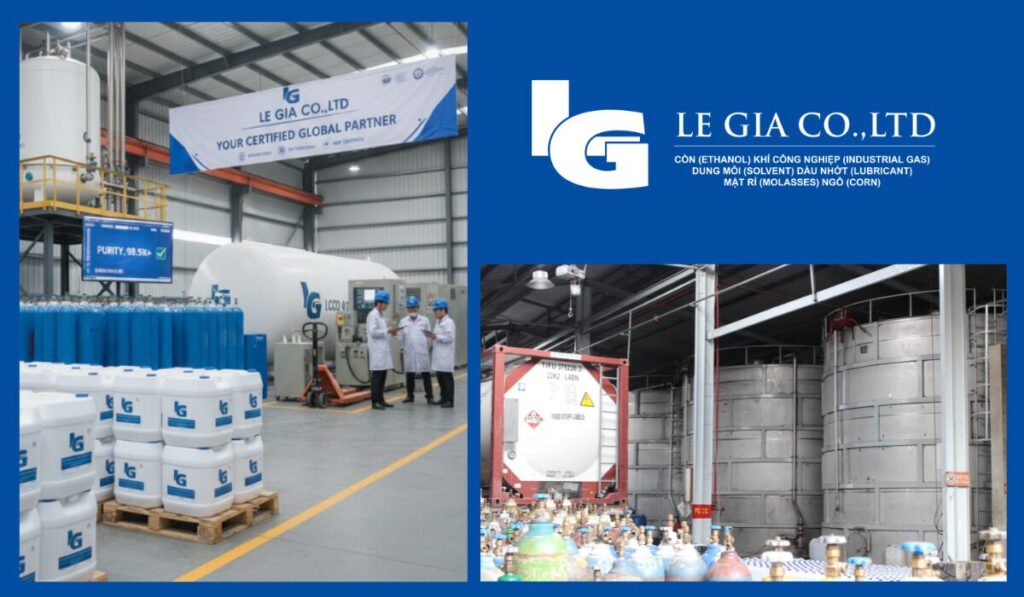
Le Gia has operated in ethanol production and export for over 20 years, holding ISO 9001:2015, ISO 13485:2016, and GMP certifications across a fully integrated production chain. With an annual capacity of 12 million liters and an established export track record to Japan, South Korea, Canada, Australia, and ASEAN markets, Le Gia represents the category of supplier that procurement professionals need when supply security — not just price — is the primary variable.
In a market where spot buying is expensive and logistically uncertain, Le Gia’s core offering to strategic buyers is framework contract supply with reference pricing mechanisms, combined with Custom Blending services that optimize ethanol specifications for each client’s specific end-use requirements. When global spot ethanol prices are elevated, the ability to optimize blend formulation for actual technical requirements — rather than purchasing to a fixed catalogue specification — can reduce effective per-unit ethanol consumption without compromising output quality. This is a procurement lever that most buyers only discover when margins are under pressure.
| Capability | Detail |
| Annual Production Capacity | 12,000,000 liters |
| Lead Time | From 10 business days |
| Export Markets | Japan, South Korea, Canada, Australia, ASEAN |
| Quality Certifications | ISO 9001:2015 · ISO 13485:2016 · GMP |
| Ethanol Purity Range | 96% to 99.9% |
| Blending Services | Custom Blending to client technical specifications |
| Consultation | Free — Hotline: +84 908 769 151 |
Frequently Asked Questions — Ethanol Market 2026
What Is the Current Ethanol Price in Southeast Asia and What Is the Short-Term Outlook?
According to IMARC Group’s February 2026 pricing data, ethanol prices in Southeast Asia were at $0.92 USD/kg. C&F prices for U.S. ethanol delivered to Southeast Asia reached $716–760 per metric ton in the week of March 4, 2026 — more than 10% above the same week in 2025, according to the U.S. Grains & BioProducts Council. The IEA’s March 2026 Oil Market Report assessed Brent crude at approximately $92 per barrel at time of publication, up around $20 per barrel for the month, with prices having peaked near $120 earlier in the conflict — indicating that energy market volatility is far from resolved.
The forward outlook depends primarily on two variables: the duration of the Strait of Hormuz disruption, and the pace of IEA strategic reserve releases (400 million barrels authorized — the largest in history). Even under an optimistic resolution scenario, Deutsche Bank’s head of global macro research noted in mid-March 2026 that prices are unlikely to return to the $60–70 per barrel range seen before the conflict. For ethanol buyers, this means the elevated price environment should be treated as the operating baseline through at least Q2 2026, not a temporary anomaly.
Will Vietnam’s E10 Mandate Actually Take Effect on June 1, 2026 — or Could It Be Delayed Again?
This is the most frequently asked question from fuel distributors and blending operators, given that the previous E10 roadmap under Decision 53/2012 was delayed for nearly nine years. The legal structure this time is materially different. Circular 50/2025/TT-BCT is already in effect as of January 1, 2026. The circular gives the Minister of Industry and Trade the authority to adjust blending ratios based on technical and economic conditions — but there is no automatic delay mechanism built into the regulation. Additionally, the current geopolitical environment is creating political pressure to accelerate, not slow, the transition to biofuels.
The most realistic risk scenario for June 1 is a technical implementation extension for specific operators with documented infrastructure gaps — not a blanket postponement of the national mandate. Procurement teams and blending operators should plan based on the June 1 date as the operating assumption. Those waiting for a potential delay before acting on supply arrangements are taking a high-probability risk that material quantities of E10-grade ethanol will be significantly more expensive and harder to secure in May and June 2026 than they are today.
What Ethanol Grades Does Le Gia Supply, and How Does the Custom Blending Process Work?
Le Gia supplies fuel-grade ethanol (E100) meeting Vietnam’s E10 blending standards, along with food-grade, pharmaceutical-grade, and industrial-grade ethanol at purity levels from 96% to 99.9%, with impurity levels below 10ppm for high-purity applications. Custom Blending engagements follow a structured three-step process: the client provides technical specifications or describes the end-use application; Le Gia’s R&D team proposes an optimized formulation with detailed pricing within 2–3 business days; after sample confirmation, production and delivery proceed within 10 business days from order confirmation.
For international buyers, Le Gia provides full export documentation, certificates of analysis, and supports third-party laboratory verification on request. Framework contract buyers receive priority allocation and reference pricing — a significant structural advantage when spot market availability tightens ahead of the June 1 mandate deadline. To initiate a procurement consultation at no cost, contact Le Gia directly at +84 908 769 151.
How Does Le Gia’s Supply Chain Remain Stable During Global Market Volatility?
Le Gia operates a fully integrated, closed-loop production system — from feedstock sourcing through distillation, quality control, and outbound logistics — which means the company is not dependent on third-party spot procurement at any point in its supply chain. This vertical integration is the structural basis for delivery commitments of 10 business days even in periods of market tightening, a timeline that spot-market-dependent intermediaries cannot reliably replicate when freight and insurance costs spike.
For long-term contract partners, Le Gia maintains strategic inventory buffers calibrated to committed volumes, ensuring that framework agreement obligations are fulfilled even when global spot availability tightens. This is not a general policy statement — it is a supply chain architecture decision made specifically to support partners operating under regulatory compliance deadlines such as Vietnam’s June 1, 2026 E10 mandate. Buyers operating on spot arrangements do not receive the same allocation priority during periods of supply constraint.