200 proof food grade ethanol is a high-purity, anhydrous ethyl alcohol containing $\ge 99.9\%$ ethanol by volume and less than 0.1% water. Classified as “absolute alcohol,” this solvent is non-denatured and derived from natural sources such as grain or molasses to meet USP (U.S. Pharmacopeia) and FCC (Food Chemicals Codex) standards.
Because it is free from toxic denaturants and residual moisture, it serves as the essential solvent for pharmaceutical synthesis, luxury perfumery, and high-yield botanical extraction where water contamination must be eliminated.
What exactly is 200 proof food grade ethanol?
In the specialized world of solvents, “Proof” is a traditional measure of alcohol content, where 200 proof represents 100% pure ethanol. However, achieving and maintaining this level is a feat of chemical engineering. 200 proof food grade ethanol is a colorless, volatile, and neutral-smelling liquid that has been dehydrated to remove the last vestiges of water. Unlike industrial-grade alcohol, it is “non-denatured,” meaning it contains no foul-tasting or toxic chemicals added to discourage human consumption, making it safe for products that touch the human body or are ingested.
For a company like Le Gia, with 20 years of expertise, producing 200 proof ethanol is not just about distillation; it is about purity at the molecular level. It requires a closed-loop system to prevent the alcohol from “breathing” and absorbing moisture from the air, as ethanol is highly hygroscopic. This purity ensures that the solvent remains inert in sensitive chemical reactions and does not introduce unwanted contaminants into your production line.
Why choose 200 proof over 190 proof for your factory?
The choice between 190 proof (95%) and 200 proof (99.9%) ethanol is the difference between a “good” extraction and a “perfect” one. 190 proof is the “azeotropic” point – the limit where standard distillation cannot separate more water from the alcohol. While 190 proof is excellent for many uses, the 5% water content acts as a polar impurity. In many industrial processes, water is a catalyst for spoilage or a hindrance to the solubility of non-polar compounds like essential oils and resins.
Choosing 200 proof means you are investing in a solvent that offers maximum potency and efficiency. For factories focused on high-value outputs, such as CBD oil or rare botanical essences, 200 proof ethanol ensures that your extract remains concentrated and clear, without the cloudy appearance or diluted potency caused by residual moisture. It is the professional’s choice for “winterization” processes where fats and waxes must be separated from oils at sub-zero temperatures.
How does zero moisture content maximize your extraction yield?
Water is a powerful but non-selective solvent. When extracting delicate botanical compounds, the presence of water in 190 proof alcohol often pulls out unwanted water-soluble components like chlorophyll, sugars, and tannins. These “impurities” can darken the final product and impart a bitter taste. 200 proof food grade ethanol, being anhydrous, targets the active oils more selectively, resulting in a cleaner, more stable, and more flavorful extract that requires less post-processing.
Furthermore, in moisture-sensitive chemical syntheses, even a fraction of a percent of water can kill a reaction or lead to byproduct formation. In the manufacture of high-end cosmetics and perfumes, the absence of water allows for a faster evaporation rate and a more consistent scent profile. By eliminating water, you are essentially “tightening” your production variables, leading to higher yields and lower waste.
What makes molecular sieve technology superior for achieving 99.9% purity?
Historically, achieving 100% alcohol required toxic “entrainers” like benzene to break the water-alcohol bond, a method strictly forbidden in food-grade production today. Modern excellence relies on Molecular Sieve technology. These are crystalline beads with pores precisely sized at 3 Angstroms – large enough to trap water molecules but too small for ethanol molecules to enter. As the 95% alcohol vapors pass through these beds, the water is physically “sieved” out.
This process is entirely physical and leaves no chemical residue. At Le Gia, we utilize advanced molecular sieve dehydration to ensure our 200 proof ethanol meets the strictest international standards. This technology allows us to provide a product that is not only pure but also consistent across millions of liters, ensuring that every batch you receive from us performs exactly like the last.
What are the critical USP and FCC standards for food ethanol?
When sourcing 200 proof food grade ethanol, the labels “USP” and “FCC” are your primary safeguards. The USP (United States Pharmacopeia) grade ensures the ethanol is pure enough for medical and pharmaceutical use, with strict limits on volatile impurities like methanol, acetaldehyde, and heavy metals. These toxins can cause neurological damage or severe allergic reactions if present in consumer goods, making USP compliance a non-negotiable for reputable manufacturers.
The FCC (Food Chemicals Codex) standard specifically regulates chemicals used in the food industry. It guarantees that the ethanol has been produced under strict hygienic conditions and is free from contaminants that could alter the safety or flavor of food products. By adhering to these global standards, Le Gia ensures that our ethanol is not just a chemical, but a safe, high-quality ingredient for your most sensitive applications.
Where is 200 proof food grade ethanol applied in modern industry?
The applications for absolute food-grade alcohol are vast and growing. In the pharmaceutical industry, it is used as a solvent for creating tinctures, elixirs, and as a cleaning agent for high-precision medical equipment. Because it leaves zero residue upon evaporation, it is ideal for sanitizing “cleanroom” environments where even a microscopic water spot could host bacterial growth.
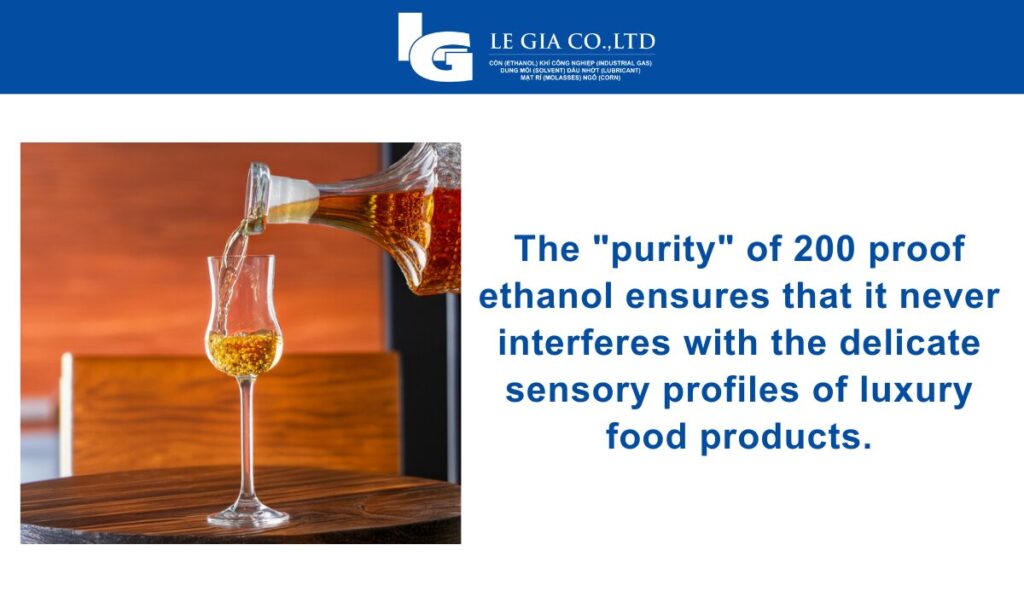
In the food and beverage sector, it is used as a carrier for flavors and colors, and as a solvent for extracting vanilla, citrus oils, and other natural essences. Its high volatility makes it perfect for coating candies or as a surface sanitizer for food-contact machinery. The “purity” of 200 proof ethanol ensures that it never interferes with the delicate sensory profiles of luxury food products.
Why do botanical and essential oil extractors demand absolute alcohol?
For the extraction of high-value botanicals, such as agarwood, rose oil, or cannabis, 200 proof ethanol is the industry standard. The “winterization” process – a critical step in refining extracts – requires the oil to be dissolved in ethanol and frozen. In this environment, 200 proof ethanol allows for the cleanest separation of waxes and lipids, which precipitate out of the solution while the active cannabinoids or terpenes remain dissolved.
Using a lower proof alcohol during winterization can lead to “ice” formation (from the water content), which traps the valuable oils and reduces yield. Extractors at the top of their game know that using 200 proof ethanol is the most cost-effective way to produce a “shatter” or “distillate” that is crystal clear and highly potent.
How does high-purity ethanol benefit pharmaceutical and cosmetic formulations?
In the cosmetic industry, particularly for high-end perfumes and colognes, 200 proof food grade ethanol is the preferred carrier. Its neutral odor ensures that it does not compete with the fragrance notes. Its rapid evaporation provides a “cooling” effect on the skin without leaving a tacky or wet residue. For organic and natural cosmetic brands, using food-grade ethanol is a way to maintain a “clean label” while ensuring product stability.
Pharmaceutical companies also rely on absolute alcohol for the synthesis of active pharmaceutical ingredients (APIs). In these high-stakes environments, the solvent’s purity directly impacts the drug’s safety and efficacy. Le Gia’s commitment to low methanol levels (often far below the 200 mg/L limit) makes us a trusted supplier for labs that cannot afford even a single part-per-million of error.
How to safely store 200 proof ethanol in an industrial setting?
Storing 200 proof ethanol is a serious responsibility. With a flashpoint of only $13^\circ\text{C}$ ($55^\circ\text{F}$), it is highly flammable and categorized as a Class 1B flammable liquid. An ethanol fire is particularly dangerous because its flame is almost invisible in daylight, making it difficult to detect until it has spread. Proper storage is not just about keeping the liquid in a tank; it is about managing the invisible vapors that can accumulate in low-lying areas.
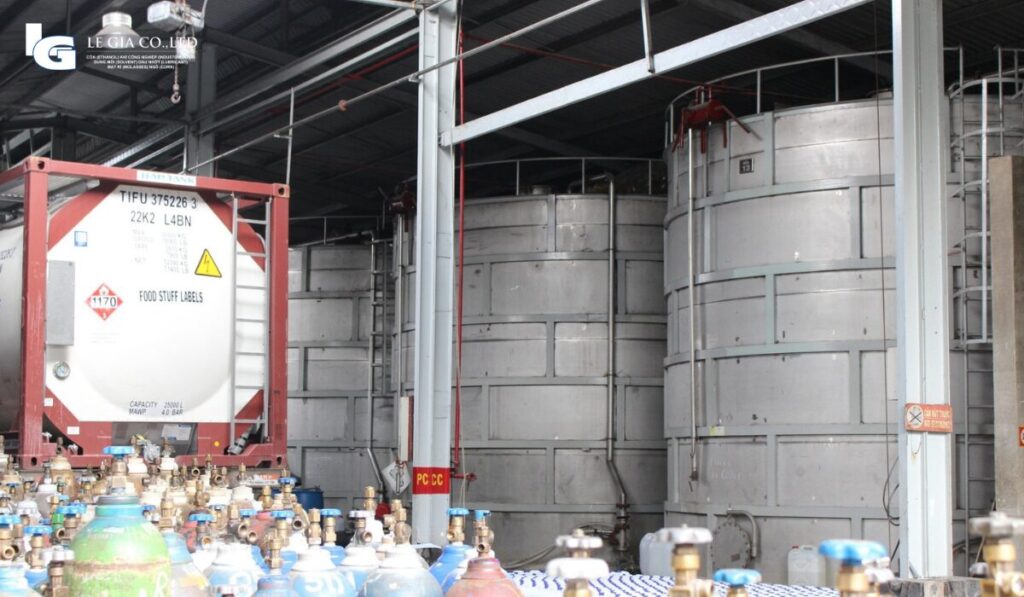
Every facility using high-proof alcohol must have a robust Fire Prevention and Fighting (PCCC) system. This includes specialized storage tanks, explosion-proof lighting, and rigorous staff training. At Le Gia, we don’t just sell you the product; we offer the expertise to help you set up a safe, compliant infrastructure that protects your workers and your investment.
What are the specialized PCCC requirements for high-proof alcohol warehouses?
A warehouse storing 200 proof ethanol must be constructed with fire-rated materials and isolated from other production zones. It must feature “explosion-relief” venting and a floor designed to contain spills without allowing them to enter public sewers. Because ethanol is miscible with water, standard fire sprinklers are often ineffective or can even spread the fire. The gold standard is a foam-based suppression system (Alcohol-Resistant AFFF), which smothers the fire and prevents re-ignition.
Ventilation is equally critical. Since ethanol vapors are heavier than air, they “pool” on the floor. A warehouse must have forced ventilation at the ground level to prevent the atmosphere from reaching the Lower Explosive Limit (LEL). Regular inspections of these systems are mandatory under Vietnamese and international safety laws.
How to effectively prevent static discharge during chemical transfer?
Static electricity is the “silent killer” in chemical accidents. When 200 proof ethanol flows through pipes or is poured into containers, the friction generates a static charge. A single spark – even one too small to see – can ignite the vapor-rich environment. To prevent this, all storage tanks, piping, and vehicles must be grounded and bonded.
At Le Gia, our delivery teams follow a strict “Ground First, Open Second” protocol. We use specialized grounding clamps to ensure that any static charge is safely neutralized into the earth before a single valve is opened. We also recommend that our clients use stainless steel or specialized HDPE (antistatic) containers for internal transport, as regular plastic can build up dangerous levels of static electricity.
What are common mistakes when sourcing 200 proof ethanol suppliers?
The most dangerous mistake is prioritizing price over purity. The market is flooded with “industrial” alcohol that has been illegally relabeled as “food grade ethanol.” This alcohol often contains methanol or other denaturants that are nearly impossible to smell but are highly toxic. Using such a solvent in food or medicine can lead to massive product recalls and legal prosecution. Always demand a verified COA (Certificate of Analysis) from an independent third-party lab like Quatest.
Another mistake is overlooking the supply chain’s reliability. 200 proof ethanol is highly volatile and moisture-sensitive; if your supplier does not use proper sealing and dedicated tankers, your “200 proof” may arrive as “195 proof” due to moisture absorption during transport. Partnering with an established leader like Le Gia, we control the entire supply chain, ensures that you get exactly what you pay for.
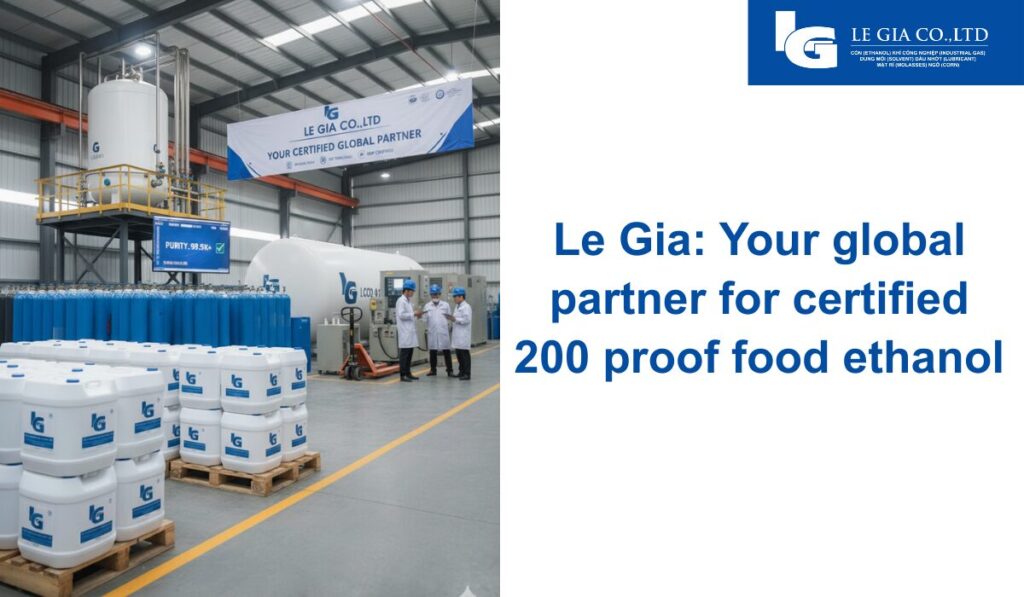
Le Gia: Your global partner for certified 200 proof food ethanol
With over 20 years of experience and a production capacity of 12,000,000 liters per year, Le Gia Co., Ltd is the premier specialist in high-purity ethanol. Our 200 proof food-grade ethanol is trusted by global giants like Acecook, Ajinomoto, and Nutifood for its unwavering quality and safety. We don’t just provide a chemical; we provide a foundation for your product’s success.
Our products are available in over 10 countries, backed by international certifications including ISO 9001:2015, ISO 13485:2016, and GMP. We commit to transparent pricing and a secure supply chain, delivering your orders within 10 working days. When you choose Le Gia, you are choosing a partner dedicated to your safety, compliance, and growth.
Ready to elevate your extraction quality with the purest 200 proof food grade ethanol? Don’t leave your product’s safety to chance. Contact Le Gia today for a technical consultation and a competitive quote!
- Hotline: (+84) 0908 769 151
- Email: ethanol@legia.vn
- Website: https://legia.vn/
- Address: 108 Khuong Viet, Tan Phu Ward, Ho Chi Minh City.
Frequently Asked Questions about 200 proof food grade ethanol (FAQ)
1. Is 200 proof ethanol actually 100% pure?
Technically, it reaches 99.9%+. The remaining 0.1% is usually trace moisture, as 100% absolute purity is nearly impossible to maintain once the container is opened to the air.
2. Can I use 200 proof food grade ethanol for making hand sanitizer?
Yes, but it is typically “overkill.” 70% to 80% ethanol is more effective at killing bacteria on the skin because the water content helps the alcohol penetrate cell walls. However, for sanitizing surgical tools, 200 proof is excellent as it leaves no residue.
3. Why does 200 proof ethanol smell different than regular alcohol?
Pure 200 proof food-grade ethanol has a very clean, neutral, and slightly sweet aroma. If you smell something “sharp” or “chemical-like,” it likely contains impurities or denaturants.
4. How long can I store 200 proof ethanol?
If kept in a cool, dark place in a tightly sealed, moisture-proof container (like stainless steel or HDPE), it can last indefinitely. However, we recommend using it within 2 years for peak sensory quality.
5. Does Le Gia provide shipping for small quantities?
Yes, we cater to both large-scale industrial (tankers) and smaller factory needs (200L drums), ensuring all clients receive the same level of certified purity.